
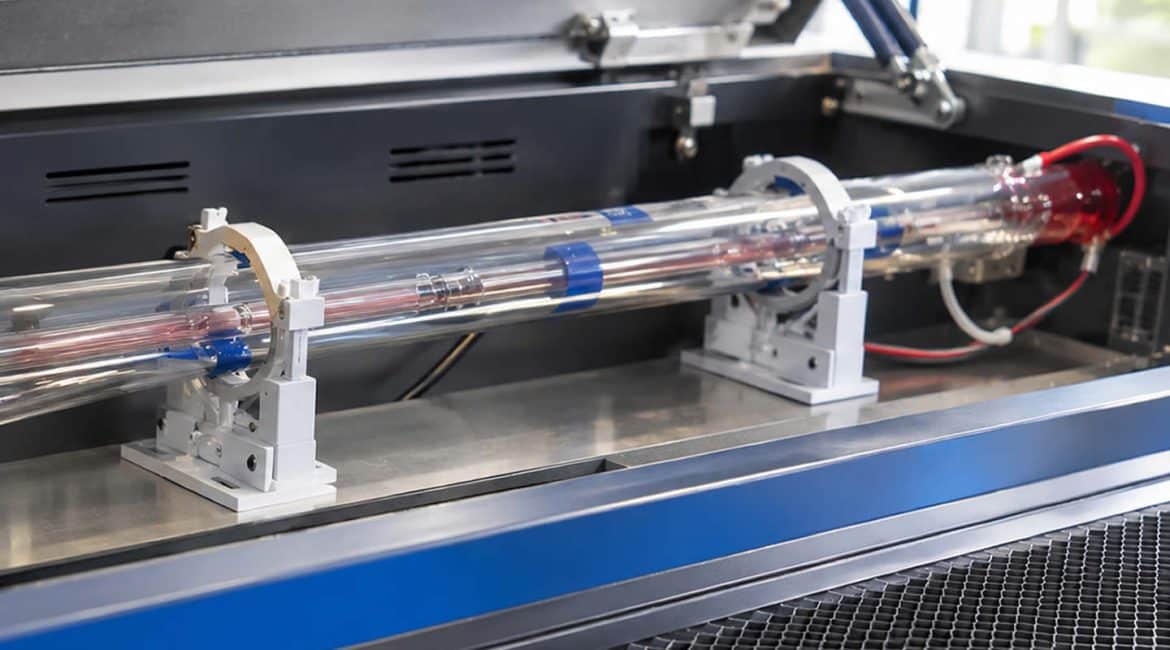
In industrial processing and the DIY maker community, CO2 glass laser tubes stand out for high efficiency and good value. Reliable laser tube cooling supports that efficiency. However, many newcomers focus on power or beam alignment. They often overlook the hidden “life-support system” behind the machine: the cooling water system.
For laser tube cooling, water acts as the tube’s blood. If the water runs too hot or too cold, output power can fall sharply. Cuts may fail to penetrate. In extreme cases, a laser tube worth thousands of yuan can burst with a loud bang in seconds.
This guide explains laser tube cooling temperature control. It shows you how to configure a chiller properly. It also helps you avoid dangerous technical mistakes.
Best Water Temperature for Laser Tube Cooling: Why 18°C–25°C?
Most CO2 glass laser tubes (such as Yongli, Reci, and YunTu brands) work best with cooling water at 18°C to 25°C. This range follows strict laser physics principles.
Above 25°C (sharp efficiency loss): A CO2 laser tube uses electrical discharge to excite gas and produce a laser. During this process, the tube converts more than 85% of electrical energy into heat. In laser tube cooling, high water temperature makes gas molecules move more violently. CO2 molecules in the upper energy level cannot accumulate steadily. Population inversion efficiency drops sharply. As a result, laser power declines fast. Cut edges begin to show dross and burn marks.
Above 30°C (extremely dangerous): If water temperature stays above 30°C, thermal stress on the glass tube wall reaches its limit. The glass may crack. The output mirror coating may peel off. The laser tube may fail completely.
Below 15°C (condensation risk): Many beginners think colder water works better. Some even add ice to the tank. This is a serious mistake. When water temperature falls far below workshop temperature, condensation forms instantly on the tube’s outer wall and mirror mount. This looks like water beads on a cold drink bottle in summer. If a water drop reaches the high-voltage end, it can trigger high-voltage arcing at tens of thousands of volts. That can puncture the laser power supply or burn the motherboard.
Chiller Selection for Laser Tube Cooling: Water Pump vs. Industrial Chiller
Good laser tube cooling needs the right chiller. Many buyers try to save money with a simple submersible pump and a plastic water bucket. This setup has a clear power limit.
40W–60W low-power equipment (light use): A water pump and plastic bucket can barely work for laser tube cooling. However, you must monitor water temperature with a thermometer at all times. Once water temperature exceeds 25°C, pause the job and add ice or change the water.
80W and above (or continuous operation): You must use a compressor-based industrial chiller for laser tube cooling, such as the CW-5000 or CW-5200.
Never buy a circulation-only chiller without cooling capacity. For example, the CW-3000 is essentially a water tank with a cooling fan. For laser tube cooling in summer, the CW-3000 cannot keep water below 25°C. After half an hour of continuous work, water temperature can climb above 35°C. When you choose a chiller, its cooling capacity must exceed the heat generated by the laser tube. Leave at least 20% extra capacity.
Coolant Choices for Laser Tube Cooling: Pure Water vs. Antifreeze
What should you put in the cooling tank? This choice directly affects laser tube life.
First choice: pure water or distilled water
For laser tube cooling, use pure water with minerals removed, such as large bottled pure water from a supermarket. Never use tap water, mineral water, or well water. Calcium and magnesium ions in tap water easily form scale in the high-temperature discharge area. Hard scale sticks to the inner tube wall. It blocks heat transfer and causes uneven heating. In turn, that can trigger tube failure.
Winter protection: dedicated antifreeze
In northern workshops without heating, residual water can freeze overnight in winter. Ice expansion can crack the glass laser tube instantly. In severe cold, mix propylene-glycol industrial antifreeze at the correct ratio. Do not use too much antifreeze. Keep the ratio below 30% in most cases. Antifreeze has higher viscosity. It reduces water flow speed and cooling efficiency. When spring temperatures rise above 0°C, replace the antifreeze with pure water promptly.
Seasonal Tuning for Laser Tube Cooling
Workshop temperature changes with the seasons. You should adjust chiller settings flexibly for reliable laser tube cooling.
Summer condensation control: Workshop temperatures can reach 30°C–35°C in summer. Humidity is often high. If the chiller still targets 20°C, the laser tube will definitely form condensation. For laser tube cooling in summer, use the chiller’s Intelligent Mode. Let water temperature adjust with ambient temperature. Keep water temperature 3°C–5°C below ambient temperature. This maintains cooling and prevents condensation.
Winter freeze protection and preheating: Before startup in winter, check water temperature first. If it is below 10°C, do not start high-power cutting immediately. For laser tube cooling in winter, preheat first. Run the chiller for 5–10 minutes. Let water temperature rise naturally above 15°C. Then start low-power beam output for preheating. This avoids thermal shock and cracking from sudden temperature changes.
A Real Laser Tube Cooling Failure: A Case of Ignored Water Flow
A woodworking factory installed a 130W CO2 laser cutting machine. One afternoon, an operator was cutting 18mm wood boards continuously. A water outlet hose kinked because nearby wood pressed against it. Water flow became extremely weak.
The workers had turned off the chiller’s buzzer alarm because they found it noisy. The operator did not notice that water protection had failed.
Less than two minutes passed. Water flow inside the laser tube stopped. Residual water boiled and vaporized instantly under high-voltage discharge at tens of thousands of volts. It created huge high-pressure steam. Then came a loud “bang.” The 1.6-meter glass laser tube shattered from tail to head. High-pressure water and glass fragments sprayed across the machine cabinet. The accident destroyed a laser tube worth nearly 2,000 yuan. It also burned the high-voltage power supply.
This real and painful case shows a key lesson. Poor laser tube cooling flow or lost temperature control is one of the deadliest risks for CO2 laser tubes.
Laser Tube Cooling Maintenance Summary and Mnemonic
To extend CO2 laser tube life, remember this short maintenance mnemonic for laser tube cooling:
“Keep water at twenty-two; change pure water often. Keep flow clear; prevent condensation.”
Check the flow indicator regularly. Replace pure water every two weeks. Make sure the chiller alarm works properly. Then your laser equipment can maintain strong, stable power output.