
In daily operation of laser cutting or engraving equipment, many operators face the same confusion. When the machine was first installed, it could easily cut through 10 mm acrylic. After half a year of use, cutting through 8 mm acrylic starts to feel difficult, and the cut edge may even develop burn marks and dross.
At this point, people often ask: “Is my laser tube power attenuation just normal aging, or is the tube broken? Can it still be repaired, or must I spend money on a new tube?”
This article explains the physical laws of laser tube power attenuation in plain language. It also shows you simple, practical ways to judge the tube’s health and draw a clear line between “repair” and “replace.”
Ⅰ. Is Power Attenuation Inevitable? Understanding the Natural Degradation Pattern
The answer is: yes, it is completely normal. This is determined by the physical and chemical characteristics inside the laser.
Take the most common industrial CO2 glass laser tube as an example. Its ability to emit laser light depends on high-voltage discharge in a mixed gas inside the tube, such as CO2, nitrogen, helium, and xenon. During long-term use, the following microscopic changes inevitably occur inside the tube:
1.Gas molecule dissociation and consumption
Under intense high-voltage discharge, CO2 molecules continuously dissociate into carbon monoxide (CO) and oxygen (O₂). Although the tube contains a reducing catalyst, this chemical balance gradually breaks down over time. As a result, fewer CO2 molecules remain available for effective laser emission.
2.Electrode material sputtering and absorption
Under electron bombardment, the high-voltage electrodes sputter trace amounts of metal vapor. This vapor deposits on the tube wall or mixes into the gas, absorbing part of the discharge energy.
3.Microscopic thermal aging of the output mirror
The output mirror at the laser outlet is exposed to high-energy-density laser radiation for a long time. Its coating undergoes microscopic thermal aging, and its transmittance slowly decreases.
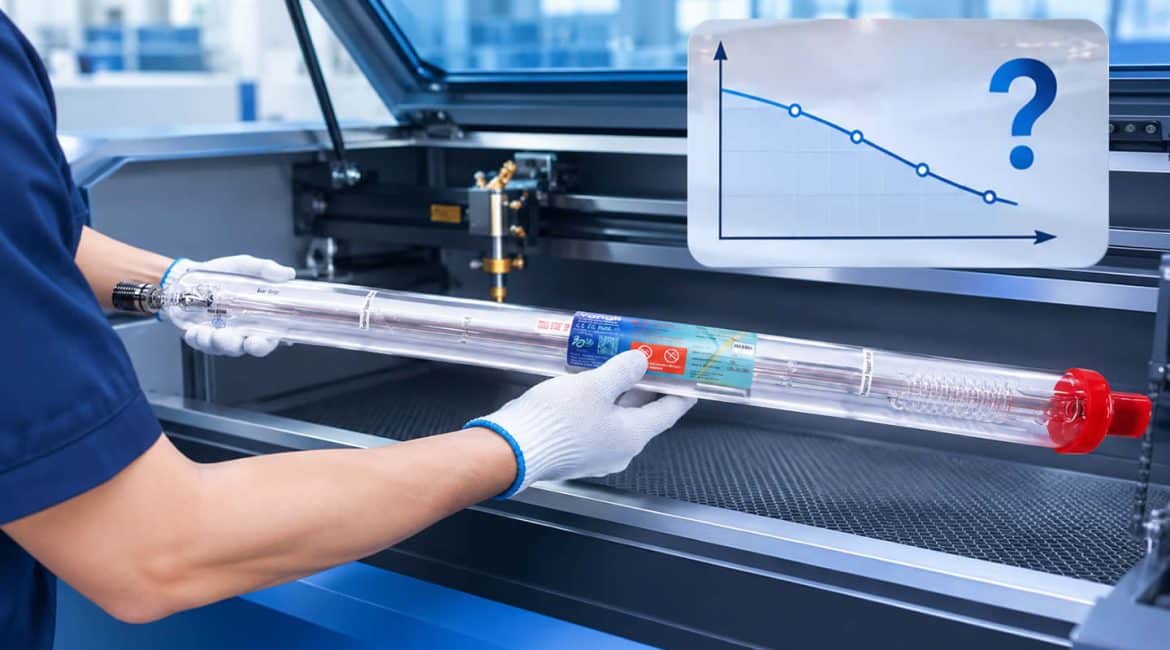
Normally, after the first 100 to 200 hours of “break-in,” a new laser tube enters a gradual degradation phase that can last thousands of hours. A monthly power decrease of 1% to 3% is normal during this phase. When cumulative use reaches 3,000 to 6,000 hours, depending on the operating current, the attenuation curve begins to drop steeply, and the tube enters the aging decline phase.
Ⅱ. Two Simple Ways to Judge Attenuation Without a Professional Power Meter
Most factories or workshops do not have an expensive laser power meter. Even so, you can quickly assess the laser tube’s attenuation state through simple observations during daily processing.
Method 1: Cutting speed and thickness comparison—the most intuitive baseline test
When the equipment is newly installed, it is important to establish a “baseline parameter log.” For example, record that at 100% power and a speed of 15 mm/s, the machine can perfectly cut through 5 mm acrylic.
During later use, keep the same material and the same power setting, and observe the maximum speed required to cut through that thickness:
- If the speed drops from 15 mm/s to 12 mm/s, the power has suffered only a slight natural attenuation of 10% to 20%. This is within the normal range. You can continue using the tube by slightly slowing the speed or slightly increasing the power.
- If the speed must drop below 6 mm/s, a decline of more than 50%, or if the original thickness can no longer be cut through regardless of the settings, the power attenuation is severe.
Method 2: Spot morphology and discharge color observation
Check the discharge color:
Observe the internal discharge tube through the laser tube. When the tube is healthy, the discharge should show a rich, pure purple-red or pink color. If the discharge color turns pale white or light blue, or if the beam flickers violently inside the tube, the gas has been severely consumed or there is a slight leak. In that case, power has already dropped significantly.
Burn a spot to inspect energy distribution:
Place a piece of alignment paper in front of the first mirror mount. Use 10% low power and a short pulse of 0.5 seconds to burn a spot. A healthy spot should be round, have clear edges, and be darkest in the center—a single-mode circular spot in TEM00 mode. If the spot becomes oval, internally concave like a ring, or splits into two hot spots, the resonator cavity has deformed and the attenuation is very severe.
Ⅲ. Draw the Boundary: “Repair” or “Replace”?
When insufficient laser output power affects production, should you try to repair the peripheral system or decisively replace the tube? Use the following principles to judge.
Cases that belong to “repair”: false attenuation caused by external factors
In many cases, the laser tube itself is not broken. Other parts of the system are simply taking away energy. These situations do not require tube replacement:
1.Contamination on the focusing lens or reflecting mirror
Oil smoke or dust on the lens absorbs laser energy. Cleaning or replacing the inexpensive lens can restore power.
2.High water temperature or water scale
Cooling water above 30°C, or scale buildup in the water circuit, causes poor heat dissipation. Clean the water circuit, replace the distilled water, and return the water temperature to about 20°C. Power usually recovers immediately.
3.Optical path misalignment
The laser hits the edge of a reflecting mirror or the inner wall of the cutting head nozzle, causing beam blockage. Recalibrate the three-point alignment of the optical path.
4.Aging laser power supply
The power supply output current does not reach the set value. Repair or replace the power supply.
The “replace” boundary: irreversible damage to the tube body
If the external causes listed above have been ruled out, the following conditions mean the physical life of the laser tube has ended, and the tube must be replaced:
- Power has dropped by more than 40%, and slowing the speed cannot meet production needs
Continuing to increase the power supply current only accelerates heating of the discharge tube and may even cause the tube to explode. At this point, replacing the tube is the most cost-effective solution. - The discharge color is pale white, and there is no arcing at the high-voltage end
This indicates that the CO2 gas inside the tube has undergone irreversible dissociation or sealed-off failure. In other words, the gas is “dead.” - The internal glass has cracked, or water has entered the water-cooling jacket
The inner tube has cracked due to uneven heating and has lost its physical seal. - The inner side of the output mirror is ablated, or the coating has peeled off
Because the inner cavity is sealed, damage to the inner side of the mirror cannot be manually cleaned or repaired. The entire tube must be replaced.
Expert Selection and Maintenance Advice
Do not blindly pursue excessive power
Select the laser tube according to the material thickness you commonly process. Running a 150 W laser tube at an ultra-low power of 10% for a long time, or running an 80 W tube at 100% extreme current for a long time, will accelerate attenuation.
Keep a daily maintenance log
Establish an equipment operation log that records cumulative operating hours and changes in processing parameters. This allows you to purchase spare parts before the laser tube enters the rapid decline phase and avoid production downtime while waiting for parts.