
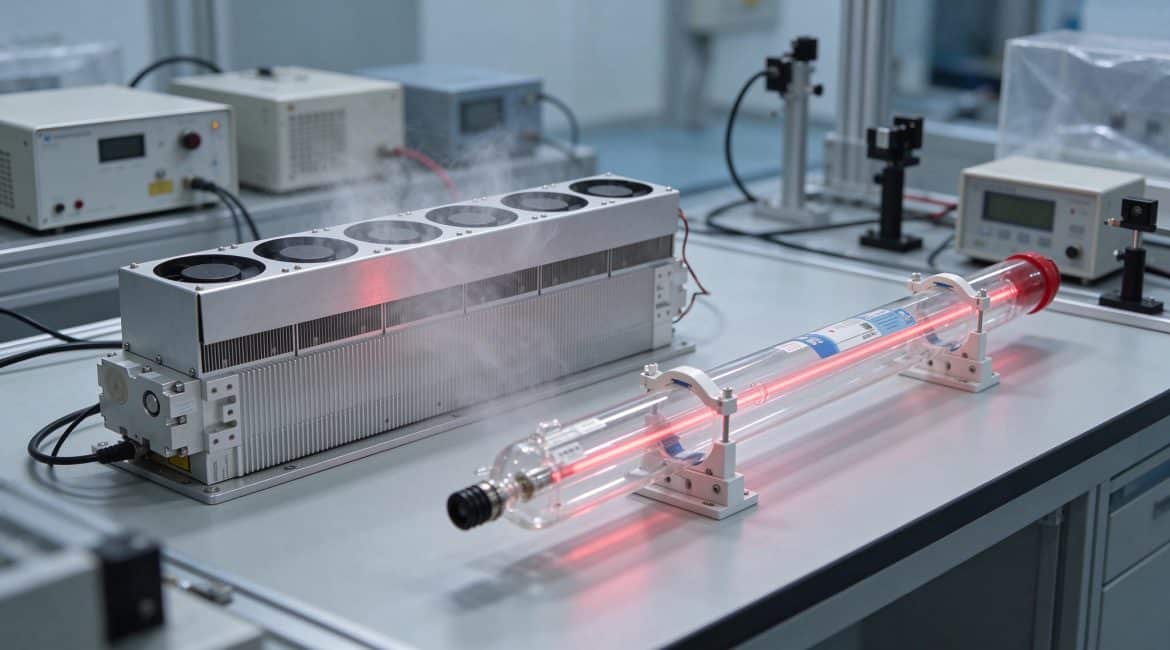
In CO2 laser processing, many buyers face one classic question. Should they choose a low-cost, rugged DC-excited glass laser tube? Or should they invest in a more advanced RF laser tube? This choice affects uptime, speed, and operating cost. A clear comparison saves money and avoids downtime.
Some buyers avoid an RF laser tube because it looks expensive. As a result, their production speed stays low. Others chase the highest-end RF laser tube and overspend. Therefore, the right answer depends on your real jobs, not on price alone. Below, we compare switching speed, beam quality, maintenance, and applications. This guide helps you compare an RF laser tube with a DC tube. Then you can match the technology to your production line.
- The Core Working Principles Differ
Both systems emit CO2 laser light at 10.6 micrometers. However, they create and control that light in different ways. Both systems produce the same wavelength, so material absorption stays similar. The real difference comes from how each tube starts and controls the discharge. This difference affects response time, beam shape, and maintenance needs.
A DC-excited glass laser tube uses high-voltage electrodes. These electrodes directly break down the mixed gas inside a long glass tube. A high-voltage DC supply, often tens of thousands of volts, drives the tube.
An RF laser tube uses a radio-frequency electric field. This field usually runs at tens of megahertz and excites the gas inside a sturdy metal cavity. The RF power module sits inside the unit. Therefore, no exposed high-voltage line runs outside the tube.
This structural difference leads to clear performance differences. The tube structure also shapes cooling needs and electrical safety.
- Four Core Performance Dimensions
2.1 Switching Speed and Pulse Frequency: Who Runs Faster?
An RF laser tube switches on and off very fast. Its pulse frequency can reach tens of kilohertz. It also supports microsecond-level switching. Therefore, high-speed marking and fine continuous engraving keep sharp edges and avoid trailing.
A DC tube responds more slowly. High-voltage discharge and gas ionization limit its switching speed. If the beam switches rapidly during fast motion, edges may blur or dots may become uneven. Consequently, a DC tube suits long, continuous cutting better.
Speed matters most in marking and engraving. The beam must follow fast motion and switch cleanly. A slow switch can cost you clarity and yield.
2.2 Beam Quality and Spot Performance: Precision Has a Gap
An RF laser tube delivers high beam-mode quality, usually an excellent fundamental mode. It produces a smaller focused spot and more concentrated energy. Its spot also stays round. Therefore, it creates fine detail in leather engraving, fabric perforation, and dense paper cutting.
A DC tube meets normal cutting needs within its rated power. However, heat can distort the spot during high-power or long continuous work. The spot may become slightly elliptical or multimode. As a result, cut edges may look less even.
Spot shape affects detail, kerf width, and edge quality. A tight round spot gives cleaner lines and less post-processing. A distorted spot may raise scrap and rework.
2.3 Maintenance Cost and Service Life: Balance Investment and Return
A DC tube costs little to buy and replace. Prices usually range from a few hundred to a few thousand yuan. However, it is a consumable. Its life often reaches only 3,000 to 6,000 hours, so you must replace it regularly. Its high-voltage end also tends to arc. Moreover, it demands strict water temperature and water quality.
An RF laser tube costs more upfront. Still, it works as a long-term investment. Its fully metal sealed-off structure supports a very long life, often tens of thousands of hours. Many high-end RF laser tube models also support gas regeneration and refill. They need no high-voltage transformer, so they offer better safety. In daily use, they need almost no maintenance.
Uptime also affects total cost. A cheap tube with short life can raise labor and downtime. A durable RF unit may cost more at first, yet it can lower long-term service burden. Water treatment and replacement labor can change the real cost.
2.4 Suitable Materials and Application Scenarios
An RF laser tube excels in high-speed marking, micro-engraving, and high-speed cutting of thin non-metallic materials. Typical jobs include electronic film, leather perforation, fine wooden crafts, and fabric engraving. When a job needs speed, accuracy, and fine detail, an RF laser tube is the first choice.
A DC tube excels in deep cutting of medium-to-thick non-metallic materials. Typical jobs include acrylic over 10 mm, thick wood boards, and large advertising signs. These jobs value material thickness and total output energy more than ultra-fast response. Here, a DC tube wins with strong cost-effectiveness.
Material thickness changes the choice. Thin jobs reward speed and control. Thick jobs reward raw power and cost efficiency.
- Decision Guide: Which One Should Your Line Choose?
Use the following standards when you select equipment. Check your daily job mix, not one rush order. List your main materials, typical thickness, and required edge quality. Then compare total cost per hour, not just tube price.
If your main business covers advertising signage, large acrylic letter cutting, or industrial thick-board processing, choose a DC-excited glass laser tube. It delivers steady cutting power at the lowest depreciation cost. Therefore, it offers the best value.
If your main business covers high-speed engraving of leather and shoe materials, denim washing and laser distressing, electronic component marking, or high-end custom gifts, choose an RF laser tube. Its speed and precision raise capacity and improve yield. As a result, an RF laser tube can quickly pay back the price gap.
In short, an RF laser tube and a DC tube serve different jobs. Do you need low-cost cutting of thick materials? Then a DC tube fits. Do you need high speed, high precision, and low maintenance? Then an RF laser tube fits. A trial on your own material gives the clearest proof. Match the right RF laser tube to your line, and you get the best result. That approach protects quality, cost, and delivery time.