
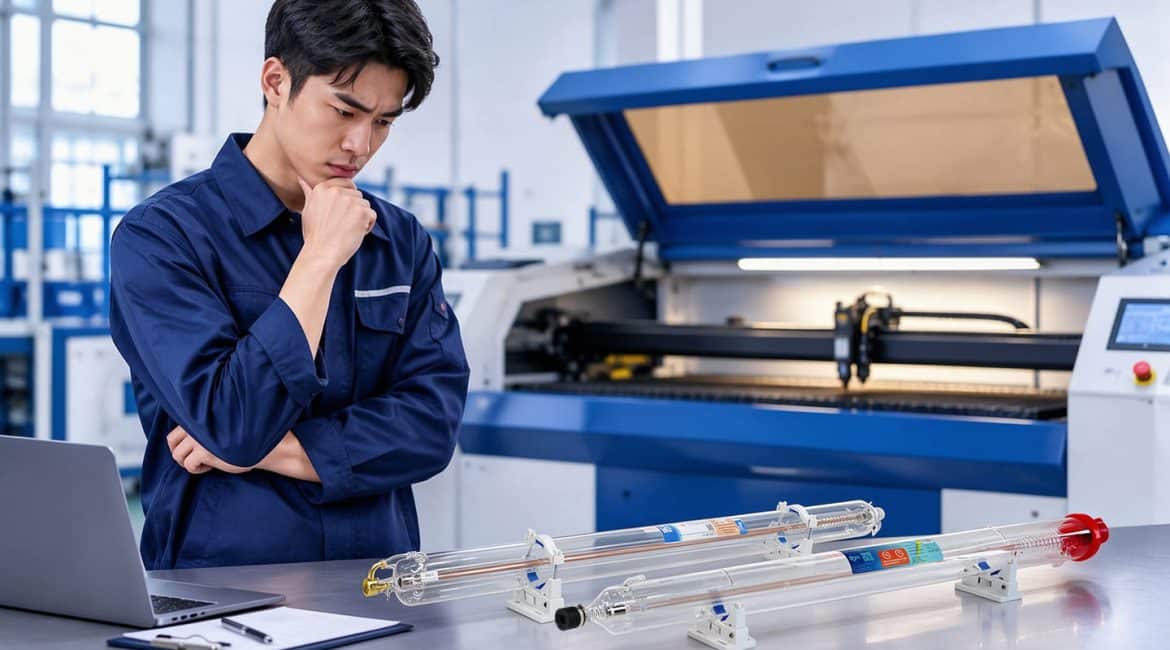
In non-metal cutting and engraving, the CO2 laser Tube is a core consumable. Its quality directly determines cutting capability, processing speed, and production cost. A poor CO2 laser Tube can raise scrap rates even when the machine settings stay the same. A stable tube also supports consistent output across long production runs.
The market offers many CO2 laser Tube brands at very different prices. For example, a 100W unit may cost about CNY 800–900 or CNY 2,000–3,000. Many buyers focus only on “power and price.” As a result, they face serious power overstatement, a scattered beam spot, poor cutting, or early tube failure. Such problems waste material, time, and money. This wide price range can confuse new buyers and experienced operators alike. Compare total cost, not just the first payment.
Where does the real difference between these brands lie? How can we identify rebranded products and overstated power? Below, we explain key processes and warranty policies for CO2 laser Tube selection. These standards apply to both new and replacement purchases. Clear standards make side-by-side comparison much easier.
Four Key Dimensions Behind CO2 laser Tube Brand Quality Differences
Mainstream brands such as Yongli, Reci, Jitai, and Yuntuo differ from low-quality generic or rebranded CO2 laser Tube products. The difference does not appear in the glass shell shape. Instead, it lies in four internal process details. Therefore, a careful buyer should check the manufacturing method inside the tube. These details decide long-term stability, cutting quality, and real operating cost. Check them one by one and record the results.
1.1 Catalyst and Discharge Uniformity
A CO2 laser Tube contains a mixed gas. Under high-voltage discharge, CO2 molecules break down into carbon monoxide and oxygen. Major brands coat the inner discharge tube with a high-quality sintered catalyst. This catalyst quickly restores the broken-down gas. As a result, the discharge stays even and pure purple-pink, and output power remains very stable. Stable gas chemistry also slows natural power decay. This process matters because gas condition controls discharge stability. As a result, the tube keeps a steady power curve during long shifts.
Generic CO2 laser Tube products lack a quality catalyst. Their gas quality drops quickly during discharge. The discharge becomes uneven, output fluctuates, and the beam spot wobbles inside the tube. Consequently, the cutting result changes from one job to the next. This unstable process reduces output consistency and increases downtime.
1.2 Beam Mode and Spot Quality
The output beam mode of a CO2 laser Tube directly determines cut width and depth. Leading factories use high-precision resonator mirror assembly. Therefore, they can stably output the fundamental mode (TEM00). This mode is a small round spot with high center energy and smooth edges. After focusing, it gives a flat cut with no burrs. A clean beam also reduces heat damage around the cut. In daily production, a clean spot reduces rework and saves material.
Poor-quality CO2 laser Tube often produce distorted multimode beams, such as elliptical, ring-shaped, or double spots. These spots have poor energy concentration. The cut turns black and leaves dross. Even a higher rated power cannot produce high-quality work. Therefore, spot quality matters more than a large printed wattage. Ask for a clear spot test before you buy. A clear spot test shows the real beam quality within seconds.
1.3 Sealing Process and Gas Retention Life
The CO2 glass tube is a sealed-off gas device. For a CO2 laser Tube, metal-to-glass sealing at the tube end and output mirror is a critical step. Well-known brands use a special water-cooled metal flange seal and a high-purity infrared lens. The seal is excellent, and static shelf life can exceed one year. Good sealing also protects output stability after long storage. This step protects gas purity and prevents slow leaks.
Small workshops or rebranded CO2 laser Tube products often use simple hard glue sealing. Heat can age the glue layer at a micro level. Gas then slowly leaks through the seal. Many rebranded tubes “sit unused for six months and then emit a white, weak beam or no beam.” Poor sealing causes this problem. In addition, a weak seal can cause slow power loss that users notice only after production suffers. Always inspect the seal before installation, because storage conditions can affect it. A strong seal keeps gas inside and moisture outside.
1.4 Warranty Policy and After-Sales Service
Major manufacturers offer clear tiered or full warranty periods for their CO2 laser Tube lines, such as 180 to 365 days. During the warranty period, non-human natural decay or quality problems qualify for replacement or repair through official channels. Clear warranty terms also reduce arguments after a failure. A written warranty protects your investment and sets clear service expectations.
Low-price rebranded CO2 laser Tube suppliers often promise only “it lights up on arrival.” Sellers may also shift responsibility and blame normal gas leakage on user error. They offer no real after-sales protection. Therefore, check the warranty in writing before you pay. Ask about the claim process, shipping cost, and response time. A clear policy lowers risk and supports long-term production.
Practical Tips: How to Identify Overstated Power in a CO2 laser Tube and Spot Rebranded Products
Once you understand these core differences, you can use three practical checks during purchasing. These checks are simple, fast, and useful in daily buying decisions. Use these checks before payment, not after a failed job. These steps also help you build a reliable supplier list.
2.1 Check Tube Dimensions to Spot Overstated Power
Physics limits CO2 laser Tube output power. The physical length and diameter of the discharge tube directly set the maximum power. A seller cannot ignore this rule with marketing language. Ask for the rated power in writing and compare physical dimensions.
For example, a CO2 laser Tube that is only 1.2 m long and 80 mm in outer diameter usually has a physical power limit near 80W. If a seller labels it as “120W peak power,” that is a typical overstatement. Moreover, the same size cannot safely deliver much higher long-term output. Do not accept vague answers about peak power.
Buying rule: Trust the “rated power,” not the “peak power.” Any low-price tube that claims “130W from a 1.2 m tube” uses overcurrent to force extra power. Its service life will drop sharply. Therefore, a realistic rating often costs less over time. A realistic rating gives predictable cuts and fewer surprises.
2.2 Check Anti-Counterfeit Stamps and Serial Codes to Spot Rebranded Fakes
Some small workshops buy used or rejected CO2 laser Tube units from major factories. They then wrap the tube in a sticker and sell it as new. This practice hides the real history of the product. A sticker alone cannot prove product origin or age.
Buying rule: Major brands such as Yongli and Reci laser-engrave a unique serial code and anti-counterfeit stamp on their CO2 laser Tube glass or flange. They do not use a simple paper sticker. After delivery, contact the manufacturer’s official after-sales team to verify the code and production date. In addition, keep the purchase record for future checks. A genuine serial code should match the model and production date. Verify the code before you install the tube.
2.3 Observe Discharge Tube Color and Coating Appearance
Discharge tube coating: A quality CO2 laser Tube has a uniform light-brown or reddish-brown catalyst coating inside the discharge tube. If the inside looks like plain transparent glass with no catalyst coating, it lacks catalytic reduction capability. This visual check is quick and clear. Small visual clues often reveal big quality risks.
Output mirror coating: Check the output mirror of the CO2 laser Tube. A new genuine product should have a clear, flawless golden coating. If you see glue overflow or small scratches at the mirror edge, suspect a refurbished tube. It may also be low-quality rebranded stock. Meanwhile, inspect the seal area for uneven glue or stains. Take clear photos of the tube and label before installation for future claims. Document everything for warranty protection.
Expert Selection Summary
Do not choose a CO2 laser Tube by price alone. In short, a good product should match your workload and production needs.
For high-intensity factory cutting, choose high-quality long-life series from leading CO2 laser Tube brands such as Yongli and Reci. The unit price is a little higher. However, the beam stays stable, decay is slow, and the effective hourly cost is lower. For simple sign engraving or low-frequency DIY work, choose an economy CO2 laser Tube series from a legitimate brand. Always buy through an authorized channel. Avoid rebranded generic CO2 laser Tube products with no anti-counterfeit code. Choose a supplier who answers technical questions clearly. A good match beats a cheap mismatch every time.