
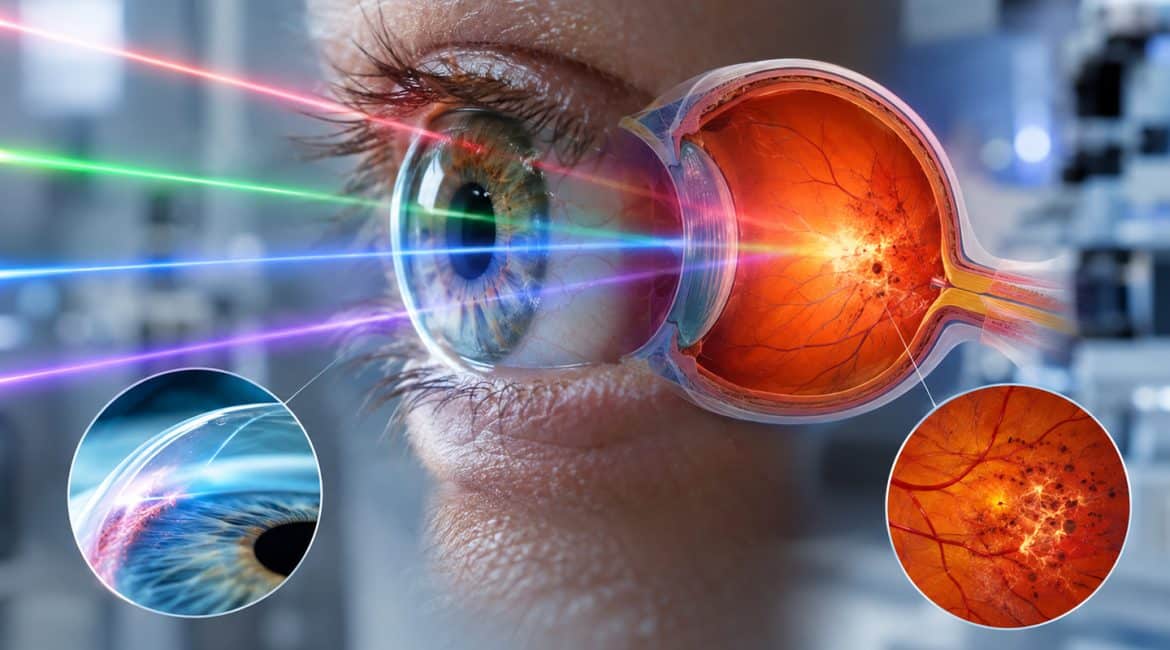
With laser technology now widely used in industrial cutting, medical aesthetics, and scientific research, “laser safety” is far more than an abstract concept. For every operator who works with lasers, the human eye remains the most vulnerable and easily injured organ.
Many people assume that as long as they don’t stare directly at a laser beam, they’re safe, or they believe that “invisible light” poses little threat. In reality, different laser wavelengths act like fundamentally distinct “invisible weapons”—they penetrate the eye to varying depths and strike completely different structures.
Today, we’ll start from the eye’s optical anatomy to uncover the true damage mechanisms behind different laser wavelengths.
I. The Deadly Amplifier: The Eye’s “Focusing Effect”
Before exploring specific wavelengths, we must first understand a physical mechanism that multiplies laser hazards exponentially—the focusing effect of the eye’s refractive system.
The cornea and crystalline lens together form a high-precision lens assembly. When visible or near-infrared light enters the eye, this “lens” focuses parallel beams precisely onto the macular region of the retina.
- For ordinary ambient light, this focusing ability gives us clear vision. But for laser light, it becomes a catastrophic amplification process:
- After entering the pupil, the laser passes through the crystalline lens, and the spot size on the retina shrinks by thousands of times.
Consequently, the energy density (power density) received per unit area on the retina is instantly magnified by 100,000 to 200,000 times!
Even a seemingly insignificant laser of just a few milliwatts, once focused by the eye onto the retina, experiences a dramatic surge in energy density—just like using a magnifying glass to concentrate sunlight and ignite paper, it can “burn” retinal cells in an instant.
II. Four Divergent Paths: Where Each Wavelength Strikes
Different ocular tissues—the cornea, lens, and retina—absorb light at varying rates depending on wavelength. This determines exactly where each laser type “lands” and what damage it inflicts.
- Ultraviolet Lasers (UV, 180nm – 400nm): The Cornea and Lens “Burn Agent”
UV photons carry extremely high energy. The UV-B and UV-C bands (short-wavelength UV) are largely absorbed by the outermost corneal layer, causing photokeratitis (similar to “welder’s flash”), which feels like sand in the eyes—intense pain and tearing. Meanwhile, the UV-A band (long-wavelength UV) penetrates the cornea to reach the crystalline lens, causing protein denaturation and coagulation. Prolonged exposure or high-dose irradiation can trigger severe premature cataracts.
- Visible Light Lasers (400nm – 700nm): The “Open Flame” That Targets the Retina
Green, red, or blue visible lasers pass completely through the cornea and lens, then undergo strong refractive focusing to act directly on the retina. Beyond thermal burns, high-energy blue light (400–500nm) also triggers photochemical toxicity, destroying the rod and cone photoreceptor cells. Although the human eye has a natural blink reflex to visible light (an avoidance response of about 0.25 seconds), if the laser power is high enough, the blink reflex cannot activate in time—and the retina suffers irreversible damage, leaving a permanent blind spot.
- Near-Infrared Lasers (Near-IR, 700nm – 1400nm): The Most Dangerous “Invisible Assassin”
This is the most commonly used industrial laser band (e.g., 1064nm fiber lasers). Near-infrared light is completely invisible to the naked eye, so the eye produces no blink reflex, and the pupil does not constrict in response to bright light.
This invisible radiation passes unobstructed through the front of the eye, undergoes 100,000-fold focusing, and silently strikes the retina. By the time an operator notices blurred vision or dark spots in their visual field, the macular region has often already been burned and necrotized. The injury is extremely insidious and typically irreversible.
- Far-Infrared Lasers (Far-IR, e.g., CO2 Lasers, 10.6μm): The Cornea’s “Thermal Cutter”
CO2 lasers belong to the far-infrared band, where water exhibits extremely high absorption. Because the corneal surface contains abundant water, far-infrared laser energy is completely absorbed by the cornea the instant it makes contact.
This damage is essentially severe thermal burning—it can cause corneal perforation, opacification, and even blindness. However, it generally does not penetrate deeper into the eye to damage the retina.
Expert Safety Recommendations
- Choose Protective Eyewear Based on Wavelength. Laser safety glasses are absolutely not ordinary sunglasses or wind goggles! Each pair of protective eyewear has specific optical density (OD) requirements for particular wavelength bands. For example, glasses that protect against 1064nm may offer zero protection against 355nm UV light.
- Beware of Diffuse Reflections and “Invisible” Light. High-power lasers striking metal or shiny surfaces produce diffuse reflections that remain powerful enough to instantly burn the retina. When aligning near-infrared or UV equipment, you must wear compliant protective eyewear at all times.
- Implement Beam Shielding and Safety Interlocks. Industrial processing areas must feature enclosed beam enclosures and access-controlled safety interlocks to prevent unauthorized personnel from entering laser radiation zones—eliminating accidental exposure at the physical level.