
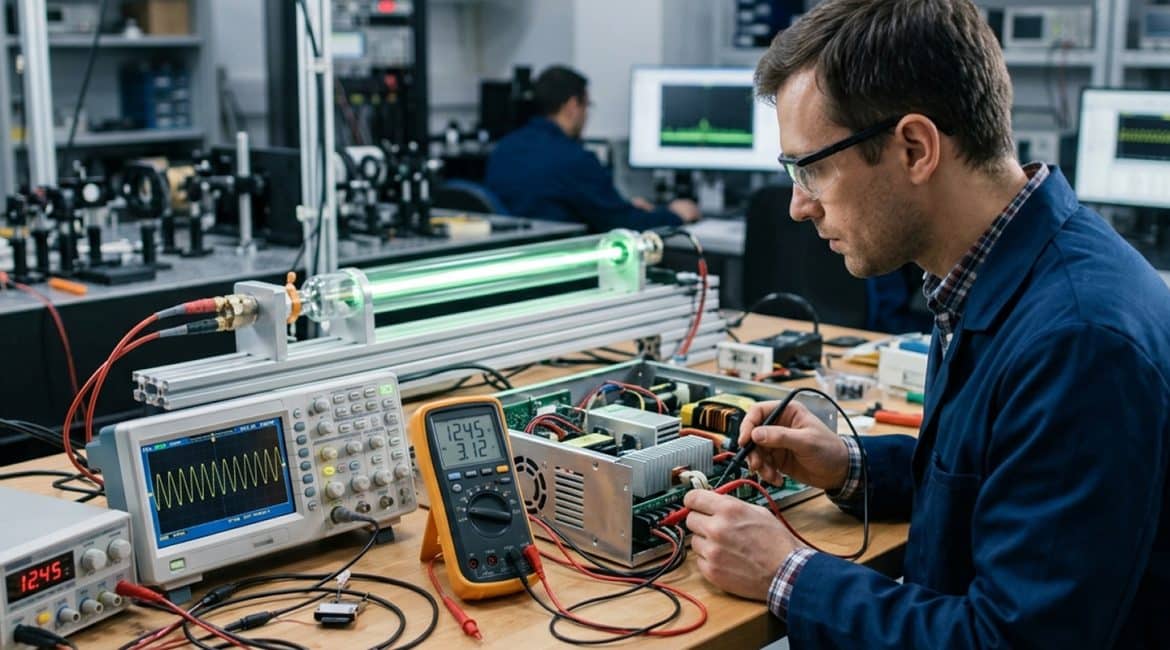
In many laser processing systems—especially the common glass-tube CO₂ lasers—most operators tend to focus on the laser tube itself or the focusing optics. Meanwhile, the true “heart” hiding deep inside the cabinet, the laser power supply, often goes unnoticed.
Think of the laser tube as the robot’s muscle, and the laser power supply as the heart that pumps energy into it continuously. If the heart misbehaves—say, blood pressure spikes or the rhythm becomes irregular—the muscle simply cannot perform steadily, and it might even stop altogether.
Today, let’s explore how to perform a routine “health check” on your laser power supply, and more importantly, how electrical parameters like voltage, current, and ripple quietly influence both the lifespan of the laser tube and the quality of your work.
Three Key “Health Indicators” of a Laser Power Supply
When performing electrical maintenance, engineers typically focus on three core output parameters:
- Operating Voltage
A CO₂ laser tube is a gas discharge device. To ionize the internal gas mixture and produce laser light, it requires tens of thousands of volts (striking voltage). Even during normal operation, sustaining voltage remains in the tens of kilovolts range. If the voltage drops too low, the tube may fail to ignite or flicker out repeatedly. Conversely, excessive voltage can trigger high-voltage arcing, potentially damaging surrounding components. - Operating Current
Current directly determines the energy density delivered into the laser tube, which in turn dictates the output power. When you adjust the laser’s power setting, you’re essentially controlling the milliampere-level current that the power supply feeds to the tube. - Ripple
This is the most overlooked “silent killer.” In simple terms, the DC output from a power supply isn’t a perfectly flat line—it carries tiny AC fluctuations superimposed on it, known as “ripple.” The lower the ripple, the cleaner and more stable the DC power being delivered.
The “Triple Threat” of an Unstable Power Supply to Your Laser Tube
If your laser power supply is of poor quality, or if its filter capacitors have aged over time, leading to unstable current or excessive ripple, the laser tube will suffer several severe consequences:
- Disrupting Gas Discharge Uniformity
The gas inside the laser tube emits light through uniform collisions between electrons and gas molecules under a high-voltage electric field. When the power supply current fluctuates wildly, or ripple becomes severe, the discharge plasma inside the tube begins to shake. Macroscopically, this manifests as uneven energy distribution across the laser beam spot—sometimes hotter in the center, sometimes at the edges—or even a visibly “wobbling” spot. - Causing Erratic Processing Power
For precision cutting or shallow engraving, even tiny power fluctuations directly show up on the workpiece. When ripple is excessive, even if you set a fixed power level in your software, the actual laser energy output oscillates at the power supply’s frequency. The result? Periodic striation marks along cut edges, or uneven engraving depth with dark patches. - Accelerating Electrode Aging and Tube Fracture
Excessive ripple means frequent high-frequency current peaks. These sudden surges deliver repeated thermal shocks to the cathode and anode inside the tube, accelerating electrode sputtering and oxidation. Even worse, rapid current swings cause uneven temperature rises within the gas, and the resulting thermal stress can easily crack or even shatter the fragile glass envelope—dramatically shortening the laser tube’s service life.
A Step-by-Step “Health Check” for Engineers
To ensure stable optical performance and consistent processing quality, we recommend performing a routine inspection of your laser power supply every quarter or every six months:
- Monitor the Maximum Operating Current
Using the milliammeter already installed on your equipment, or a high-precision clamp meter, observe the current reading when the laser runs at full power. Never exceed the rated current! For example, a laser tube rated at 28mA maximum should never be run above 30mA for extended periods—doing so can cut its lifespan by more than half. - Inspect Ripple with an Oscilloscope
If you have the right tools, connect an oscilloscope to the current sensing terminal of the power supply. Switch to DC coupling mode and examine the flatness of the waveform. If you spot obvious sine waves or high-frequency spikes (indicating a ripple factor beyond normal limits), the internal filter capacitors have likely aged and failed—time to repair or replace the power supply. - Check High-Voltage Insulation and Arcing Risks
High-voltage output cables and terminals are prone to weak discharge in humid or dusty environments—you might hear a faint “crackling” sound or see a bluish glow. Such discharge causes severe voltage fluctuations. Regularly clean dust from the high-voltage section and reapply insulating silicone sealant to prevent these issues.
Expert Maintenance Recommendations
Matching Matters Most: When replacing a laser power supply, always ensure its power rating and maximum output voltage strictly match your laser tube’s specifications. An undersized supply will overheat dramatically, while an oversized one may strike the tube too aggressively, damaging the electrodes.
Proper Grounding Is Your Lifeline: Both the laser power supply and the machine frame must have a reliable single-point ground. Good grounding not only drains high-voltage static and prevents arcing, but also absorbs high-frequency electromagnetic interference generated by the supply itself, reducing ripple’s impact on your control boards.