
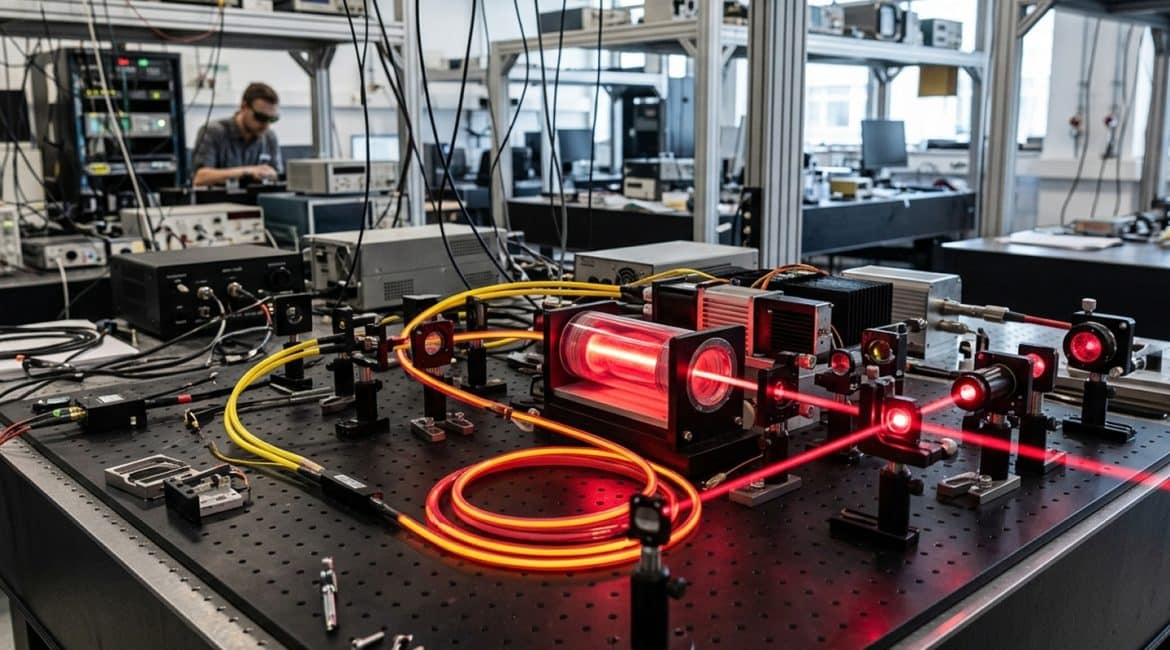
Fiber lasers are champions in modern industrial manufacturing. They excel in cutting, welding, and precise marking. Compared to traditional CO2 or YAG solid-state lasers, fiber lasers are smaller. They also need less maintenance. Furthermore, their electro-optical (E-O) efficiency is outstanding. It easily reaches 30% to 40% or more. Traditional CO2 lasers, however, typically achieve only about 10%.
This means fiber lasers deliver much more laser energy. You pay the same for electricity.
How do fiber lasers achieve this groundbreaking efficiency? What clever physics hides within their structure? Today, we will simply explain the core secrets of fiber lasers.
I. Three Core Components: How Lasers Are “Forged”
To turn ordinary electrical energy into powerful laser light, a fiber laser uses three main modules. These modules work together seamlessly.
1.The Pump Source – Energy’s “Generator”
High-efficiency semiconductor laser diodes (LDs) usually form the pump source. It injects initial high-energy photons into the system. Think of it as fueling an engine. This provides the primary power for laser generation.
2.The Gain Fiber – Energy Amplification’s “Main Stage”
This is the heart of the fiber laser. The gain fiber is a special glass strand. It contains rare-earth elements like ytterbium (Yb) or erbium (Er). When pump light travels through this fiber, the rare-earth ions become excited. They then release many new photons. These photons share the same frequency and direction. Consequently, this process achieves geometric energy amplification.
3.The Resonator – The “Filter” for Beam Purity
Traditional lasers use two precise mirrors for their resonator. However, fiber lasers employ a different method. Scientists etch Fiber Bragg Gratings (FBGs) directly into the fiber. These gratings serve as mirrors. The laser beam reflects back and forth between them. The gain fiber continuously amplifies it. This continues until it reaches very high energy. Finally, the beam exits from the low-reflectivity grating end.
II. The Double-Clad Structure: Smartly Turning “Rough” Light into “Refined” Light
Traditional lasers face a big problem. High-power semiconductor pump light often has a “rough” or broad beam. Yet, the core region for gain (the fiber core) is “extremely thin.” Forcing broad light into the thin core leads to very low coupling efficiency.
Fiber lasers solve this issue perfectly. They use an ingenious design: the double-clad fiber.
- Inner Core: This sits at the very center. Its diameter is tiny, just a few to tens of micrometers. It contains rare-earth elements. The inner core amplifies and transmits the final laser.
- Inner Cladding: This surrounds the core. Its area is tens to hundreds of times larger. Broad pump light can go directly into this inner cladding.
- Outer Cladding: This is the outermost protective layer. Its refractive index is lower than the inner cladding’s.
When pump light enters the thicker inner cladding, the outer cladding acts like a total internal reflection mirror. It traps the light inside the inner cladding. The pump light zigzags through the inner cladding. Each time it crosses the central thin core, the rare-earth ions absorb some light. This excites them.
This clever “large-area light input, small-core absorption” method achieves nearly perfect pump light absorption. This is a key reason for the high electro-optical conversion efficiency of fiber lasers.
III. Heat Dissipation and Conduction: The “Long-Strip” Natural Cooling Advantage
Traditional solid-state lasers (like rod-shaped YAG lasers) struggle with thermal lensing. This happens when power increases. The crystal is too thick. Internal heat cannot escape well. This causes crystal deformation. It degrades beam quality and can even cause fracturing.
Fiber lasers, however, have inherent physical advantages for heat dissipation.
- Extremely High Surface Area to Volume Ratio: The gain fiber can be meters or even tens of meters long. Yet, its diameter is only hundreds of micrometers. This “extremely thin and long” shape offers a huge surface area. Thus, it easily dissipates heat.
- Natural Cooling and Flexible Layout: Heat spreads evenly along the entire fiber. Simple air cooling or coiling the fiber onto a water-cooled plate removes it easily. Heat never concentrates at one point. This prevents localized overheating.
- All-Fiber Enclosed Structure: The laser beam remains entirely within the enclosed fiber waveguide. This occurs from generation to output. This “all-solid-state” structure needs no exposed mirrors. Thus, it avoids tedious optical alignment maintenance. Furthermore, it completely prevents contamination from dust and oil.
Summary
Fiber lasers have revolutionized industrial processing. This stems from the perfect blend of optical engineering and material science.
Semiconductor pumps provide an efficient energy source. The double-clad structure ensures excellent pump light absorption. Moreover, the fiber’s unique shape offers natural heat dissipation. Combined with an all-fiber enclosed optical path, fiber lasers achieve a triple win. They deliver high electro-optical efficiency, high beam quality, and low maintenance costs. Therefore, they are an indispensable tool in modern industry.