
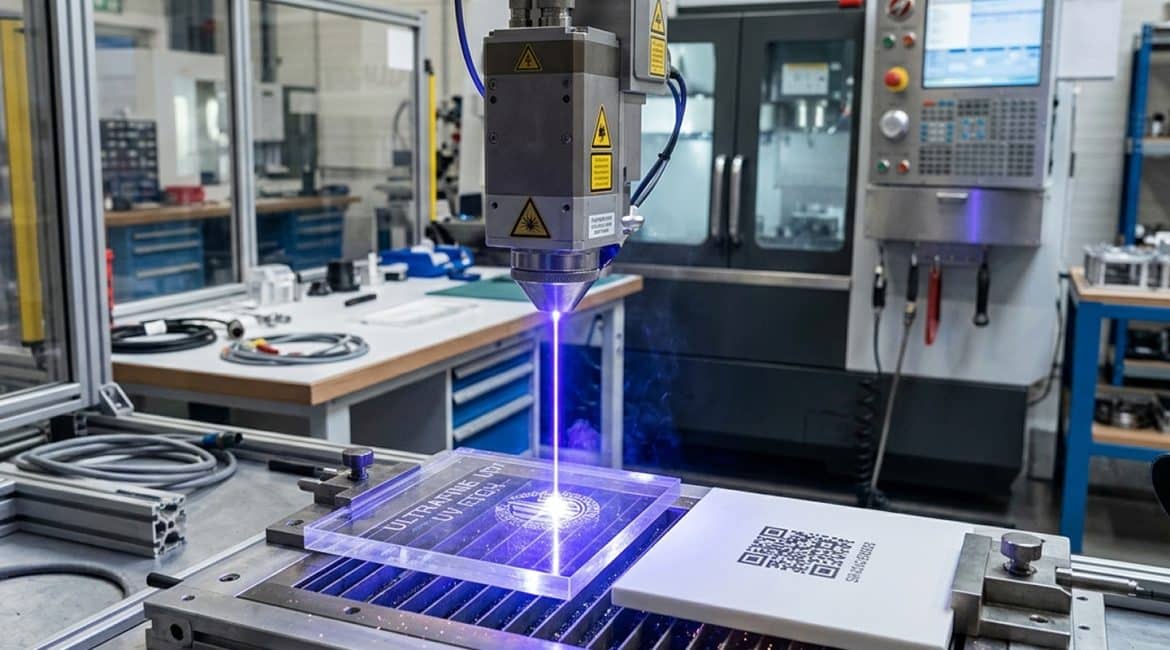
In industrial processing, we often encounter challenging materials. For instance, consider delicate transparent glass, common white plastic tubes in medical devices, or high-density polyimide circuit boards.
Using typical infrared fiber lasers or CO2 lasers for marking or cutting these materials often yields unsatisfactory results. For example, transparent glass remains unharmed; the laser simply passes through it. Furthermore, white plastics frequently suffer from severe charring and melted, deformed edges. In contrast, UV lasers provide a clean and precise solution for these challenging materials.
So, how do UV lasers easily handle these materials? How do they produce micron-level patterns with no burn marks and perfectly smooth edges? The secret lies in the material’s light absorption rate and the unique photon energy mechanism that defines ultraviolet laser processing.
I. Penetration and Absorption: Why Traditional Lasers “Fail”
To understand laser processing, we must first grasp how materials interact with light. When a laser beam hits a surface, the light typically follows one of three paths: it reflects, transmits (penetrates), or absorbs. Consequently, only the absorbed energy truly processes the material.
- Transparent Materials “Ignore” Light: Transparent glass or clear plastics appear transparent because they have extremely low absorption rates for visible and near-infrared light. For example, a 1064nm fiber laser. Therefore, infrared lasers pass through glass much like sunlight through a window. Most energy transmits directly, making effective cutting or marking impossible.
- White Materials “Reflect” Light: White plastics appear white because they reflect most visible light. Similarly, in the near-infrared spectrum, white materials exhibit very high reflectivity and scattering rates. If we force high power from an infrared laser, the material eventually breaks down. However, this destruction occurs through intense heat accumulation. This process often leads to thermal melting, yellowing, or even charring at the material’s edges.
II. UV Wavelength (355nm): The Unique Advantage of High Absorption
When we shorten the laser wavelength to the ultraviolet (UV) spectrum, usually 355 nanometers, the material’s physical response changes fundamentally. This is where UV laser technology truly shines.
Most polymers (plastics), glass, ceramics, and other non-metallic materials show a common characteristic in the UV spectral region: extremely high optical absorption.
1.From “Transparent” to “Strong Absorption”
Consider common quartz glass and high-molecular plastics. They may absorb less than 1% of 1064nm infrared light. However, their absorption rate for 355nm UV light can suddenly increase to over 80% or even 90%.
This means UV lasers do not require very high power. A weak beam from a UV laser contacting the material surface instantly absorbs the energy completely. This entirely avoids the problem of the “beam passing straight through,” a common issue with other laser types.
2.”Photochemical Ablation” Replaces “Thermal Melting”
This represents the core physical advantage of UV processing. Fundamentally, infrared laser processing is “thermal processing.” It relies on high temperatures to melt or vaporize the material. In contrast, UV lasers possess extremely high photon energy, approximately 3.5 electron volts. This energy surpasses the bond energy of most high-molecular polymer molecular bonds. When UV lasers interact with a material, these high-energy photons directly break the chemical bonds between material molecules. This instantly decomposes the material into tiny molecular clusters, which then ablate away. This processing method generates almost no heat. Industry experts call it “cold processing” or “photochemical ablation.”
III. Why White Plastic Processing No Longer “Burns”?
Understanding the principles of “high absorption” and “cold processing” resolves the challenge of processing white plastics.
Instant Absorption, No Heat Accumulation: Specifically, the resin matrix in white plastics is highly sensitive to UV light absorption. When a UV laser strikes white plastic, the energy absorbs instantly within a few micrometers of the surface. This immediately breaks molecular bonds. Therefore, there is no need for prolonged heat accumulation to damage the material.
Clear Contrast, No Thermal Damage: Because of minimal thermal diffusion, UV lasers achieve very high-resolution color-changing marks on white plastic surfaces. For example, they can instantly induce color in additives like titanium dioxide. Furthermore, UV lasers produce exceptionally clean cuts. This clean processing is a hallmark of ultraviolet laser technology. Traditional thermal processing issues like black edges, bubbling, or melted residue simply do not occur.
Expert Summary
UV lasers earn their reputation as “all-round players” in micro-processing. Their key lies in leveraging inherent spectroscopic advantages.
By using a short 355nm wavelength, UV lasers overcome the “immune layer” of transparent and white materials against traditional lasers. High absorption ensures processing efficiency. Moreover, high photon energy enables cold processing without thermal damage. Ultimately, whether scribing thin-film solar cells, marking QR codes on medical tubing, or drilling micron-sized holes in glass LCD screens, UV laser technology demonstrates irreplaceable precision and quality.