
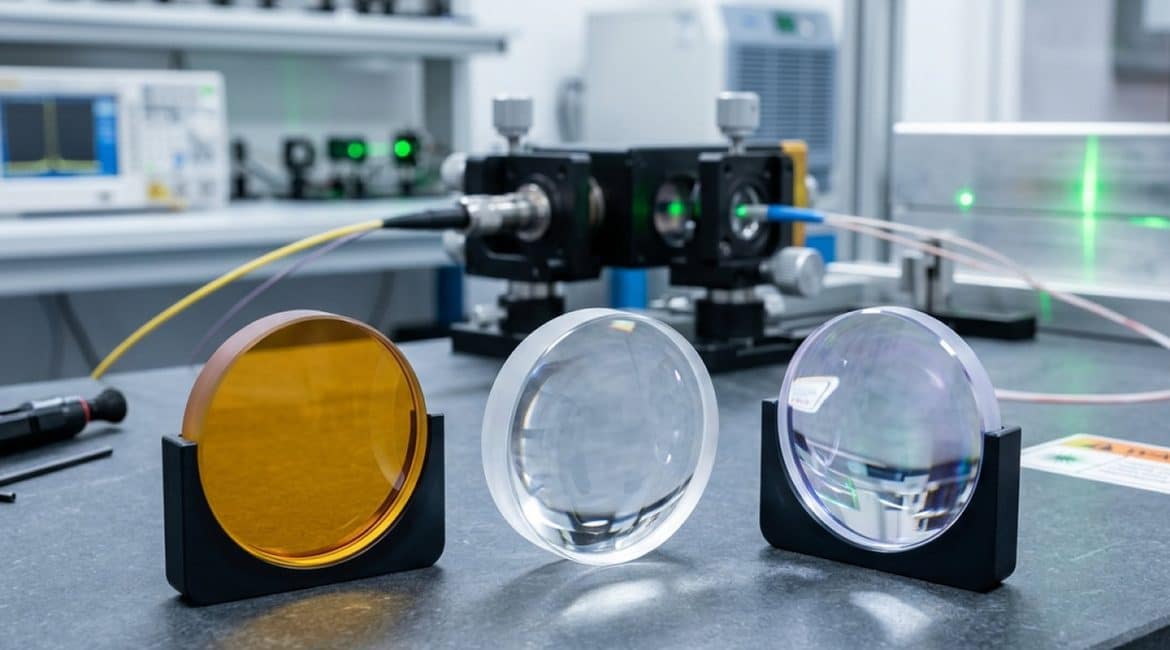
In laser processing systems, laser focusing lenses act as the laser’s “eyes.” They concentrate a broad laser beam into a tiny, high-energy-density spot. This achieves precise cutting, welding, or marking.
However, have you ever wondered why some lenses appear transparent and colorless, while others are golden yellow? What happens if you incorrectly install a fiber laser focusing lens, designed for cutting steel, into a CO2 laser used for wood or acrylic?
The answer is simple: the lens will instantly burn out, or even shatter. This entire mystery lies in the precise matching between the lens material and the laser wavelength.
I. Why Can’t One Laser Focusing Lens Do It All?
Laser light inherently possesses a specific wavelength. Ordinary window glass, common in daily life, is transparent to visible light. However, it can behave like an opaque wall to infrared or far-infrared light.
When a laser beam passes through a laser focusing lens, the material’s transmittance at that specific wavelength determines how much energy passes through smoothly. It also dictates how much energy the lens “forcibly absorbs.”
- Ideal State: The material exhibits extremely high transmittance (nearly 100%) for the specific wavelength. Laser energy passes through the laser focusing lens almost without loss. It focuses precisely on the workpiece.
- Fatal Mismatch: The material has a high absorption rate for that specific wavelength. Laser energy accumulates significantly within the lens. This rapidly converts into intense heat. Consequently, it causes thermal deformation, coating burnout, or even shattering of the lens.
Therefore, selecting the correct optical material for different laser wavelengths is the primary defense. It ensures optical path safety and processing efficiency.
II. Common Laser Wavelengths and Laser Focusing Lens Materials: A Deep Dive
Let’s examine the “golden partners” for the three most prevalent industrial lasers: CO2, fiber, and UV lasers.
- CO2 Laser (Wavelength 10.6 µm) – ZnSe: The Infrared Battlefield
CO2 lasers operate in the far-infrared band (10.6 micrometers). Most ordinary glass and quartz are completely opaque to this wavelength.
- Optimal Choice: Zinc Selenide (ZnSe) material displays its distinctive golden yellow color. It offers extremely low absorption and very high transmittance in the 10.6-micrometer far-infrared band. After double-sided anti-reflective (AR) coating, a ZnSe laser focusing lens can achieve over 99.5% transmittance.
- Physical Properties: While ZnSe offers excellent optical performance, its texture is relatively soft. It scratches easily. Furthermore, it is sensitive to severe thermal shock. Thus, a robust cooling system is essential to ensure stable operation of the laser focusing lens.
- Near-Infrared and Fiber Lasers (Wavelength 1064 nm) – Fused Silica and Sapphire
Fiber lasers and YAG lasers typically operate around 1064 nanometers. This falls within the near-infrared band. Materials transparent to visible light show lower absorption here. Consequently, more material options are available for laser focusing lenses.
- King of Cost-Performance and Performance: Fused Silica
High-purity fused silica provides exceptional transmission performance at 1064 nanometers. It also has an extremely low thermal expansion coefficient. It withstands continuous irradiation from multi-kilowatt, even multi-tens-of-kilowatt, high-power fiber lasers. It is the absolute top choice for laser focusing lenses and protective windows in industrial fiber laser cutters and welders. - Hard Protective Barrier: Sapphire
Sapphire crystal also exhibits excellent transmittance in the near-infrared band. Its most significant feature is its extreme hardness (Mohs hardness 9, second only to diamond). In harsh processing environments with abundant spatter, sapphire often serves as the outermost protective lens. Its scratch and wear resistance far exceed fused silica.
- Ultraviolet (UV) Lasers (Wavelength 355 nm) – Ultra-High Purity UV-Grade Fused Silica
UV lasers utilize short-wavelength beams (355 nanometers). Their photons possess extremely high energy. Common optical materials readily absorb short-wavelength light. This can cause “photo-darkening” or material degradation. The only critical choice here is UV-grade fused silica. UV laser focusing lenses must use ultra-high purity synthetic fused silica. Manufacturers produce this material via special processes, ensuring extremely low hydroxyl content. It boasts over 99% transmittance at 355 nanometers. Moreover, it effectively resists long-term “photo-aging” damage from high-energy UV photons. Ordinary industrial quartz lenses would quickly discolor and fail if used with UV lasers due to increased absorption.
III. Optical Thin Films: The Final Touch for Enhanced Transmittance
Selecting the correct substrate material is merely the first step. In practical applications, uncoated lens surfaces still incur 4% to 10% natural reflection losses.
To minimize energy loss, a multi-layer anti-reflective (AR) coating is vapor-deposited onto the lens surface. This micron-thick film uses the principle of light interference. It cancels out reflected light waves. This boosts the overall transmittance of the specific wavelength laser to 99.8% or even higher.
Crucially: Coatings are strictly designed for specific wavelengths. A quartz lens coated for 1064 nanometer fiber lasers, even if the base material transmits UV light, will largely reflect or absorb 355 nanometer UV laser light. This leads to a drastic drop in marking energy or coating burnout.
Expert Selection Advice for Laser Focusing Lenses
When choosing or replacing laser focusing lenses, remember this “Three-Check Rule”:
- Check Wavelength Match: For CO2 lasers (10.6 µm), always select golden yellow ZnSe. For fiber lasers (1064 nm), opt for high-purity fused silica or sapphire. For UV lasers (355 nm), specify UV-grade high-purity synthetic fused silica.
- Check Power Level: For multi-kilowatt ultra-high power fiber cutting, use special-grade synthetic fused silica with low absorption. Otherwise, “thermal lensing effects” can occur. This causes focal point drift and impacts processing accuracy.
- Check Environmental Protection: For protective lenses at the workpiece end, especially with significant dust and spatter, consider more wear-resistant sapphire lenses if the budget allows. This extends service life.
Proper selection and use of laser focusing lenses are vital. They ensure stable and efficient operation of your laser processing system.