
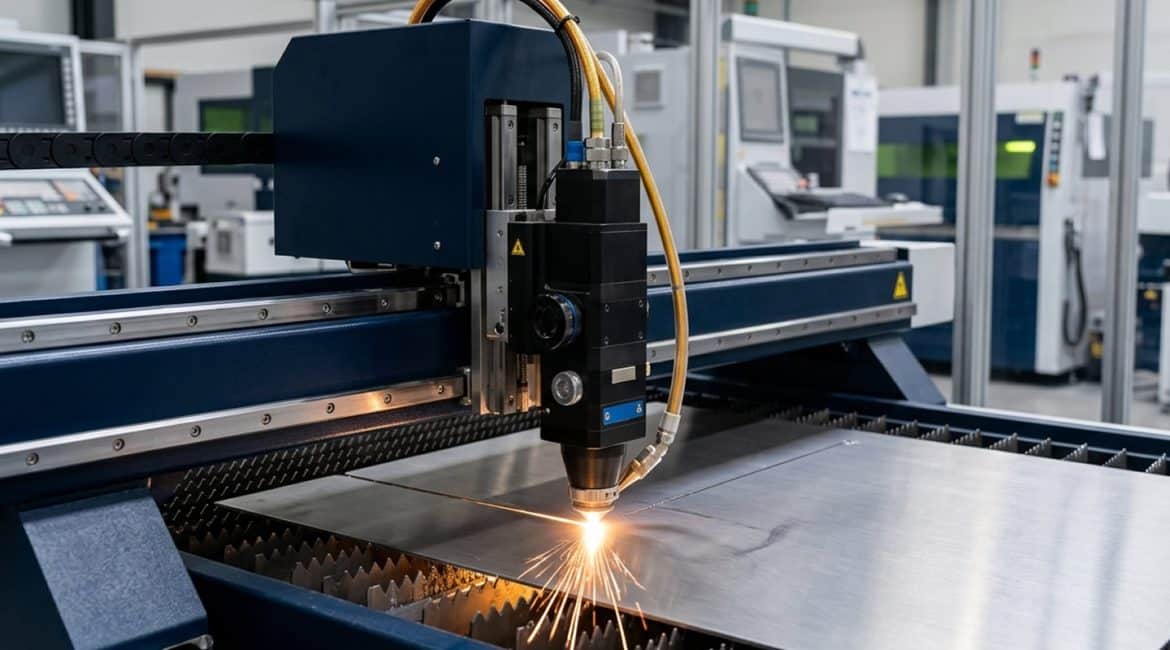
In industrial laser processing, fiber lasers have truly become the shining stars. They deliver astonishing efficiency and precision. For instance, they cut several-millimeter-thick steel plates at high speed. Furthermore, they perform micron-level fine welding on microelectronic chips.
Many often describe fiber lasers as having “high brightness, small spots, and concentrated energy.” But what are the core physical metrics behind these outstanding advantages? Today, we will delve into the Beam Parameter Product (BPP). This critical parameter defines a laser’s “sharpness.” We will also explore the mysteries of single-mode and multi-mode fiber laser beams.
I. What is the Beam Parameter Product (BPP)?
To understand laser quality, consider this analogy. An ordinary flashlight beam quickly diverges, spreading its energy. In contrast, a high-quality laser, like an invisible “light sword,” maintains an extremely small focus. It also stays compact over long distances.
The BPP (Beam Parameter Product) measures this “light sword’s” focusing ability and resistance to divergence.
- BPP Definition: It is the product of the beam waist radius (the narrowest point) and the divergence angle (how much the beam spreads).
- Physical Significance: A smaller BPP value indicates better laser beam quality. This means the fiber laser beam focuses into an extremely small spot. Moreover, it diverges more slowly during propagation, thus concentrating energy more effectively.
- Diffraction Limit: For a typical fiber laser beam with a wavelength of approximately 1064nm, the theoretical physical limit for BPP is about 0.34 mm·mrad. A beam approaching this number is nearly perfect. We call it a “diffraction-limited beam.”
II. Single-mode vs. Multi-mode: How Fiber Core Size Determines Laser Characteristics
Fiber lasers achieve extremely low BPP values due to a secret within their fiber cores. These cores transmit the laser light. Fiber laser beams primarily fall into two categories: single-mode and multi-mode. This classification depends on core thickness and light propagation modes.
- Single-mode Fiber Laser Beam
Single-mode fiber cores are incredibly thin. They typically measure only a few to a dozen micrometers, roughly one-tenth the thickness of a human hair. Due to this extremely narrow space, light propagates along a single path. We call this the “fundamental mode” or TEM00 mode.
- Key Advantage: The output fiber laser beam achieves near physical limit quality. It boasts an extremely small BPP value, closely approaching the diffraction limit.
- Processing Performance: The focused spot is tiny. It provides extremely high energy density. This makes it an incredibly sharp “surgical knife.” It is ideal for high-precision micro-machining, rapid thin-plate cutting, and applications requiring long-distance fiber laser beam transmission.
- Multi-mode Fiber Laser Beam
Multi-mode fiber cores are thicker. They usually range from dozens to hundreds of micrometers. Light can refract and propagate along multiple different paths within the core. This creates a superposition of multiple modes.
- Core Characteristics: This type of fiber laser beam supports multiple light paths. Consequently, its BPP value is generally larger. Its beam quality is inferior to single-mode. However, its thicker core allows it to carry higher laser power.
- Processing Performance: The focused spot is larger than a single-mode beam. Its energy distribution is more uniform. This makes it excel in thick-plate cutting, large-area cladding, and deep-penetration welding. It delivers wider welds and more stable melt pools.
III. High Brightness: The “Ace” for Long-Distance and Micro-Machining
In optics, “brightness” does not refer to perceived visual intensity. Instead, it defines the laser power injected per unit area per unit solid angle.
High brightness essentially combines “high power” with “low BPP.” Fiber laser beams shine in micro-machining and long-distance transmission. This is precisely due to their high-brightness characteristic.
- “Energy Strike” in Micro-machining
Micro-machining tasks, such as fine drilling or thin-film scribing, demand materials to instantly absorb extremely high energy densities for vaporization. A high-brightness single-mode fiber laser beam can precisely “squeeze” hundreds, even thousands, of watts of power into a spot just a dozen micrometers in diameter. This generates immense power density. It enables smooth, burr-free, fine processing.
- “Long Depth of Focus” in Long-Distance Transmission
An extremely small BPP value means a very small beam divergence angle. This allows the fiber laser beam to maintain an exceptionally long “Depth of Focus” after passing through a focusing lens. Consequently, even with longer working distances or slight surface variations, the laser spot size and energy density remain highly stable. This significantly simplifies remote processing and complex 3D curved surface machining.
Expert Commentary
The Beam Parameter Product (BPP) is a crucial metric. It indicates a laser’s “value.” A smaller BPP yields a “sharper” fiber laser beam. Higher brightness ensures more efficient processing.
- For micron-level precision, high-speed thin material cutting, or flexible processing at longer working distances, prioritize high-brightness, low-BPP single-mode fiber laser beams.
- If you need to handle deep-penetration welding of medium to thick plates or cut larger workpieces, requiring a wider melt pool and coverage, then a multi-mode fiber laser beam offers a more cost-effective solution with broader energy distribution.
Understanding the physical essence of BPP and brightness empowers you. You can precisely match equipment selection and process development to your needs. Ultimately, this unleashes the full power of this “light knife.”