
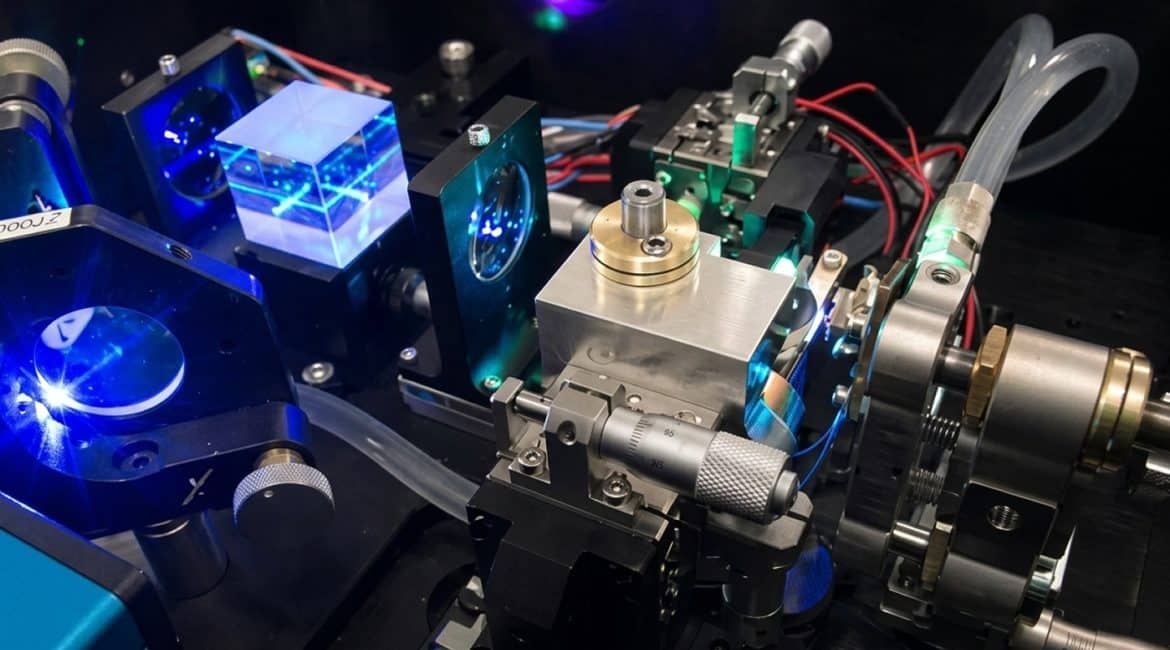
Advanced UV lasers are industry benchmarks. They excel in micro-electronics marking, wafer dicing, and high-precision micro-machining. Their unique “cold processing” minimizes heat-affected zones.
However, many operators face a frustrating issue. Initially, these devices deliver strong power and perfect spot quality. After some use, output power consistently decays, like energy draining. Moreover, costly internal crystals suffer irreversible spot damage.
The main culprit usually isn’t the laser’s end-of-life. Rather, minor contamination and seal failure happen within the internal resonator cavity. This significantly impacts UV laser performance. Today, we unveil the mysteries of UV laser internal cavity maintenance.
Ⅰ.Why Are UV Lasers More “Delicate” Than Standard Lasers?
To grasp the maintenance challenges of UV lasers, first understand their unique operating principle.
Industrial 355 nm UV lasers commonly derive from 1064 nm infrared fundamental light. This light undergoes two frequency conversions. Nonlinear frequency doubling crystals, like LBO crystals, perform these conversions. During this process, UV photons possess extremely high energy. Their short wavelength dramatically impacts the surrounding environment. This poses unique challenges for UV lasers.
- Photodarkening: High-energy UV photons directly break chemical bonds in trace volatile organic compounds (VOCs) or airborne silicone molecules. This carbonizes them. Such deposits then form on optical mirror surfaces. These black deposits severely reduce transmittance.
- LBO Crystal Hygroscopy and Deliquescence: Lithium triborate (LBO) crystals are core frequency doubling components. They are highly sensitive to airborne moisture. Exposure to humidity causes microscopic deliquescence on the crystal surface. This rapidly decreases transmittance. It can even destroy the crystal.
Therefore, a UV laser’s internal resonator cavity must maintain impeccable cleanliness. It must be free from any dust, oil, moisture, or organic gases.
Ⅱ.Cavity Sealing: The First Line of Defense Against Contamination
A UV laser’s internal cavity essentially functions as a “micro cleanroom” with stringent requirements.
Manufacturers typically seal the resonator cavity completely before shipment. They use high-quality O-rings, metal bellows, and special gas-impermeable materials. High-purity dry inert gas, such as nitrogen, then fills the interior. This ensures a stable and pure internal environment. It is critical for UV laser longevity.
Seal breach leads to severe consequences:
Loose external screws, aging sealing rings, or unauthorized cavity opening in non-standard environments allow external air to enter. This air contains moisture and organic compounds. Tens of thousands of watts of peak UV laser power density quickly contaminate mirrors and LBO crystals. This happens within hours. Such contamination leads to a drastic power drop.
Ⅲ.Strict Internal Cavity Maintenance Protocols: Cleanroom Operations and Nitrogen Purging
Internal optical components may need inspection or replacement after years of use. This often results from natural aging or minor leaks. Crucially, never disassemble them like ordinary mechanical equipment. Instead, professional technicians must guide these operations. Strictly adhere to these guidelines:
- Rigorous Class 100 Cleanroom Environment: Operators must perform cavity maintenance within a Class 100 ultra-clean workbench. They must wear cleanroom suits, gloves, and masks. Never directly touch any optical component surface. Furthermore, operators must not speak inside the open cavity. Human-emitted particles and aerosols are lethal to optical components.
- Continuous High-Purity Nitrogen Purging: Before, during, and after resealing the cavity, continuously purge it with 99.999% pure nitrogen at low pressure.
- Before Maintenance: Nitrogen purging effectively expels any trace impurities remaining inside the cavity.
- During Assembly: Maintain positive nitrogen pressure. This prevents external air from back-flowing into the cavity through gaps during assembly.
- After Sealing: Perform a prolonged nitrogen replacement. This ensures the cavity is completely dry, oxygen-free, and free of organic compounds. This is crucial for optimal UV laser performance.
- Crystal Temperature Control and Care:LBO crystals typically reside in a temperature-controlled oven with high-precision control. When shutting down for maintenance, slowly decrease the crystal oven’s heating state in a specific sequence. This avoids thermal shock and crystal fracture. Before re-starting, first activate temperature control for dehumidification. Only after the environment stabilizes should the UV laser emit light.
Expert Maintenance Recommendations
- Never Open the Cavity Without Authorization: A UV laser internal cavity is a high-precision optical system. Non-professional service engineers must never unscrew the cavity cover themselves. This risks damage to the UV laser.
- Monitor Environmental Temperature and Humidity: For your UV laser system, strictly control the operating environment. Keep relative humidity below 40%. Maintain temperatures between 20 and 25 degrees Celsius. These actions significantly reduce internal condensation and moisture ingress risks.
- Monitor Chiller Status: Setting the chiller’s condensate water temperature too low can cause condensation. This occurs on the UV laser’s external casing, or even inside the cavity. It degrades UV laser performance. Scientifically set chiller water temperature based on the ambient dew point temperature. Typically, aim for near ambient temperature (e.g., 22-24 ℃).