
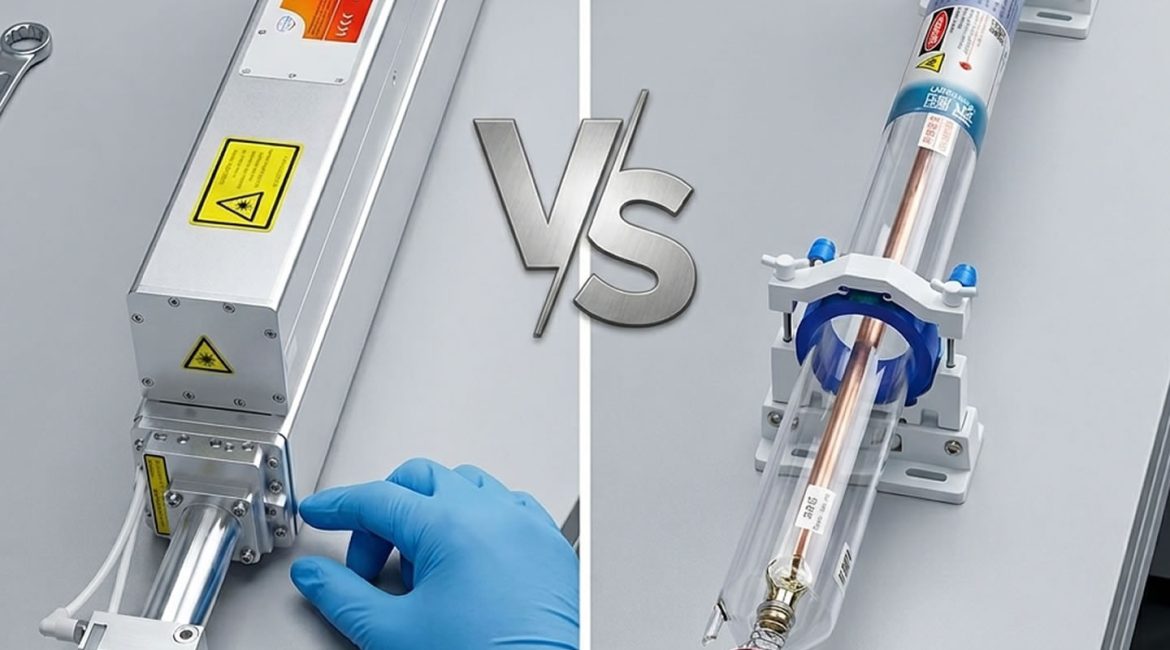
In CO2 laser processing, we often hear two terms: “glass tube” and “RF (Radio Frequency) tube.” Both output 10.6-micrometer infrared lasers. They also cut wood, acrylic, or engrave leather. However, their prices can differ by several or even dozens of times.
This huge price gap is not merely brand premium. Instead, it stems from a fundamental revolution in physics and engineering technology. Today, let’s set aside complex academic theories. We will simply explain what an RF laser is. We will also discuss why it has become an indispensable core in high-end precision manufacturing.
I. Core Concept: What is RF (Radio Frequency) Excitation?
To understand the difference between these two CO2 lasers, we must first know how they make gas produce laser light. Both glass tubes and RF metal tubes contain a gas mixture, primarily carbon dioxide. To make these gases lase, we must “feed” them energy.
- Traditional Glass Tube (DC Excitation): It uses high-voltage direct current (DC) electricity. Imagine lightning striking the air. Engineers install positive and negative electrodes at both ends of the glass tube. They apply tens of thousands of volts of high voltage. Under this high voltage, charges are forced to move within the tube. This ionizes the gas, producing laser light. This method is direct and crude. The electrodes remain directly exposed to the gas.
- RF (Radio Frequency) Laser: Radio Frequency (RF) is essentially a high-frequency alternating electromagnetic wave. It works similarly to a microwave oven. An RF CO2 laser does not need internal electrodes. Instead, it seals the gas mixture in a metal cavity. It then applies a high-frequency electromagnetic field externally. Gas molecules vibrate and collide violently in this field. Consequently, they are excited to produce laser light.
Simply put, a traditional glass tube CO2 laser is like boiling water with a lighter. In contrast, an RF CO2 laser is like heating water in a microwave oven. Compared to the former, RF excitation delivers energy more uniformly and efficiently. Furthermore, it completely avoids internal electrode involvement.
II. In-Depth Showdown: Metal Slab vs. Long Glass Tube
The change in excitation method directly leads to fundamental differences. These differences are in structure, lifespan, and stability. This applies to RF CO2 lasers and traditional glass tube CO2 lasers.
- Structural Design: Precision “Metal Slab” vs. Fragile “Long Glass Tube”
Traditional Glass Tube: To achieve higher power, glass tubes must become longer. For instance, a 150W glass tube often measures nearly 2 meters. It stacks layers: a water-cooling layer, a discharge layer, and a gas return layer. This structure is extremely fragile. A slight bump or freezing cooling water can cause it to shatter completely.
RF CO2 Laser: It typically uses a metal slab structure. Two extremely flat aluminum alloy plates serve as electrodes. They compress the gas into a narrow gap. This design makes the unit very compact. A several-watt metal tube might be palm-sized. Moreover, the metal material is extremely robust. Crucially, the slab structure itself acts as an efficient heat sink. This significantly boosts cooling efficiency. Additionally, this design ensures the beam reflects multiple times within the cavity. The resulting output beam quality is exceptionally high, very round, and fine.
- Lifespan: A Lifetime “Asset” vs. A Regularly Replaced “Consumable”
Traditional Glass Tube: Lifespan is its biggest drawback. Electrodes reside inside the tube. Each discharge causes electrolytic erosion of the electrode metal. This contaminates the internal gas. Also, gas naturally permeates and leaks. A glass tube CO2 laser’s lifespan usually ranges from 2,000 to 10,000 hours. Once the gas depletes or ages, the entire tube becomes essentially useless.
RF CO2 Laser: This is completely different. It employs high-grade metal vacuum sealing technology. There is no internal electrode contamination. The gas degrades very slowly. Its operational lifespan typically exceeds 20,000 to 30,000 hours. Even more revolutionary, when the gas inside an RF CO2 laser depletes or ages, you can send it back for refilling and refurbishment. As long as the metal cavity remains intact, it can “revive” through refilling. This transforms it from a single-use consumable into a long-term fixed asset.
- Power Stability: Rock-Solid vs. Fluctuating
Traditional Glass Tube: In industrial precision processing, fluctuating laser power is highly undesirable. A glass tube CO2 laser’s power varies significantly with water temperature. High-voltage DC discharge is inherently random. Its power fluctuation typically hovers around ±10%. When requiring low power for shallow engraving, a glass tube CO2 laser might even “strike” and fail to operate stably. This happens if it cannot reach the ignition voltage.
RF CO2 Laser: Due to its high-frequency electromagnetic drive, its response speed reaches microseconds. It easily controls power fluctuations within ±5%, or even lower. It precisely controls energy output, whether a weak 1% or a full 100% burst. This extremely high stability prevents issues during precision workpiece processing. For example, it avoids “cutting through in the first half but not the second” or inconsistent engraving depths.
Expert Commentary
The traditional glass tube CO2 laser acts like an “old soldier” in the laser world. It has drawbacks: short lifespan, rough beam spot, and slow response. However, its extremely low price still makes it valuable. It finds use in rough processing fields like garment cutting and advertising letter cutting, where high precision is not critical.
In contrast, the RF metal tube CO2 laser is a “pioneer” in modern precision manufacturing. It offers an ultra-long lifespan, extreme power stability, and a fine, small beam spot. These features are indispensable. They are the key to achieving high-speed galvanometer marking, precision drilling of flexible films, and medical skin aesthetics. Understanding the fundamental differences between these two CO2 laser types helps us make the most rational equipment investment decisions. This applies when facing various processing demands.