
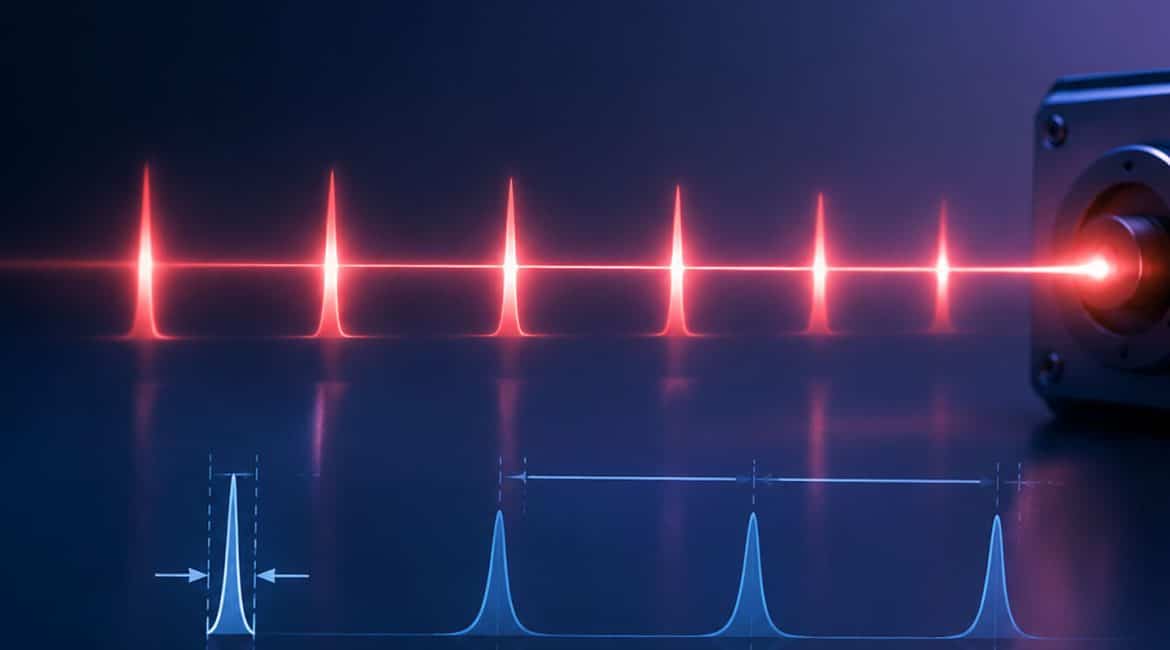
In industrial micromachining, people often call the laser a “light knife.” Unlike a common metal tool, this “light knife” cuts continuously. Furthermore, it can “flash rapidly” thousands of times per second.
This flexible switching between continuous wave (CW) and high-frequency pulsed modes is a captivating physical characteristic of RF (Radio Frequency) lasers. This unique capability, particularly the precise control over the RF laser pulse at microsecond or even nanosecond levels, makes the RF laser a true master. It excels in precise micromachining and “cold processing.”
I. Instant Magic: Flexible Switching from Continuous Wave to High-Frequency Pulsing
To understand how RF lasers achieve pulse control, we first examine traditional laser limitations.
A conventional DC (Direct Current) glass tube laser resembles an old fluorescent lamp. When you press the power switch, a millisecond (ms) delay occurs. This delay happens between gas breakdown and stable light emission. If you try to switch it on and off quickly, the gas cannot react. Consequently, it only outputs intermittent, unstable energy.
Conversely, RF (Radio Frequency) lasers utilize a high-frequency electromagnetic field to excite the gas. Gas molecules inside the RF laser constantly remain enveloped by high-frequency electromagnetic waves. They stay in a “ready-to-emit light” critical state.
- Continuous Wave (CW) Mode: When the RF power supply delivers continuous current, the RF laser acts like an open faucet. It outputs uniform, continuous laser energy. This mode suits rough cutting, requiring large energy to quickly melt materials.
- Pulsed Modulation (e.g., Q-switching/PWM Modulation) Mode: When a control signal rapidly cuts and restores the RF drive, the laser “ignites” and “extinguishes” instantly. This happens with extremely high reaction speeds, in microseconds (μs) or even nanoseconds (ns). By adjusting the control signal’s duty cycle, the RF laser can freely regulate average output energy. It does this without altering the laser’s peak power.
This microsecond-level switching response grants the RF laser exceptional control flexibility, much like an “electromagnetic throttle.”
II. Core Parameters Explained: Pulse Width and Repetition Rate
To expertly wield this “light knife,” engineers must precisely adjust two core parameters. These parameters define the RF laser pulse characteristics.
- Pulse Width: This refers to the duration of each laser emission. A shorter pulse width means faster, more concentrated energy release per single interaction with the material.
- Repetition Rate: This indicates how many times the laser flashes per second. We typically measure it in kilohertz (kHz). For example, 100 kHz means the laser flashes 100,000 times in one second.
Together, these two parameters determine the laser energy distribution over time. They are crucial for controlling the RF laser pulse for specific applications.
III. The Essence of Temperature Control: Achieving “Cold Processing” with Pulses
When processing heat-sensitive materials like films, PET plastics, leather, or electronic components, the Heat-Affected Zone (HAZ) poses a significant challenge.
As the laser irradiates a material, heat not only vaporizes the material at the focal point. It also spreads outwards, much like a droplet of ink diffusing in water. If heat diffusion outpaces material vaporization, surrounding unprocessed areas will melt, yellow, scorch, or even deform.
1.CW Mode Limitations: Heat Accumulation
In CW mode, the laser continuously irradiates the material. Heat constantly transfers and accumulates in the surrounding areas. Imagine branding plastic with a red-hot iron. The cut edge will invariably show wide melted margins and charred marks. This demonstrates the limitations of a continuous RF laser output for delicate work.
2.The Triumph of High-Frequency Short Pulses: The Physics of “Cold Processing”
A remarkable phenomenon occurs when we switch the RF laser to a high repetition rate and narrow pulse width mode.
- Instantaneous Impact: Within microseconds or even less, high peak power laser energy instantly injects into the material. This causes its temperature to immediately exceed the vaporization point. The material vaporizes into gas before it transfers heat to the surroundings. This precise control over the RF laser pulse is key.
- Cooling Interval: A tiny “pause” (or interval) between two pulses allows surrounding material precious cooling time. This effectively prevents heat accumulation.
- Micron-Level Cuts: This “hit, pause, hit again” process completes within milliseconds. On a macroscopic level, it results in extremely flat cuts. Edges show no charring, thus achieving truly “cold processing.”
Adjusting the RF laser pulse is essentially a delicate balance between energy and time.
- If you need to cut through thick materials, total energy is your goal. Therefore, choose a higher pulse width or directly enable CW mode.
- Conversely, for fine drilling, film scribing, or micro-QR code engraving on heat-sensitive materials, you must set the RF laser to high repetition frequency and extremely narrow pulse width. Use a brief “energy burst” to penetrate the material. Simultaneously, minimize the heat-affected zone.
Mastering the art of RF laser pulse adjustment unlocks the precise temperature control code for micromachining.