
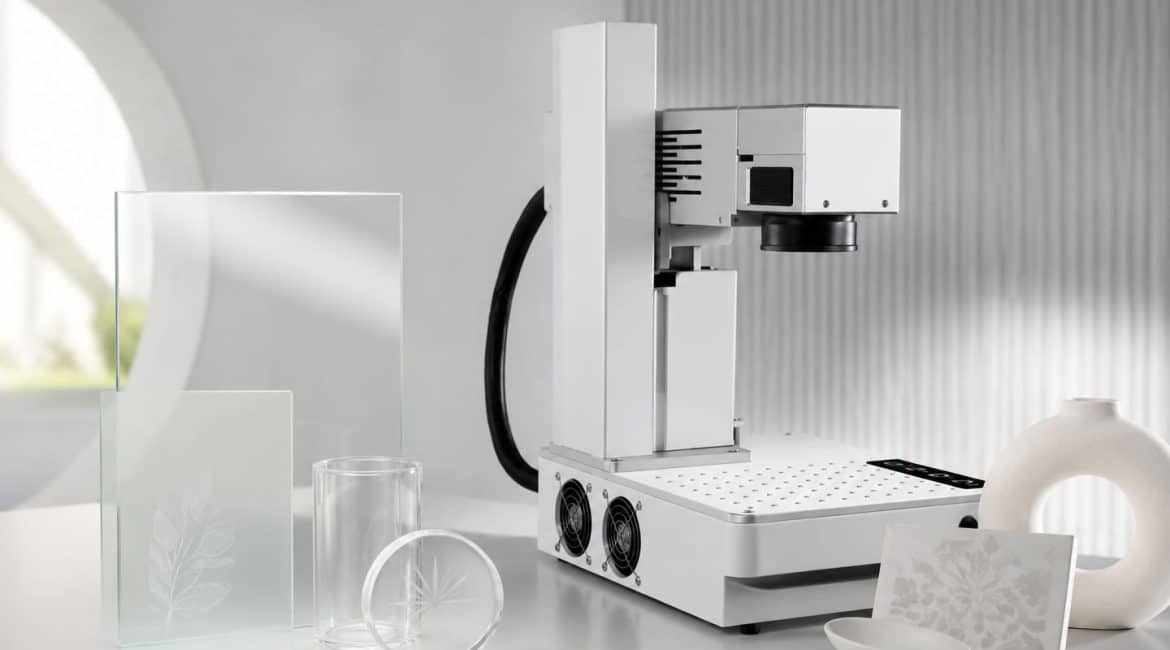
In modern manufacturing, brittle materials like glass, sapphire, and alumina ceramics are both highly valued and challenging. These materials offer exceptional hardness, wear resistance, and insulation. Consequently, they are essential for smartphone screens, semiconductor substrates, and high-end optical components. However, they are also notoriously delicate. Slight processing errors can cause edge chipping, invisible micro-cracks, or even sudden shattering.
Traditional methods, such as mechanical cutting or long-wavelength infrared (IR) laser processing, often struggle with these challenges. The advent of UV laser technology, however, provides a revolutionary solution. It allows for precise fabrication on these hard, fragile materials while effectively preventing cracking.
I. Brittle Materials’ Processing Dilemma: Thermal Stress and Micro-cracks
To understand the unique advantages of UV lasers, we must first grasp why glass and ceramics fracture easily during processing. Traditional IR lasers (e.g., 1064nm fiber lasers or 10.6μm CO2 lasers) process these materials by generating intense heat. This heat locally melts or vaporizes the material. Nevertheless, glass and ceramics possess very low thermal conductivity. Therefore, the laser-heated area expands sharply, while adjacent regions remain cool.
This extreme localized thermal expansion difference creates significant “thermal stress” within the material. Brittle materials cannot release this stress through plastic deformation. Ultimately, these stresses manifest as tiny, invisible micro-cracks along the processed edges. During subsequent use or under external force, these micro-cracks rapidly propagate like a domino effect. This eventually leads to the complete disintegration of the component.
II. The UV Laser’s Anti-Cracking Secret: “Photochemical Ablation” for “Cold Processing”
UV lasers effectively overcome brittle material processing challenges. Their core strength lies in their extremely short wavelength (typically 355nm) and the ultra-high photon energy they carry.
- Molecular Bond “Photo-Surgical Cutting”: IR lasers primarily process through “thermal melting.” In contrast, UV laser processing relies on “photochemical ablation.” The UV laser’s photons possess extremely high energy. This energy directly breaks the molecular chemical bonds within glass and ceramics. Consequently, the material is directly “ablated” or “vaporized” in the form of molecular or atomic fragments.
- Physically “Cold Processing”: The laser energy is almost entirely used to break chemical bonds. Very little energy converts into heat. Therefore, the heat-affected zone (HAZ) of the laser interaction area shrinks dramatically, often to micro- or even nano-scale. This fundamentally eliminates the generation and accumulation of thermal stress. Thus, UV laser technology achieves “cold processing” with virtually no thermal damage. Without severe thermal expansion, the processed edges naturally avoid forming crack-inducing micro-cracks.
III. Proven Techniques: UV Laser Process Optimization for Crack Prevention
Even with advanced UV laser equipment, achieving perfect cutting results is not automatic. In practical production, engineers must master two key adjustment techniques. These ensure maximum crack prevention:
1.Multi-pass Scanning: Layer-by-Layer Ablation, Preventing Heat Accumulation
Avoid attempting to cut through the material in a single pass. Injecting excessively high pulse energy at once will still lead to localized heat accumulation.
√ Correct Practice: Employ a high scanning speed combined with low single-pulse energy. The UV laser then “peels away” the material layer by layer through multiple, rapid scans (e.g., dozens or even hundreds of passes). This method provides short cooling buffers between each scan. Consequently, it effectively controls the material’s overall temperature, keeping it consistently low.
2.Precise Control of Power and Pulse Overlap Rate: Ensuring Uniform Energy, Preventing Local Overheating
During cornering or complex curve path processing, the laser head or galvanometer speed naturally slows down. If the UV laser power remains constant, the energy input at corners becomes excessive. This often causes localized heat bursts and chipping.
√ Correct Practice: Activate the UV laser system’s “power-on-the-fly” function. This means the laser power automatically adjusts with the scanning speed. It ensures the energy density injected into the material per unit distance remains constant. Simultaneously, precisely control the pulse overlap rate within the optimal range (typically 70%-80%). This not only guarantees a continuous and smooth cut surface but also effectively prevents heat overload from excessive pulse overlap.
The application of UV lasers in processing hard and brittle materials represents a physical revolution. It fundamentally replaces traditional thermal energy with high-energy photons. This technology allows inherently rigid and cold glass and ceramics to exhibit fine workability, similar to soft wood.
By precisely controlling the UV laser’s wavelength characteristics and mastering energy tuning, engineers can craft exquisite products. These items possess both outstanding mechanical strength and ultimate aesthetic beauty within the delicate micro-world.