
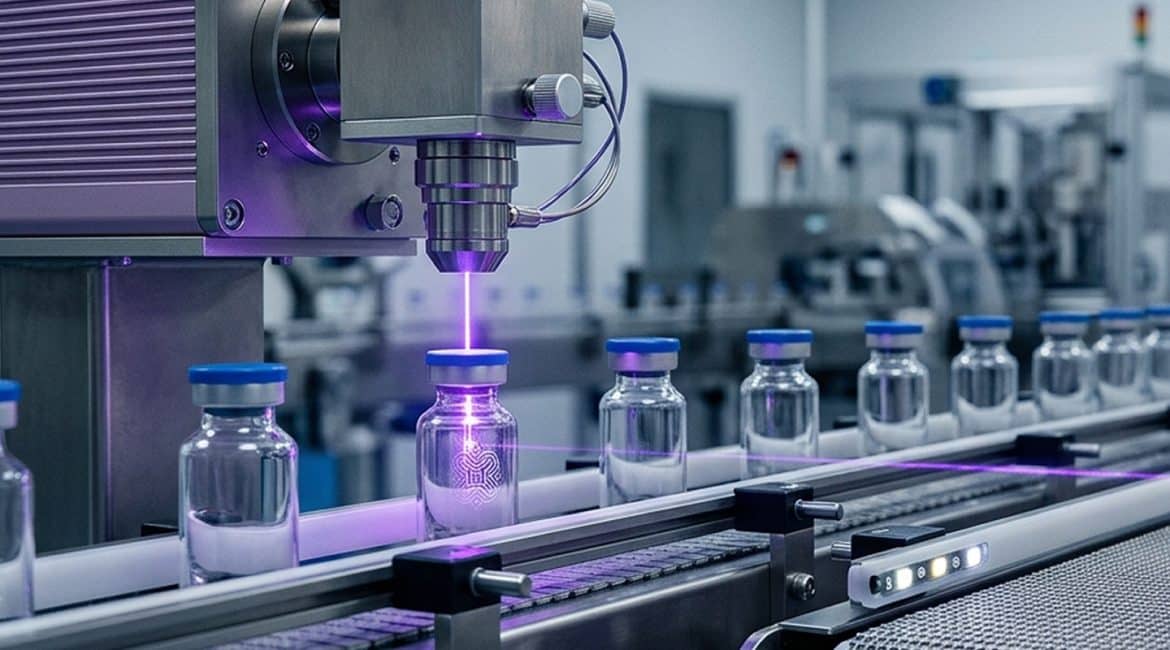
When you buy medicine or milk, do you notice the tiny batch numbers and QR codes on packaging? These serve as product “identity cards.” They track every movement from factory to consumer. Crucially, they carry vital traceability and safety information.
However, traditional ink jet printing has drawbacks. It is prone to erasure, alteration, and chemical contamination. To truly safeguard our food and medicine, UV laser marking technology is emerging. It provides a robust defense for anti-counterfeiting and traceability on food and drug packaging.
I. The Pitfalls of Traditional Ink Jet Printing: Why UV Laser Marking is Essential
Safety is non-negotiable in the food and pharmaceutical sectors. Traditional ink jet printing, used extensively in industry, reveals critical weaknesses:
- Easy Erasure and Alteration Risk: Unscrupulous entities can easily use organic solvents. They erase original production dates or batch numbers. Then, they reprint false information. This poses a significant threat to food and drug safety.
- Chemical Contamination Risk: Inks and solvents often contain volatile organic compounds (VOCs). Printing near drug packaging or food contact surfaces carries a risk. Microscopic chemical substances might permeate. This fails strict food and drug safety standards.
- Frequent Downtime and High Maintenance Costs: Print heads frequently clog. They require substantial ink and cleaning fluids. This increases production costs. Moreover, it frequently interrupts highly automated production lines, lowering efficiency.
II. The Core Strengths of UV Laser Marking: Ink-Free, Permanent, and Ultra-High Definition
UV laser marking (typically using a 355nm wavelength) effectively solves these issues. This success comes from its unique physical effects and high processing precision.
1.”Cold Processing” and Zero Contamination:
Unlike infrared lasers that burn materials with heat, UV laser photons carry high energy. They directly break molecular bonds on plastic, glass bottles, or composite films. This process is “photochemical ablation” or “cold processing.” It generates almost no heat. Consequently, the material surface avoids charring or yellowing. Furthermore, UV laser marking requires no inks, consumables, or chemical reagents. This guarantees zero chemical contamination at the source. It fully complies with stringent food and drug contact-grade safety standards.
2.Permanent Anti-Counterfeiting, “Engraved Deep”:
UV laser marking records information by directly altering the material’s surface microstructure. The resulting QR codes and text integrate with the packaging itself. The marks remain clear, even after alcohol wiping, severe scratching, or high-temperature sterilization. This ensures truly unalterable and permanent anti-counterfeiting.
Exceptional Clarity and Micro-Code Marking Capability:
The focused spot of a UV laser is incredibly small, usually only tens of micrometers. This enables UV laser marking to create ultra-high-density QR codes. These codes hold vast traceability information within a tiny space, just a few square millimeters. Even on small areas like a medicine bottle cap edge or an aluminum blister foil, scanning devices achieve 100% fast and accurate reading in seconds.
III. Seamless Integration into Modern Factories: An Efficient Production Line Tool
Beyond its superior marking results, UV laser marking machines excel in industrial integration. They are an ideal choice for modern factories.
- Seamless High-Speed Line Integration: Equipped with high-speed galvanometers and “marking-on-the-fly” technology, UV laser marking machines synchronize perfectly. They work with bottling or bagging lines running hundreds of items per minute. Marking completes without pauses, ensuring production efficiency.
- Low Maintenance and Automation Costs: There are no ink consumables. There are no clogged print heads. The equipment operates continuously and stably, 24/7. Integrating industrial vision inspection systems further enhances automation. These systems automatically verify QR code readability in real-time. They also automatically reject abnormal products, improving quality.
In an era of widespread concern for food and drug safety, every word and code on packaging reflects a company’s commitment to consumer trust. UV laser marking technology offers distinct advantages: ink-free, high-clarity, and indelible. It provides a robust, anti-counterfeiting and traceability shield for food and pharmaceutical products.
While the initial purchase cost of UV laser marking equipment might exceed traditional ink jet printers, consider the long-term benefits. These include zero consumable costs, minimal downtime, and the brand value from enhanced anti-counterfeiting and consumer trust. This makes it a wise, far-sighted investment.