
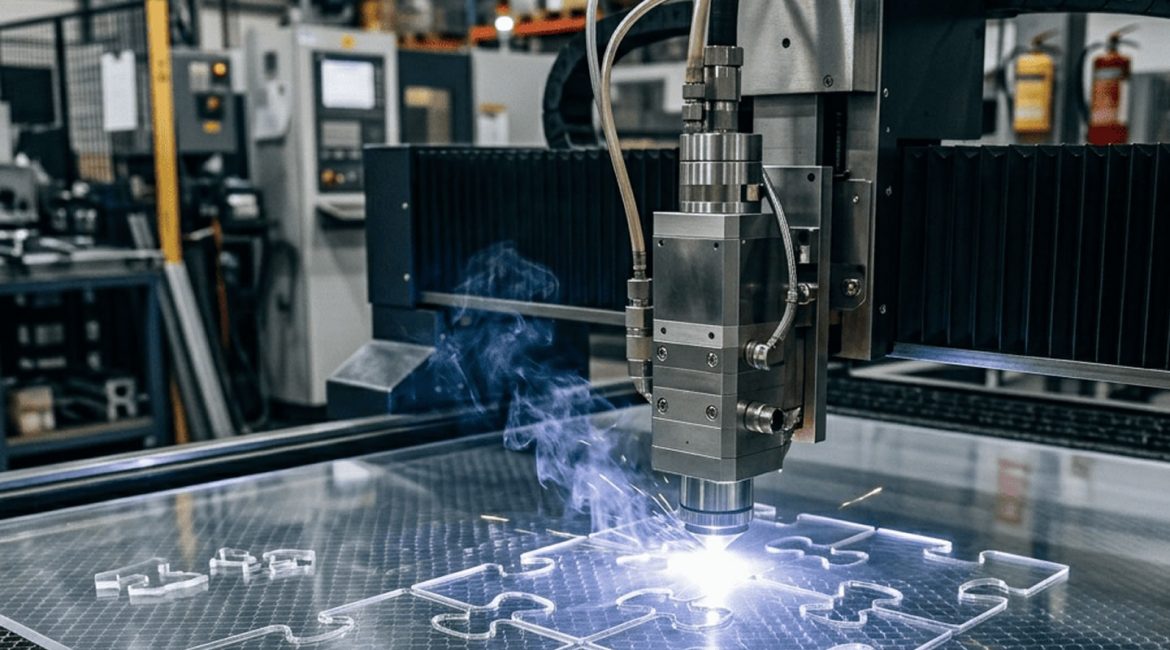
On modern smart manufacturing lines, speed means money. Precision is the lifeline. Indeed, traditional DC (Direct Current) glass tube lasers often struggle. They cannot handle marking dozens of products per second. Furthermore, they also fall short for high-speed cutting of micron-level electronic films. Therefore, industry invariably focuses on RF (Radio Frequency) excited lasers, or RF lasers. Why are High-speed CO2 RF lasers the absolute first choice for high-precision processing? Essentially, this is due to their two inherent core physical advantages. They offer extreme response speed. Moreover, they provide nearly perfect beam quality.
I. Core Advantage One: Ultra-Fast Response with “Neural Reflexes”
Traditional glass tube lasers rely on tens of thousands of volts of DC high voltage. This ionizes the gas. The process resembles lighting an old fluorescent tube. A millisecond (ms) physical delay occurs. This delay happens from switch activation to full gas ionization and laser emission. For low-speed processing, this poses no issue. However, in ultra-high-speed processing, such a delay becomes catastrophic. High-speed CO2 RF lasers revolutionize this driving method. They use high-frequency electromagnetic waves (radio frequency) to excite the gas. Their internal switching response speed reaches microsecond (μs) or even nanosecond (ns) levels. The modulation frequency is extremely high. Consequently, these High-speed CO2 RF lasers can switch on and off thousands of times per second. Imagine a traditional glass tube as a clumsy ordinary light bulb. In contrast, a High-speed CO2 RF laser acts like an LED pixel on a screen. It perfectly “flashes” light and dark at incredibly high frequencies. This instant response capability forms the indispensable electrical foundation for high-speed processing.
II. Core Advantage Two: A “Gaussian Fundamental Mode” Like a Surgical Scalpel
Response speed addresses the “fast” aspect. Beam quality, conversely, tackles the “precise” requirement. In the laser industry, the beam quality factor M² measures beam excellence. A value closer to 1 signifies a more perfect beam. High-speed CO2 RF lasers typically employ a precise slab resonator design. This design ensures their output beam closely approximates the ideal TEM₀₀ fundamental mode (Gaussian mode). A Gaussian mode beam offers distinct characteristics: The spot is extremely round and fine. Energy concentrates intensely at the central micro-point. It smoothly diminishes outwards. Furthermore, it boasts ultra-high power density. The focused spot shrinks to micron levels. Thus, even with modest total power, the energy at the focal point instantly vaporizes material. This achieves efficient processing. This laser beam truly represents the “perfect surgical scalpel” desired in industrial manufacturing. Ultimately, this precision is a hallmark of High-speed CO2 RF lasers.
III. Powerful Combination: Achieving Excellence in Real-World Applications
The perfect combination of “speed” and “precision” in High-speed CO2 RF lasers transforms production lines. It delivers a significant leap in efficiency and product quality.
1.High-Speed Galvo Marking and Marking on the Fly
On production lines for food, pharmaceuticals, or electronic components, products move rapidly on conveyors. The laser must engrave complex production dates or QR codes. It must do this within a mere fraction of a second. Traditional lasers exhibit slow response and coarse spots. Consequently, engraved strokes show blurry edges, trailing, or even breaks. However, High-speed CO2 RF lasers work with high-speed galvo systems. They offer “instant response” and a fine spot. Thus, even with products moving rapidly (marking on the fly), they engrave crisp, high-contrast micro anti-counterfeit codes. The results are consistently clean and precise.
2.Fly Cutting and Thin Film Processing
Cutting Flexible Printed Circuits (FPC) or composite thin films using traditional methods often causes problems. Excessive heat accumulation leads to melted, yellowed, or warped material edges. High-speed CO2 RF lasers can modulate at extremely high frequencies. They break continuous laser light into countless tiny “energy pulses.” During high-speed fly cutting, each pulse completes vaporization and removal. This happens before the material conducts heat to surrounding areas. This “cold processing” characteristic ensures smooth, flat material edges at very high cutting speeds. The Heat Affected Zone (HAZ) remains virtually zero. This capability underscores the value of High-speed CO2 RF lasers in delicate material processing.
Expert Commentary
Speed and precision are never isolated qualities. High-speed CO2 RF lasers become the “uncrowned kings” of industrial high-precision processing for a fundamental reason. They solve temporal energy response delays using high-frequency RF technology. Moreover, they also overcome spatial focusing limits with a slab resonator design. Therefore, for modern factories seeking ultimate efficiency and quality, adopting this High-speed CO2 RF laser technology means holding the key to future manufacturing.