
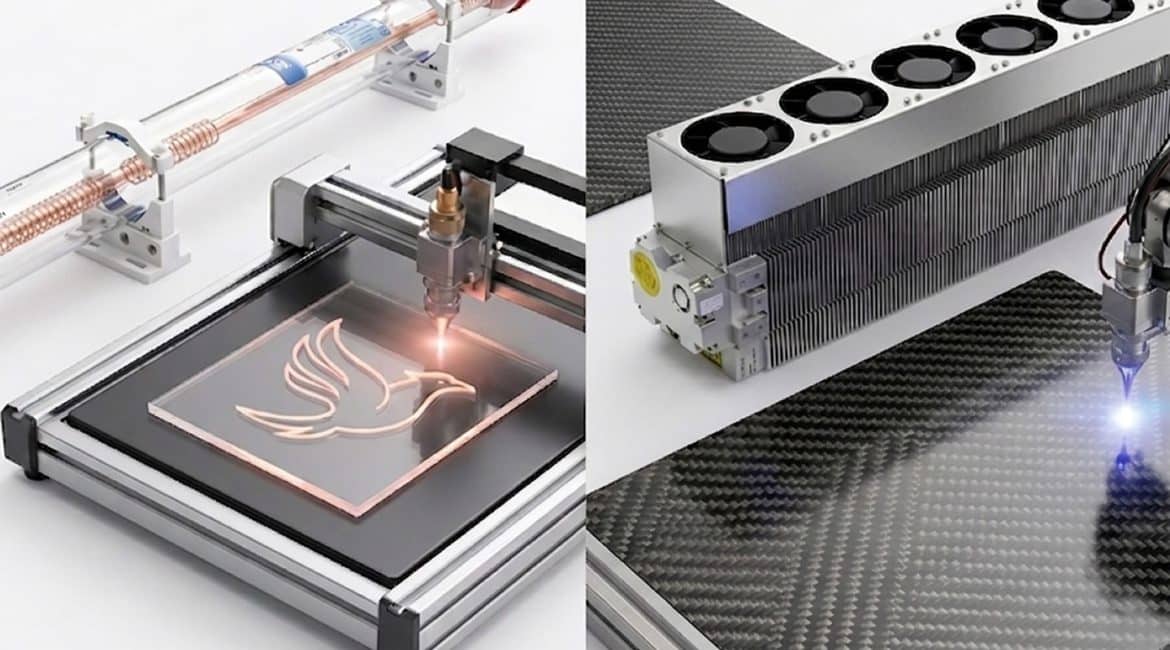
In the realm of laser processing, “Yongli” serves as a benchmark for reliability. A vast number of seasoned professionals launched their operations using Yongli’s dependable DC glass tubes. However, processing demands have fundamentally evolved. The industry is rapidly shifting from basic cutting operations toward intricate engraving and high-throughput production—a transition that has led many to evaluate Yongli’s RF metal tube portfolio.
If you find yourself caught between choosing classic glass tube technology and the advanced capabilities of RF metal variants, this guide offers a tailored framework for your next investment decision.
A frequent question arises: “I only cut wood; can the price premium of an RF tube truly be justified?” While the upfront acquisition cost of an RF system is significantly higher, evaluating these options through the lens of output quality and manufacturing efficiency reveals a fundamental truth: they are entirely different classes of production machinery.
I. Core Distinctions: Distinct Technological DNA
To make a strategic investment, it is essential to comprehend the foundational physical differences that separate Yongli DC glass tubes from RF metal configurations.
- Beam Quality: The Metric of Precision
While Yongli’s DC glass tubes deliver industry-leading beam quality within their category, the inherent physics of direct current excitation imposes a ceiling on the purity of their fundamental mode. In contrast, RF metal tubes utilize a specialized slab structure designed to yield an exceptionally pure TEM00 fundamental mode. This architecture guarantees an intensely concentrated central spot energy with a sharp, clean drop-off at the perimeter.
Operational Impact: Engraving micro-text with a glass tube can occasionally produce slightly softened or bleeding edges. Conversely, RF tubes render intricate typography with crisp definition and an almost negligible heat-affected zone (HAZ).
- Response Speed: The Performance Ceiling
This represents the most critical divergence between the two architectures. Glass tubes experience a millisecond-level propagation delay during plasma ignition and extinction, behaving much like a traditional incandescent lighting fixture. RF metal tubes, however, operate at remarkably high modulation frequencies, executing precise on/off switching cycles within microseconds.
Operational Impact: Executing intricate bitmap engravings or high-speed marking with a glass tube often induces thermal accumulation, leading to overburning or ghosting at directional changes. RF tubes mitigate this through exact pulse modulation, ensuring every pulse is deposited precisely on target and eliminating edge distortion entirely.
- Capital Expenditure: The Barrier to Entry
Glass tubes remain unparalleled in terms of cost-to-performance efficiency, serving as the industry workhorse for entry-level operations and high-volume, coarse processing. On the flip side, RF metal tubes require a larger initial investment. This premium is driven by the ultra-precise engineering required for their metal resonant cavities and the inclusion of sophisticated radio-frequency power matching networks.
II. Strategic Indicators: When is it Time to Upgrade?
A technology migration should never be pursued arbitrarily; it must be dictated by operational bottlenecks and specific production requirements. Consider transitioning to an RF metal tube when your business encounters the following scenarios:
- The Demand for High-Fidelity Detailing: If your current glass tube struggles with spot-size blurring when executing micro-text, high-density QR codes, or complex grayscale imagery—or if edge charring compromises quality—the micro-spot and rapid gating of an RF tube offer the ideal solution.
- Maximizing High-Speed Motion Platforms: If you are deploying ultra-fast galvo-scanner systems and find that the sluggish response of a glass tube is throttling your hardware’s true capabilities, upgrading to an RF architecture is essential to unlock an order-of-magnitude leap in throughput.
- A Requirement for Industrial-Grade Duty Cycles: For production lines operating on continuous 24/7 schedules where beam profile drifts caused by chiller temperature fluctuations cannot be tolerated, the thermal stability of an RF tube eliminates costly parameter tuning and downtime.
- Processing Sensitive or Advanced Materials: When working with thin technical films, specialized coatings, or highly fragile substrates, the “cold processing” capability of an RF tube—enabled by minimal thermal dwell time—drastically suppresses scrap rates.
III. The Synergistic Architecture of Yongli’s Portfolio
As an industry pioneer, Yongli has mastered both glass-envelope manufacturing and RF laser engineering, providing clients with a scalable operational trajectory.
If your commercial volume centers on bulk, large-format cutting, Yongli’s high-power glass tubes remain a highly profitable foundation for your cash flow. However, as your enterprise diversifies into premium custom merchandise, medical components, or electronics processing, integrating Yongli’s RF metal series allows you to leverage consistent brand support while smoothly pivoting from high-volume processing to high-margin precision manufacturing.
Industry Insight
Upgrading your equipment is not merely an expense; it is an acquisition of process control via advanced engineering.
- Glass tubes excel at volume output, generating profitability through operational scale.
- RF metal tubes deliver speed and extreme accuracy, capturing high-value margins.