
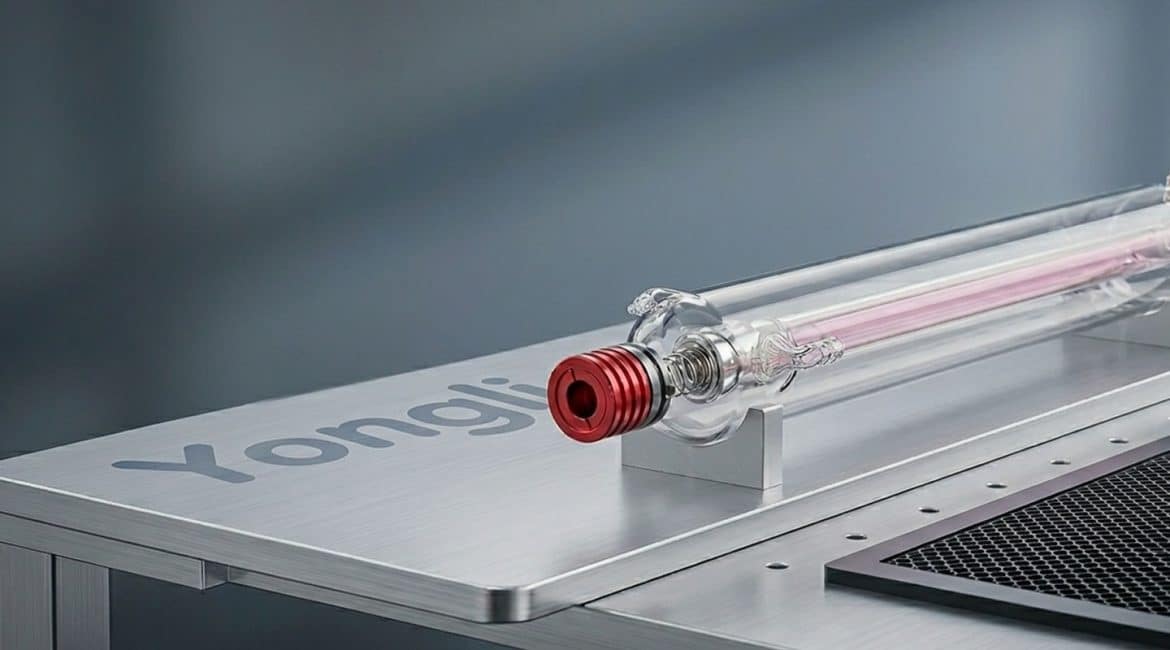
In the lifecycle of a CO2 laser tube, two “invisible killers” persistently threaten operational longevity. The first is gas degradation, where the internal gas mixture experiences a shift in its optimal molecular ratio. The second is electrode sputtering, a process where dislodged metal atoms contaminate the tube’s internal vacuum environment. By pioneering advancements in both gas chemistry and electrode engineering, Yongli has systematically dismantled the industry stereotype that traditional glass-envelope CO2 lasers are inherently short-lived, delivering instead a portfolio characterized by exceptional service life and industrial-grade reliability.
I. The Optimal Catalyst: The Physics of Gas Mixture OptimizationThe operation of a CO2 laser relies on a sequence of complex molecular collisions within a resonant cavity. The discharge environment is governed by three primary gases—carbon dioxide (CO2), nitrogen(N2), and helium (He)— each fulfilling a distinct thermodynamic and quantum-mechanical role:
- CO2 (The Active Medium): Drives the vibrational-rotational energy level transitions required to emit infrared light at a wavelength of 10.6μm. It is the foundational molecule for beam generation.
- N2 (The Energy Transfer Agent): Absorbs electron kinetic energy from the electrical discharge and efficiently transfers it via resonant energy transfer to the CO2 molecules, pumping them to the upper laser level.
- He (The Thermal Stabilizer): Functions as a critical cooling agent. Possessing exceptionally high thermal conductivity, helium rapidly depresses the kinetic temperature of the gas mix by conducting heat away from molecular collisions to the cooled tube walls, preventing thermal bottlenecking that would otherwise de-excite the upper laser levels and kill efficiency.
Yongli’s competitive edge lies in the precise volumetric control of these components, augmented by the introduction of proprietary trace catalyst gases. This tailored chemistry facilitates an autonomous self-repair cycle. During prolonged discharge periods, CO2 molecules naturally dissociate into carbon monoxide (CO) and oxygen (O2), which typically leads to an irreversible decline in laser power. Yongli’s catalytic formulation actively promotes the continuous re-association of these byproducts back into CO2. Acting as an internal, continuous molecular recycling plant, this mechanism maintains a stable gas equilibrium and consistent power output across thousands of operating hours.
II. Advanced Electrode Engineering: Mitigating Degradation from Sputtering
As the entry point for electrical discharge into the gas medium, electrodes represent a highly vulnerable component within a gas laser system. In conventional designs, these elements suffer from cathode sputtering—a phenomenon where continuous, high-energy ion bombardment dislodges metal atoms from the electrode matrix. These atoms deposit onto the glass envelope, clouding the optics, absorbing laser energy, and destabilizing the discharge geometry.
Yongli deploys a multi-layered engineering defense to neutralize sputtering at the manufacturing level:
- Refractory Alloy Formulation
By moving away from standard ferrous or basic steel elements, Yongli utilizes specialized refractory alloys characterized by ultra-high melting points and superior resistance to ion impact. This material foundation drastically minimizes the initial detachment rate of metal atoms under intense plasma conditions.
- Molecular Surface Passivation
A highly uniform, molecular-level passivation layer is chemically bonded to the electrode surface. This coating serves as a protective barrier during cold cathode discharge, enabling efficient electron emission while restricting the kinetic transfer that drives atomic erosion.
- Fluid Dynamics Cavity Design
Using advanced fluid dynamics and electromagnetic simulation software, Yongli optimizes the physical geometry of its electrodes. This architecture ensures an incredibly even current density distribution across the entire surface area, completely eliminating localized current crowding and arc pitting caused by thermal overloading.
Thanks to these combined mitigations, the inner glass walls of the laser tube remain clear over extended lifecycles, ensuring near-zero transmission loss and preserving a stable beam quality (M2 factor) throughout the component’s operational life.
III. Industrial Stability and the Warranty Advantage
The intense engineering focus directed at gas formulations and metallurgy serves a singular industrial objective: long-term power stability.
In high-throughput manufacturing, a sudden, catastrophic laser failure is often less disruptive than a slow, unmonitored power decay. Gradual attenuation can lead to out-of-tolerance parts, compromised cut geometries, and unnoticed scrap production. By mastering these core chemical and physical variables, Yongli keeps power drift within an exceptionally tight tolerance margin. It is this predictable aging curve that allows Yongli to back its products with extended factory warranties that frequently lead the market.
For the end-user, this translates into direct financial advantages: reduced operational overhead, minimal unscheduled downtime, and the assurance of predictable processing parameters from the moment the system is powered on.
Expert Commentary
Yongli’s market reputation for high reliability stems from a willingness to solve fundamental engineering challenges rather than just assembling components. They have directly addressed the nuances of chemical equilibrium in plasma physics and material fatigue under ultra-high vacuum conditions. For automated, 24/7 manufacturing setups where processing precision dictates margin, investing in a laser brand that prioritizes core underlying material science is a decisive factor in securing long-term operational profitability.