
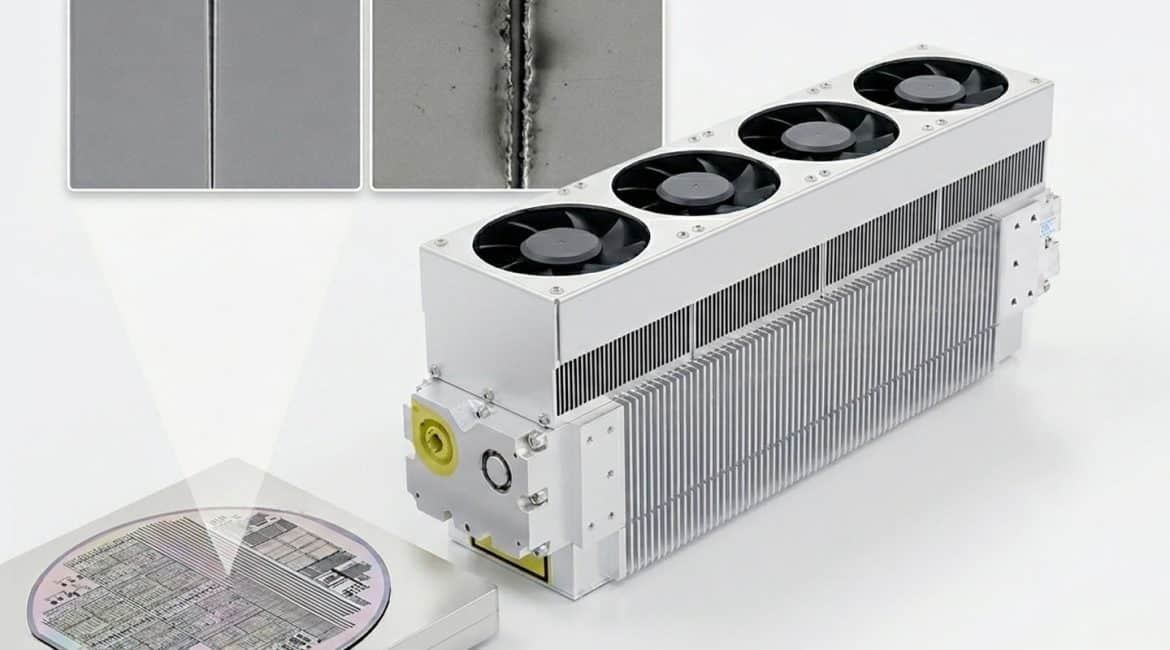
At the core of every Radio Frequency (RF) gas laser lies a critical architectural component that dictates its operational profile: the optical resonator. If the active medium provides the raw energy, the resonator functions as the precision guidance system, establishing the beam’s geometric boundaries, spatial coherence, and power scaling limits. For RF slab configurations, resonator design is paramount—determining whether the system emits a near-perfect Gaussian profile or a highly divergent, high-power flux.
I. Architectural Classifications: The Physics of the Resonant Cavity
The planar geometry of RF slab lasers—defined by two parallel, water-cooled metal electrode plates separated by a narrow discharge gap—departs fundamentally from conventional cylindrical designs. This unique physical envelope allows optical engineers to exploit two distinct cavity topologies, each tailored to specific industrial outcomes.
1.Stable Resonators: The Foundation for Spatial Purity
The majority of industrial micro-machining RF lasers utilize a stable cavity configuration, typically consisting of a flat rear mirror and a curved, partially transmissive output coupler. Within this geometry, the oscillating wavefronts undergo periodic refocusing, remaining completely confined within the geometric boundaries of the optical axis.
- Engineering Attributes: These cavities exhibit high alignment tolerance and robust resistance to mechanical vibration and localized thermal fluctuations.
- Modal Behavior: They inherently favor the propagation of the fundamental transverse mode (TEM00), yielding an exceptionally clean spatial profile and a highly predictable far-field intensity distribution.
- Application Focus: When long-term process consistency and micro-spot profiles are required, the stable resonator is the industry standard. It is the optimal engine for high-density vector engraving, sapphire scribing, and thin-film micro-patterning.
2.Unstable Resonators: Maximizing Volume Extraction
For applications where raw multi-kilowatt output takes precedence over a narrow diffraction limit, unstable resonators—specifically confocal unstable designs—are deployed. Utilizing a combination of mismatched divergent optics (such as a concave and a convex mirror arrangement), this architecture forces the beam to expand transversely during each round trip until it overflows past the edge of the smaller mirror, exiting the cavity as a collimated ring.
- Engineering Attributes: Unstable resonators feature a significantly larger mode volume. This enables the optical field to interact with a vast cross-section of the excited gas medium within the slab, extracting high optical power that far exceeds the limits of stable configurations.
- Far-Field Performance: Although the near-field output displays an annular (donut-shaped) profile with a central obscuration, sophisticated external beam-conditioning optics can focus this profile in the far field to achieve massive energy density.
- Application Focus: This topology trades away absolute modal purity in exchange for single-source wattage. It serves as the primary power plant for heavy industrial plate cutting, high-speed automated cladding, and thick-gauge steel welding.
II. Parameter Dynamics: Wavefronts, Divergence, and Focal Flux
The choice of resonator geometry creates a cascading effect across all critical beam parameters, directly influencing how the laser interacts with a target substrate:
- Beam Mode: Stable resonators ensure a pure fundamental mode. This means energy concentrates intensely at the spot’s center. In contrast, unstable resonators, at high power, often generate higher-order modes. This leads to a larger spot size and more diffuse energy distribution.
- Divergence: This critical parameter gauges an RF laser’s beam quality and usability. Smaller divergence means the laser beam maintains a smaller spot size over long transmission distances. Stable resonators control divergence to a minimum. They use apertures or special cavity designs. However, unstable resonators, due to their unique output mechanism, often require additional collimating mirror systems. These correct their larger initial divergence.
- Far-Field Distribution: This is the most crucial performance indicator for users. In cutting applications, we prioritize energy density near the focal point. A stable resonator provides “sharp” energy distribution at the focus. This suits fine cuts. Conversely, an unstable resonator offers “robust” energy at the focus. It is better for rapid material ablation.
III. Strategic Selection: Aligning Resonator Mechanics with Process Requirements
In industrial system integration, selecting an RF laser source involves balancing power extraction against beam quality:
- Deploy a Stable Resonator when the process demands strict adherence to sub-millimeter geometric tolerances. The highly stable waveguide modes ensure clean, burr-free cuts when processing technical ceramics, flexible circuits, and advanced polymers.
- Deploy an Unstable Resonator when the business objective centers on high-speed throughput and deep material penetration. The expanded mode volume unlocks the full thermal potential of the gain medium, providing the high-energy flux necessary to vaporize or melt thick industrial substrates rapidly.
Ultimately, there is no universally superior resonator design; there is only the mathematically correct configuration for a specific processing challenge. For systems integrators, evaluating these underlying optical trade-offs is essential to ensuring long-term operational stability and maximum return on investment for the end-user.