
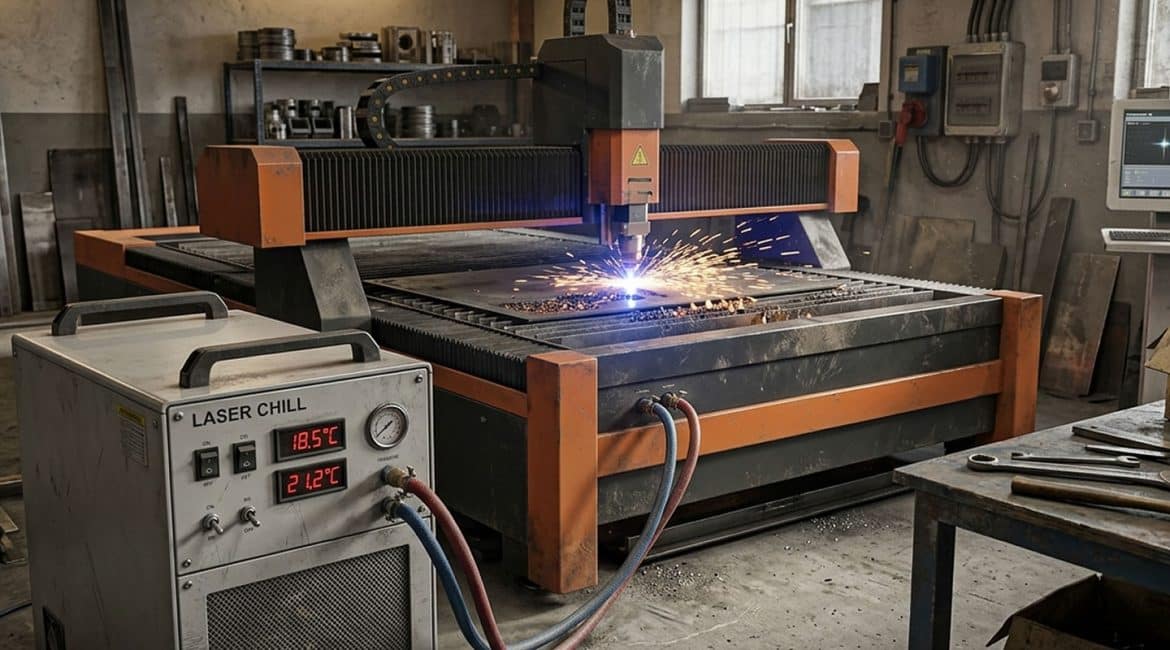
Carbon dioxide (CO2) lasers operate with a high thermal overhead; typically, less than 15% of the input electrical energy is converted into optical output, while the remaining 85% is dissipated as waste heat. If this thermal load is not evacuated immediately, the internal kinetic energy of the gas medium escalates, destabilizing molecular transitions and causing an immediate drop in output power. Left unchecked, excessive thermal accumulation can induce catastrophic structural failure, including the melting of delicate internal optical elements. Consequently, a dedicated closed-loop refrigeration unit is an indispensable component of any industrial laser architecture.
I. The Core Directive: Transitioning from Basic Cooling to Thermal Stabilitation
A common misconception is that a chiller functions merely as a passive water pump. In high-tolerance manufacturing, its true engineering value lies in its dynamic thermal stability. Utilizing a closed-loop compressor and active refrigerant circuit, these systems do not simply cool; they lock the process water within a precise, micro-monitored window. For advanced Radio Frequency (RF) metal slab lasers, maintaining a temperature tolerance of ±0.1℃ is a critical operational threshold for two primary reasons:
- Power Output Consistency: The gain efficiency of a gas laser is deeply sensitive to temperature fluctuations, which alter the refractive index of the gas mixture. Any thermal drift introduces output power instability, resulting in uneven engraving depths or incomplete cuts across the workpiece.
- Beam Profile Preservation: The internal optical resonant cavity expands and contracts in response to ambient thermal loading. Without precise temperature regulation, this subtle mechanical warping causes a drift in the beam quality factor (M2). A tightly focused, high-energy spot can quickly become structurally diffused or “bloated,” widening the kerf and degrading edge definition.
II. The Physics of ±0.1℃: Mitigating the Thermal Lensing Effect
In precision laser processing, minor thermal gradients trigger immediate optical distortions. Rapid fluctuations in the cooling fluid induce a phenomenon known as “thermal lensing” within the laser optics. The transmissive optics effectively mimic a dynamic lens with a constantly shifting focal length, scattering light and causing the beam’s focal point to drift continuously along the z-axis during operation.
To achieve a ±0.1℃ stability threshold, premium chilling units deploy proportional-integral-derivative (PID) intelligent control algorithms. These systems continuously sample the return fluid temperature, utilizing variable frequency inverter technology to adjust the compressor and pump loads in real time. This micro-adjustment locks the coolant loop to its exact setpoint, ensuring the laser medium operates within its optimal quantum efficiency window.
III. Procurement Blueprint: Engineering-Driven Selection Strategies
Matching a thermal management system to an industrial laser requires rigorous calculation rather than basic wattage approximation:
- Calculated Cooling Capacity: The unit’s nominal cooling capacity must fully absorb the laser’s maximum thermal output under peak duty cycles. A safety margin of 20% to 30% should be factored into the calculation to account for high summer ambient temperatures and to prevent the compressor from cycling continuously at full capacity.
- Hydraulic Flow Rate and Head Pressure: Coolant velocity must be carefully regulated. Excessive flow velocity induces cavitation, which erodes internal cooling channels and introduces mechanical vibrations that compromise beam stability. Conversely, inadequate flow rates fail to evacuate heat efficiently, creating localized hot spots. System integrators must strictly adhere to the manufacturer’s specified flow (L/min) and pressure (MPa) configurations.
- Environmental and Atmospheric Adaptation: Facilities located in high-temperature or tropical regions require units engineered with extended ambient operating ranges. Furthermore, in high-dust industrial environments, condenser fins must be kept free of debris; particulate accumulation rapidly degrades heat exchange efficiency, stressing the refrigeration circuit.
- Dielectric and Fluid Medium Integrity: Industrial gas lasers demand high-purity distilled or deionized water. Standard tap water contains dissolved minerals that precipitate out under thermal stress, forming scale deposits inside the laser’s cooling jacket that can completely choke the fluid channels. In cold climates, a precisely metered glycol-to-water ratio must be maintained according to manufacturer specifications to prevent localized freezing inside the heat exchanger.
IV. Operational Protocols: Critical Maintenance Workflow
As the primary life-support system for high-value optical assets, a chilling unit requires a structured preventative maintenance schedule to ensure continuous operation:
- Fluid Renewal Cycle: Flush and replace the cooling medium every 1 to 3 months to prevent bio-fouling, particulate accumulation, and changes in fluid conductivity.
- Condenser Airflow Optimization: Clean the air intake filters and blow out dust from the condenser coils at least once a month. Unimpeded airflow reduces electrical power consumption and extends the operational lifespan of the compressor.
- Interlock and Alarm Validation: Never bypass or jump water flow switches or over-temperature alarms for operational convenience. These safety circuits serve as the laser’s primary defense against catastrophic thermal shock; an unmitigated loss of flow can destroy a high-performance laser tube within seconds.
Industrial Insight
In automated manufacturing, a laser system is only as reliable as its thermal foundation. Investing in an advanced refrigeration unit with micro-degree PID control is a prerequisite for high-yield precision work. Resolving thermal instability at the source eliminates the hidden costs of beam drift, parameter re-tuning, and unexpected component degradation, securing the long-term economic viability of the production line.