
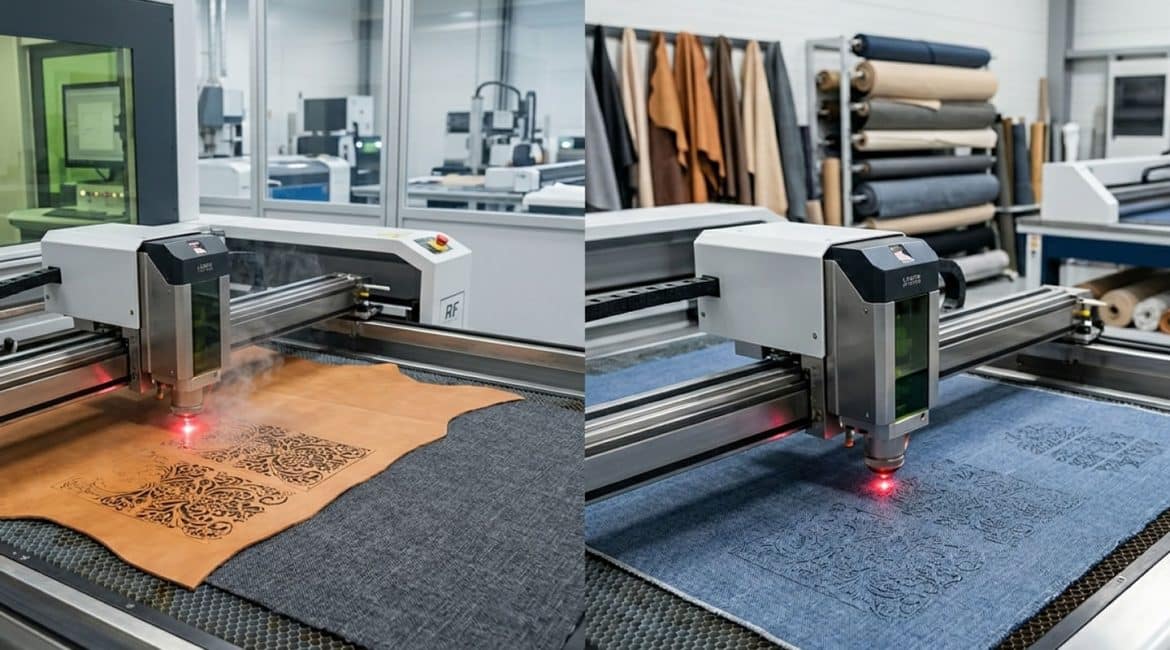
Textiles, synthetic webs, and natural leathers share a defining characteristic: they are highly compliant, temperature-sensitive substrates. Conventional mechanical converting methods—such as die-stamping or automated oscillating knife cutting—exert significant localized stress on material boundaries. This mechanical loading causes irreversible physical deformation, edge fraying, and dimensional inaccuracy, directly compromising the aesthetic and functional yield of the final component.
To circumvent these structural defects, manufacturers are increasingly integrating Radio Frequency (RF) gas laser technology—a non-contact, thermally controlled processing alternative designed specifically for delicate and high-value flexible materials.
I. The Non-Contact Paradigm: Mitigating Mechanical Stress
At its physical foundation, RF laser processing eliminates mechanical tooling contact entirely. High-performance optics focus the output beam into a micron-scale spot, concentrating energy to instantly vaporize the target substrate along a precise toolpath.
Because no physical force is transferred to the material, pliable knits, delicate silks, and dense, top-grain leathers remain completely free from structural stretching, twisting, or localized tearing. This absolute preservation of material geometry is essential for intricate pattern matching and part-to-part consistency in premium garment manufacturing and automotive upholstery upholstery layout.
II. Core Technical Advantages of RF Excitation in Flexible Converting
The distinct advantages of RF slab lasers over traditional Direct Current (DC) glass tubes stem from their unique radio-frequency plasma excitation system, which unlocks rapid gating capabilities and high modulation frequencies.
- Advanced Thermal Mitigation (Anti-Scorching)
Organic and synthetic fibers are highly vulnerable to thermal degradation, which manifests as charred edges, yellowing, and persistent odors. RF lasers address this via exceptionally narrow pulse widths combined with rapid gating speeds. This “rapid penetration, instant exit” sequence restricts thermal diffusion into the surrounding bulk material, narrowing the heat-affected zone (HAZ) and delivering clean, burr-free cuts with virtually no carbonization or discoloration.
- High-Frequency Microsecond Response for Intricate Geometry
Executing high-speed filigree, openwork engraving, or complex vector text on non-wovens requires instantaneous beam modulation during rapid galvanometer scanning. The microsecond-level switching response of an RF cavity ensures that the laser pulse is delivered exactly at the designated spatial coordinates. This eliminates the plasma ignition delays and power trailing common in glass tubes, preventing overburning at tight corners and geometric overlaps.
- High-Aspect-Ratio Micro-Perforation
Functional apparel and technical textiles frequently require high-density micro-perforation arrays to optimize breathability or acoustic absorption. Benefiting from a near-perfect beam quality factor, RF lasers can project ultra-fine focal points. When coupled with high-frequency pulsing, the system easily machines thousands of highly uniform, microscopic ventilation ports per second with smooth, sealed perimeters.
III. Industrial Case Studies: From Circular Fashion to Technical Mediums
In commercial production environments, the agility of RF laser processing has transformed manufacturing workflows across several key sectors:
- Sustainable Denim Finish Matching: RF lasers act as a clean, dry processing tool, precisely ablating the indigo surface layer of denim fabrics to generate complex grayscale “wash” effects, distressing, and localized micro-textures. This entirely replaces traditional chemical bleaching, potassium permanganate spraying, and stone-washing procedures, drastically reducing water toxicity and accelerating throughput.
- High-Volume Luxury Goods Converting: For intricate openwork on leather footwear uppers, wallets, and luxury bags, the laser executes cutting and detailing in a single automated step. This digital workflow eliminates the costly tooling overhead and lengthy lead times associated with mechanical dies, allowing designers to transition from digital CAD files to finished products within minutes.
- Edge Stabilization in Technical Non-Wovens: In the medical and industrial filtration sectors, the structural integrity of synthetic filter webs is paramount. RF laser cutting not only separates the material with extreme precision but also uses localized thermal energy to lightly fuse the severed fiber tips. This continuous micro-seal prevents edge fraying and fiber shedding during high-pressure fluid operation, extending the operational life of the filtration medium.
Strategic Insight
For modern textile and leather converters, adopting RF laser technology represents a profound shift in product value tiering rather than a simple hardware replacement. By mastering microsecond pulse dynamics, operators can effortlessly process complex geometries on technical substrates that were previously considered unmachinable.
While the initial capital expenditure for an RF-driven platform exceeds that of basic glass-tube systems, the return on investment is driven by tangible metrics: near-zero scrap rates, continuous tool maintenance-free operation, and the high margins demanded by the custom and luxury manufacturing markets.