
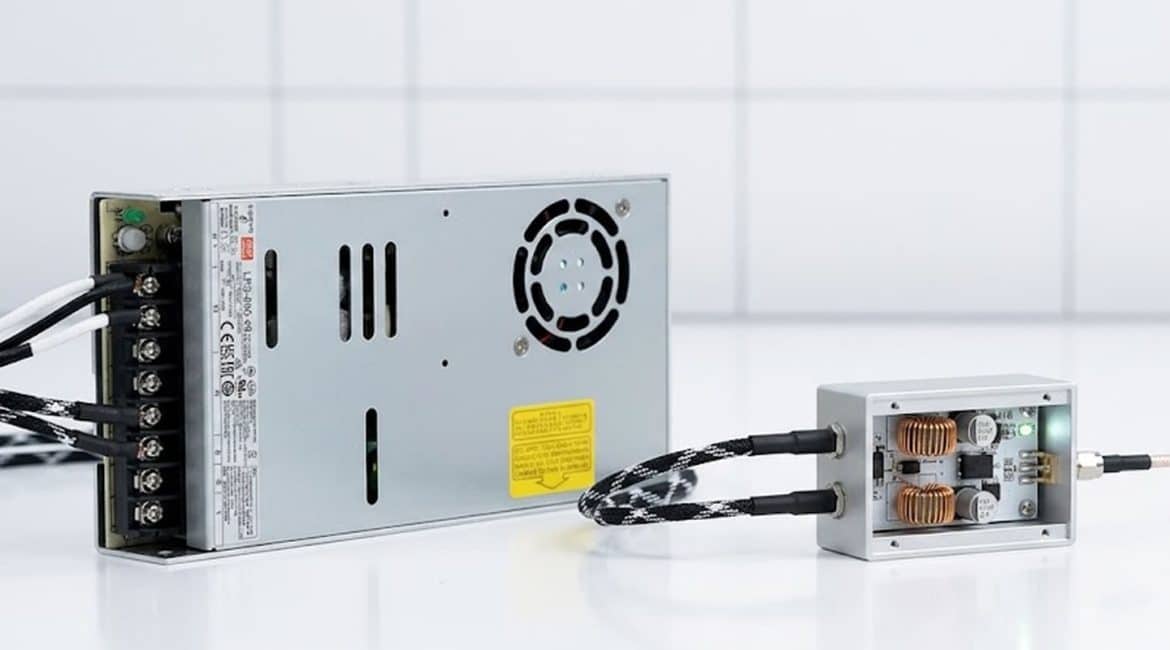
In industrial precision processing, RF (Radio Frequency) lasers are renowned for their ultra-fast response and exceptional beam quality. How do they achieve microsecond-level switching? Furthermore, how do they precisely inject energy into invisible gas molecules? The perfect synergy of the RF laser power supply and the impedance matching network makes this possible.
I. The RF Power Supply: A Magician of High-Frequency Energy
Traditional glass tube lasers use DC (Direct Current) high voltage. Like lightning, they roughly break down gas with tens of thousands of volts. RF lasers operate differently. They use high-frequency alternating electromagnetic waves. These are typically around 40 MHz or 81 MHz. This frequency range is similar to radio broadcast bands. The core task of the RF laser power supply is converting standard AC utility power into a high-power, high-frequency RF signal.
- How is the Gas Excited? The RF signal acts on the mixed gas inside the metal cavity via electrodes. Under the alternating, extremely high-frequency electromagnetic field, gas molecule electrons oscillate and collide violently. This high-frequency interaction rapidly ionizes the gas. It then enters a “plasma” state. Consequently, it releases stable laser light.
- Source of Microsecond Response: Electromagnetic field oscillation excites the gas. Direct electrode discharge is not used. Therefore, the RF laser power supply precisely adjusts control signals. This enables microsecond (μs) energy switching. This capability is crucial for RF lasers. It allows them to excel in high-speed marking and on-the-fly cutting applications.
II. The Impedance Matching Network: The Gold Standard for Energy Transfer
Even with a powerful RF laser power supply, success is only halfway achieved. RF energy has a peculiar physical characteristic. It is extremely sensitive to the “impedance” of its transmission path.
Imagine the RF laser power supply as a pump pushing water with full force. The plasma gas inside the laser cavity acts as the receiving pipeline.
- The Disaster of Mismatch: When the laser is not ignited, the cavity’s internal impedance is very high. Once the gas ionizes and ignites, its impedance drops sharply. If the RF laser power supply’s output impedance does not match the cavity’s input impedance, RF energy cannot effectively flow into the gas.
- The Dreaded Reflected Power: Unused energy does not simply vanish. It transforms into reflected power. This power surges back along the cable like a tsunami. It floods the RF laser power supply. This causes severe heating. It can even instantly destroy expensive RF amplifier tubes.
This is where the Impedance Matching Network steps in. It typically consists of precise high-voltage capacitors and inductors. It functions much like an intelligent gearbox.
Its core job is real-time “mediation” of impedance differences. It bridges the RF laser power supply and the gas within the laser cavity. When the gas state changes, the matching network dynamically adjusts. It uses its capacitors and inductors. This ensures the RF laser power supply always “sees” an ideal 50Ω standard impedance. Through this clever “adaptation” and “mediation,” RF energy injects into the gas. It achieves nearly 100% efficiency. This converts it into a continuous, rock-solid laser output.
III. Business Implications: Stable Output and Lifecycle Management
Understanding the principles of the RF laser power supply and impedance matching provides clear strategies. These strategies are vital for equipment lifecycle management and predictive maintenance.
- Monitor Reflectance: A well-designed RF laser system’s control software displays “reflected power” or “VSWR.” If these values increase inexplicably during production, it often indicates capacitor aging in the matching network. Alternatively, minor changes in the gas composition within the laser cavity could be occurring. Proactive maintenance saves significant costs. It prevents the need to replace an expensive RF laser power supply.
- Thermal Management is Paramount: The RF laser power supply and matching network generate substantial heat during operation. Even slight temperature increases can cause capacitor value drift in the matching circuit. This leads to impedance mismatch. Therefore, ensuring stable and reliable cooling for the power module by the chiller is critical. This guarantees consistent, drift-free processing power output.
Ultimately, RF lasers achieve “ceiling-level” precision in processing. This is because they transform crude discharge processes into precise electromagnetic wave control. The RF laser power supply dictates the energy limit and response speed. Meanwhile, the impedance matching network ensures energy efficiency and system longevity.