
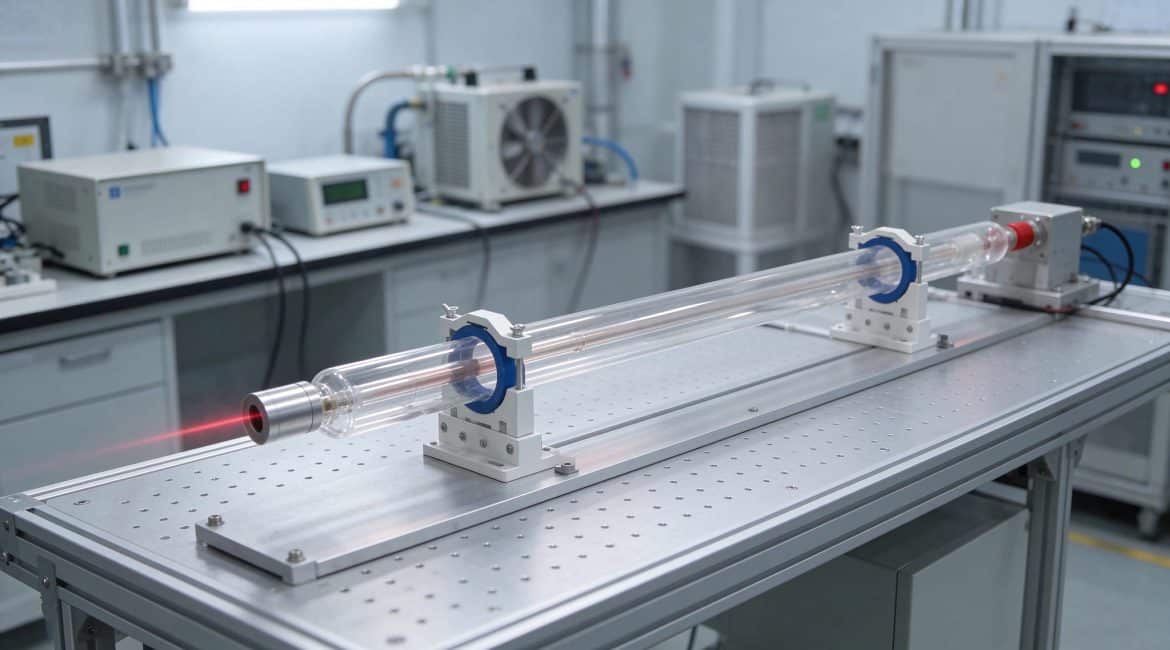
In the world of non-metal cutting and engraving, CO2 glass laser tubes have become the go-to workhorse for countless workshops and factories thanks to their excellent cost-performance ratio. However, many newcomers to laser equipment often find themselves puzzled by one persistent question: how long will my laser tube actually last?
Manufacturers frequently advertise “10,000 hours of service life” in their marketing materials. But in real-world usage, many users discover that after just six months or two to three thousand hours, the laser tube’s power output drops noticeably—or worse, it stops working entirely.
Is this a case of false advertising, or are we simply using the equipment incorrectly? Today, we’ll dive deep into the true lifespan of CO2 laser tubes and break down the 5 critical factors that influence how long they survive.
Section 1: Rated Lifespan vs. Actual Lifespan—What’s the Truth?
First, let’s clarify one important point. The “10,000 hours” that manufacturers tout typically refers to the theoretical maximum lifespan. That figure is achieved only under near-perfect laboratory conditions—constant temperature, rated current, ultra-pure water quality, and so on.
In real industrial workshops or studio environments, however, the actual effective working lifespan of a CO2 glass laser tube typically falls between 3,000 and 8,000 hours, depending on the brand and power rating.
Here’s a critical nuance: when a laser tube’s output power drops below 70% of its original rated power, it may still emit light, but processing speeds slow down noticeably and materials may no longer cut through cleanly. From an engineering standpoint, this effectively means the tube has reached the end of its “productive life” and needs replacement.
Section 2: The 5 Key Factors That Decide a Laser Tube’s Fate
A CO2 laser tube is essentially a precision sealed glass device filled with a specialized gas mixture—CO2, nitrogen, helium, and sometimes xenon. The following five factors directly determine whether it will fail prematurely or enjoy a long, healthy service life.
Factor 1: Operating Current and Power Overload—The “Small Horse Pulling a Big Cart” Syndrome
This is the number one killer of laser tubes. Many operators crank the laser power supply to 90% or even 100% for extended periods, all in pursuit of faster cutting speeds.
High current causes severe cathode sputtering inside the tube, rapidly depleting the free gas molecules. It also triggers intense localized heating along the tube body. Running consistently above rated current can slash your laser tube’s lifespan by more than half.
Factor 2: Gas Leakage and Natural Aging—”It Wears Out Even If You Never Use It”
The internal operation of a CO2 laser tube relies on a delicate physical-chemical equilibrium to maintain discharge. Even if you purchase the tube and never use it, gas molecules will slowly permeate through microscopic gaps in the glass over time. Simultaneously, chemical reactions occur between the gases and internal metal electrodes—CO2 breaks down into CO and O2, and this process cannot be fully reversed.
This means laser tubes have a shelf life. A “new” tube that’s been sitting in inventory for over a year or two will have significantly reduced actual lifespan, even if it’s never been powered on.
Factor 3: Cooling Water Quality and Temperature Control—The “Life Support System”
CO2 lasers have an electro-optical conversion efficiency of only about 10% to 15%. That means more than 85% of the electrical energy consumed is converted into intense heat.
Water temperature too high: When cooling water exceeds 30°C, thermal collision between gas molecules intensifies, population inversion efficiency drops sharply, and output power plummets. In severe cases, uneven thermal expansion can cause the glass tube to crack or even explode.
Poor water quality: Using unfiltered tap water or hard water causes scale buildup and algae growth inside the cooling channels. Mineral deposits not only severely impede heat dissipation but also create localized thermal stress that can structurally damage the glass.
Factor 4: High-Frequency Switching and Transient Current Surges
During precision dot-matrix engraving or flight marking applications, the laser tube must rapidly switch “on” and “off” within milliseconds. Each high-voltage ignition event delivers a sharp electrical shock to the tube’s electrodes and high-voltage terminals. These frequent microsecond-level current surges accelerate the spalling and oxidation of electrode materials, causing cumulative damage day after day.
Factor 5: Poor Operating Habits and Dust-Prone Environments
In workspaces with heavy dust and debris, if smoke particles accumulate on the output mirror (the light-emitting aperture), the high-energy laser beam instantly generates extreme heat on the mirror’s surface. This can burn the optical coating or even shatter the mirror entirely. Additionally, if the high-voltage wiring terminals aren’t properly insulated against moisture, arcing can occur—which can directly puncture either the power supply or the laser tube’s rear end.
Section 3: Practical Tips to Extend Your CO2 Laser Tube’s Life
Want your laser tube to “work harder and retire later”? Follow these golden maintenance rules:
- Control Your Current Limits—Always Leave a Safety Margin: Refer to the manufacturer’s maximum operating current chart (in milliamps). For everyday processing, keep your maximum output power between 70% and 80%. It’s better to slightly reduce your mechanical speed than to run continuous overload current.
- Use Pure or Distilled Water with a Proper Chiller: Always use an industrial chiller (not a simple water pump) and maintain cooling water temperature strictly between 18°C and 25°C. Use purified or distilled water only, and replace it monthly without fail.
- Keep the Mirror Clean—Enable Assist Gas: The output mirror must remain spotless at all times. Always activate compressed air assist during cutting to prevent molten smoke from back-drafting onto the mirror. If you spot dust on the mirror, immediately clean it gently with anhydrous ethanol.
- Waterproof High-Voltage Connections—Prevent Arcing: Fully seal the high-voltage terminal connections with high-voltage insulating silicone. Keep the surrounding environment dry to prevent moisture-related arcing that could puncture the tube’s rear end during humid seasons.
- Buy Just-in-Time—Avoid Long-Term Storage: CO2 glass tubes are consumables with natural aging properties. Purchase based on your production schedule—buy what you need, when you need it.
Expert Summary
The lifespan of a CO2 laser tube isn’t a fixed number written in stone. It’s more like a ratio: 30% built-in quality, 70% how well you maintain it.
By reasonably controlling output current, maintaining stable low-temperature pure-water circulation, and practicing good dust prevention habits, you can easily maximize your laser tube’s performance and minimize your overall equipment operating costs.