
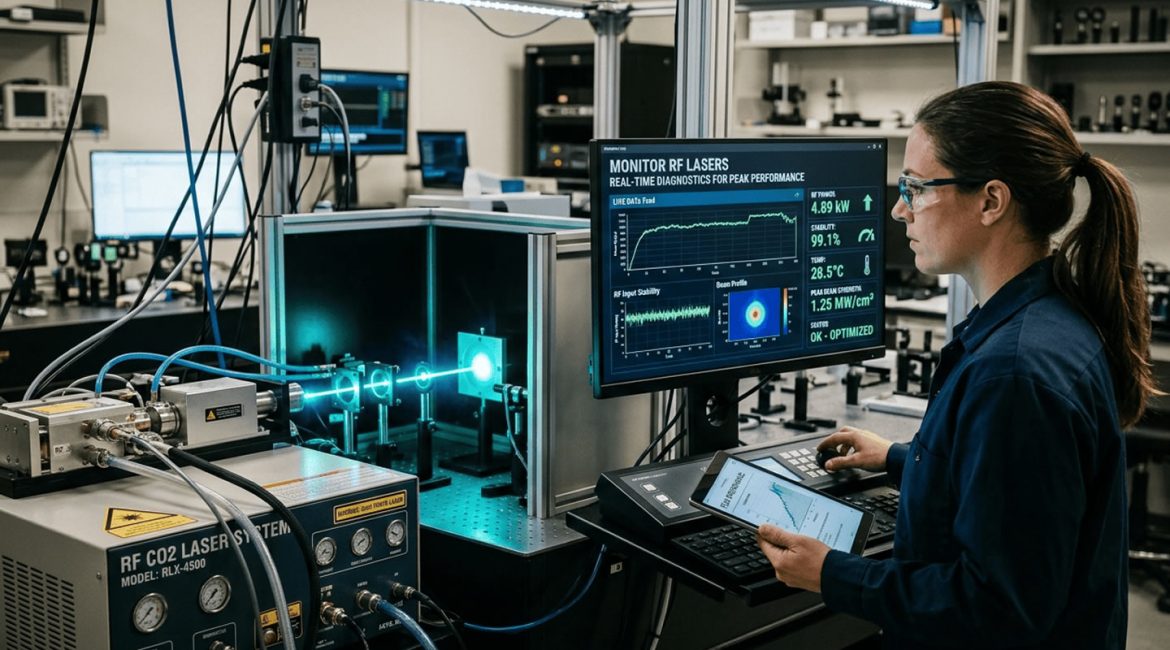
RF lasers are the high-performance heart of precision processing systems. These lasers are extremely sensitive to environmental changes. Today, merely checking if a laser “emits light” no longer suffices for performance assessment. True laser experts understand how to conduct a comprehensive data-driven “health check.” This ensures the RF laser consistently operates at its best. Therefore, you must proactively monitor RF laser performance.
I. Beam Analyzer: The Laser’s High-Definition Ultrasound
To genuinely understand a laser beam’s quality, visual inspection or simple burn paper falls short. Professional diagnosis demands a beam analyzer. It functions like a high-definition ultrasound for the laser. This tool delivers detailed and precise data, allowing you to effectively monitor RF laser beam characteristics.
1.M² Factor: The Core Indicator of Beam Purity
The M² factor is a crucial parameter for laser beam quality. Ideally, a fundamental Gaussian beam has an M² value of 1. This signifies minimal beam divergence. It forms the finest spot after focusing. When you actively monitor RF laser performance in real-time, an M² value drift from a normal 1.2 to 1.5 often suggests minor deformation or contamination of the resonator mirrors. Consequently, even if laser power appears stable, the enlarged spot significantly reduces the device’s cutting or processing capability. Thus, continuously monitor RF laser M² values.
2.Spot Profile: Insights into Energy Distribution
A beam analyzer clearly displays the laser beam’s cross-section with its three-dimensional energy distribution. A healthy, operating RF laser should exhibit a perfect “volcano” or “muffin-shaped” profile: high in the center, low around the edges.
- Spot Distortion: If the spot becomes an irregular “cashew” or shows multiple energy peaks, the resonator mode has distorted. This causes severe deviations in cutting direction, impacting processing consistency. You must monitor RF laser spot distortion closely.
- Pointing Stability: Continuously monitoring the spot’s center position drift helps determine if thermal expansion or mechanical vibration affects the optical path system. This is another key aspect when you monitor RF laser beam stability.
II. Electrical and Gas Vital Signs Monitoring: Looking Inside the Laser
Beyond observing the laser beam’s external performance, we must deeply monitor the internal process generating the laser. This includes the electrical system and gas state. Therefore, it is essential to monitor RF laser internal conditions.
1.RF Power Reflectivity: The Power Supply’s Health Alert
RF lasers generate light by exciting gas within the cavity using an RF power supply. Ideally, the laser cavity fully absorbs the RF energy transferred from the power supply.
- Energy Reflection: However, if the matching circuit ages or ambient temperature changes dramatically, some RF energy may reflect back to the power supply. This creates standing waves.
- Warning and Protection: Excessive reflectivity (typically over 10%) can cause the RF power supply to overheat. It may even burn out internal power tubes. Therefore, real-time monitoring of RF laser power reflectivity is the first critical defense. It protects the laser power supply and prevents equipment damage. Always monitor RF laser reflectivity.
2.Gas Pressure and Sealing: The Laser Tube’s Breathing Monitor
RF laser tubes contain a specific mixture of gases (e.g., CO2, N2, He).
- Pressure Changes: Although RF laser tubes are fully sealed, over long periods, minute gas leaks or gas decomposition from internal discharge can alter cavity pressure.
- Performance Impact and Warning: A drop in gas pressure directly increases the laser’s ignition voltage. This results in unstable laser power. By continuously monitoring RF laser gas pressure data, we can detect issues before actual power drops. This allows proactive maintenance, like refilling gas, preventing production interruptions. Thus, regularly monitor RF laser gas pressure.
III. From “Breakdown Repair” to “Proactive Prevention”: Achieving Predictive Maintenance
The ultimate goal of real-time monitoring is to shift maintenance. We move from reactive “breakdown repair” to proactive “predictive maintenance.” This requires robust systems to monitor RF laser health.
By establishing a detailed “health baseline” for the RF laser, we can analyze monitoring data trends:
- Trend Prediction: For instance, if the M² value shows a slow linear increase over three months, the system can issue an alert one month in advance. It recommends replacing the mirrors. This prevents discovering issues only when products are extensively scrapped, significantly reducing losses. This demonstrates the power of continuously monitoring RF laser parameters.
- Multi-parameter Linkage Analysis: When RF power reflectivity rises, accompanied by a slight increase in cooling water temperature, this often indicates declining cooling system efficiency. This, in turn, impacts impedance matching. Such multi-parameter linkage analysis can more accurately pinpoint potential problems. Effective systems monitor RF laser parameters holistically.
This data-driven predictive maintenance reduces unplanned downtime by over 70%. Furthermore, it significantly extends the lifespan of expensive laser tubes. This delivers higher production efficiency and lower operating costs for businesses.
Expert Summary
RF laser diagnosis and calibration are not one-time tasks. They should span the entire production cycle. By using a beam analyzer to monitor the RF laser’s external quality, electrical and gas indicators to observe its internal vital signs, and combining this with scientific trend analysis, your RF laser will consistently operate at its optimal state. This ensures stable and efficient production. Therefore, always monitor RF laser performance for peak efficiency.