
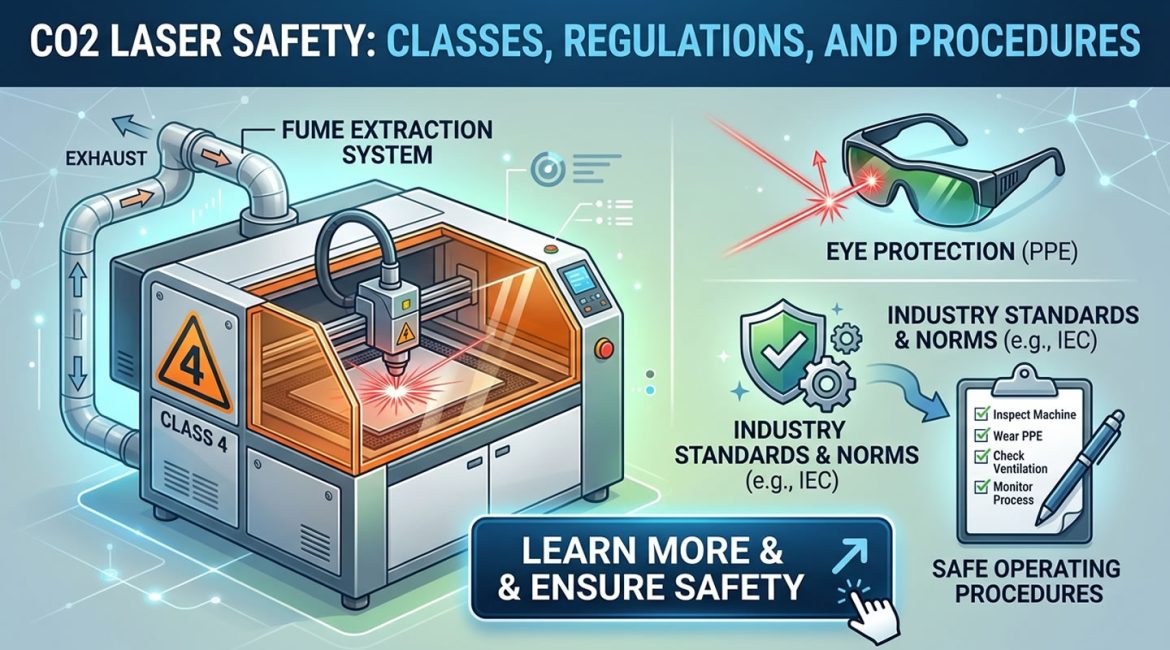
In any laser lab or production facility, safety is more than just a slogan. It is a robust protection network. This network comprises precise hardware and strict operating procedures. Laser safety ensures a secure environment.
1. Knowing Your Adversary: The Meaning of Class 4
International standards (e.g., IEC 60825-1) classify most industrial CO2 lasers over 500mW as Class 4. This designation is crucial for laser safety.
What does this mean?
– Direct and Reflected Beams Pose Constant Danger: The main CO2 laser beam can instantly blind or burn skin. Even diffuse reflections from rough surfaces cause permanent retinal damage. This underscores critical laser safety needs.
– Fire Hazard: It also presents a fire hazard. This high-energy thermal beam can easily ignite flammable materials. Proper laser safety protocols mitigate this risk.
2. Core Protection: Building “Three Lines of Defense”
To safely control this “invisible” light, we must build a stringent defense system. This system involves three layers: personal, equipment, and environmental protection. Effective laser safety integrates all three.
First Line: Personal Protection
– Specialized Protective Eyewear: Always use specialized protective eyewear. Never substitute ordinary sunglasses or welding masks. CO2 laser safety goggles specifically block the 10600nm (10.6 µm) wavelength. Even with an enclosed system, wear them during beam path alignment. This is a fundamental laser safety rule.
– Skin Protection: Protect your skin. Wear long-sleeved, flame-retardant workwear. Avoid exposing skin to potential laser reflection paths. This contributes to overall laser safety.
Second Line: Hardware Barriers
– Protective Enclosures and Interlocks: Quality Class 4 laser equipment requires an enclosed housing. Crucially, it must include interlock switches. If an operator opens the cover during processing, the laser power must immediately cut off. These features are vital for laser safety.
– Beam Blocks: Install beam blocks at the end of the optical path. Use fire-resistant bricks or water-cooled blocks. This prevents the laser from piercing the enclosure if it misses the workpiece. Such measures enhance laser safety.
Third Line: Respiratory Protection
– Local Fume Extraction System: Employ a local fume extraction system. Laser cutting smoke contains numerous nanoparticles and toxic gases. For example, cutting acrylic generates harmful dispersants. An efficient system removes odors. More importantly, it prevents toxic substances from settling in the operator’s lungs. This is a critical aspect of laser safety.
3. Operating Procedures: No “Shoot-from-the-Hip” Decisions
Standardized operating procedures prevent 90% of human errors. Integrate these steps into your daily routine. They are essential for consistent laser safety.
– Pre-Startup Inspections: Conduct pre-startup inspections. Check for proper cooling water circulation. Ensure lenses are clean and free of debris. Critically, inspect the optical path for flammable items. Remove any stray cloths or paper. Diligent pre-checks boost laser safety.
– Caution Zone Markings: Mark the caution zone clearly. Display a prominent “Class 4” warning light at the laser work area entrance. When the machine operates, prohibit unauthorized personnel from entering. Strict access control is key to laser safety.
– Parameter Verification: Verify parameters carefully. Never activate high-power lasers without confirming material absorption rates. Be especially wary of back-reflection risks. This applies particularly when processing highly reflective materials, like coated metals. Careful parameter setting is a core laser safety practice.
– Continuous Monitoring: Maintain continuous monitoring. Operators must not leave during laser processing. Many fires occur because operators briefly step away (e.g., to answer a phone call). This allows workpieces to ignite without immediate intervention. Constant supervision is crucial for laser safety.
– Proper Shutdown: Follow proper shutdown procedures. First, turn off the laser power. Allow the cooling system to run for 3-5 minutes to dissipate residual heat. Finally, switch off the main power supply. This ensures a safe conclusion to operations, reinforcing laser safety.
4. The “Straitjacket” of Industry Standards
Adhering to IEC (International Electrotechnical Commission) or ANSI (American National Standards Institute) laser safety standards is vital. It is not just about passing audits. More importantly, it ensures fault-safe protection in extreme situations. Equipment must operate according to preset logic. For instance, standards mandate that all Class 4 lasers include a manual reset button (key switch) and an emergency stop device. These are non-negotiable laser safety features.
Expert Tip: If your device emits laser radiation with the protective cover open, or lacks an emergency stop button, stop using it immediately! This severely violates safety regulations. It also risks lives. Prioritize laser safety above all else.
Summary
Laser safety is not mere bureaucracy. It forms the bedrock of precision manufacturing. We must approach CO2 lasers with respect and caution. Operators must thoroughly know every safety detail and operating procedure. Only then can this powerful beam truly become a valuable tool, rather than a hidden danger. Achieving robust laser safety requires continuous vigilance.