
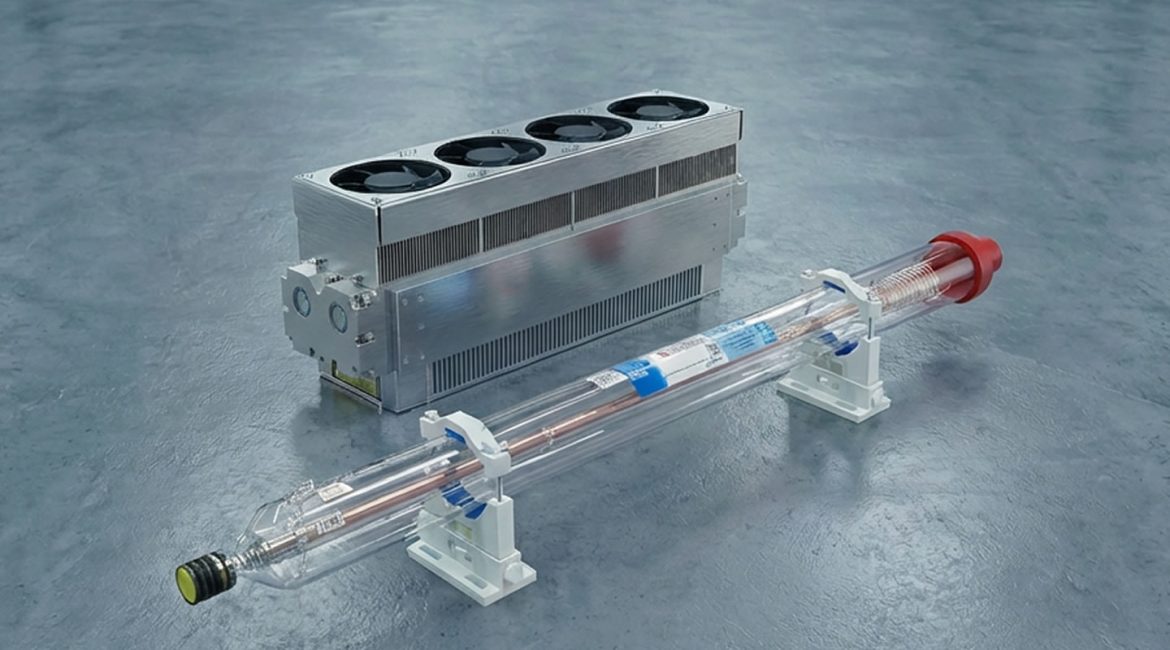
In laser processing, power and speed often capture attention. Yet, a laser tube’s core mechanisms – its excitation method and cooling structure – truly determine long-term equipment performance and processing quality. CO2 laser tubes, based on these key technical differences, fall into two main categories: Direct Current (DC) excited glass tubes and Radio Frequency (RF) excited metal tubes. Understanding these distinctions helps you accurately select the “heart” that best suits your specific needs.
1.Traditional Workhorse: Direct Current (DC) Excited Glass Tubes
DC excited glass tubes serve as the “traditional workhorse” among CO2 lasers. They are the market’s most widely applied and oldest type. You find them particularly often in cost-effective, low to medium-power equipment.
- Structure and Principle: The High-Voltage “Lightning”
A DC glass tube’s core principle involves high-voltage DC discharge. A high-voltage power supply applies tens of thousands of DC volts across the long glass tube. This process creates a continuous “lightning bolt” within the gas. Gas molecules ionize and excite under this high voltage, subsequently generating laser light. - Tube Body and Cooling:
DC glass tubes utilize glass for their tube material. This structure mandates a water-cooling system. The laser tube’s outer layer features a dedicated water jacket. It connects to an external chiller or circulation tank. Circulating water efficiently removes the significant heat generated during discharge. While glass is inexpensive, its heat dissipation efficiency remains relatively limited. - Performance Characteristics and Applications:
DC glass tubes offer low manufacturing costs. Furthermore, they easily scale to higher power outputs. However, their excitation method and material properties present certain limitations. They typically exhibit these characteristics:- Beam modes are often multi-mode or low-order modes. Consequently, the spot size is relatively large.
- Power stability is inferior to RF CO2 laser tubes. Also, it easily suffers from cooling water temperature fluctuations.
- hey do not excel at true high-frequency, fast-response pulsing. Instead, they suit continuous wave (CW) or low-frequency operation better.
Therefore, DC glass tubes commonly see use in medium-low speed cutting and engraving tasks. These applications have lower precision requirements. For instance, they process high volumes of thick materials like wood, acrylic, and leather.
2.Precision Warrior: RF CO2 Laser Tubes (Radio Frequency Excited Metal Tubes)
RF CO2 laser tubes represent a higher standard in CO2 laser technology. They excel in applications demanding high speed, high precision, and high stability. Indeed, these are the “precision warriors” of the laser world.
- Structure and Principle: The Stable “Microwave”
An RF CO2 laser tube uses a radio frequency (RF) AC power supply for excitation. Its frequency typically reaches megahertz (MHz) levels. It does not directly contact electrodes. Instead, it employs capacitive coupling. This generates a uniform RF field within a short, compact metal or ceramic cavity, exciting the gas. This unique excitation method ensures more uniform and stable gas discharge, a key advantage of RF CO2 laser tubes. - Tube Body and Cooling:
RF CO2 laser tubes use metal or ceramic as their cavity material, forming a waveguide structure. This design is robust and compact. Crucially, it offers extremely high thermal conductivity. Low-power RF CO2 laser tubes can rely directly on metal heat sinks for efficient air cooling. Medium to high-power RF CO2 laser tubes, however, use integrated precision water channels within the metal cavity for highly effective water cooling. Effective heat dissipation remains crucial for ensuring the long-term stability of an RF CO2 laser tube. This cooling approach significantly contributes to the longevity of RF CO2 laser tubes. - Performance Characteristics and Applications:
The core advantages of RF CO2 laser tubes lie in their superior beam quality and excellent pulse performance. Thanks to their waveguide structure, these RF CO2 laser tubes easily achieve a near-ideal TEM00 fundamental mode. This translates to an extremely small spot size and very high energy density. Consequently, they achieve higher cutting precision and finer scribing.
Moreover, RF excitation enables the RF CO2 laser tube to deliver high-frequency, fast-response pulses. The laser beam’s rise and fall times are extremely fast. In applications like high-speed marking and fine drilling, this allows for “instant on, instant off” operation. It minimizes the material’s Heat Affected Zone (HAZ). Therefore, RF CO2 laser tubes are widely suitable for flexible printed circuit board (FPC) cutting, high-precision marking, thin-film scribing, medical device manufacturing, and semiconductor processing. These scenarios demand rigorous precision and stability.