
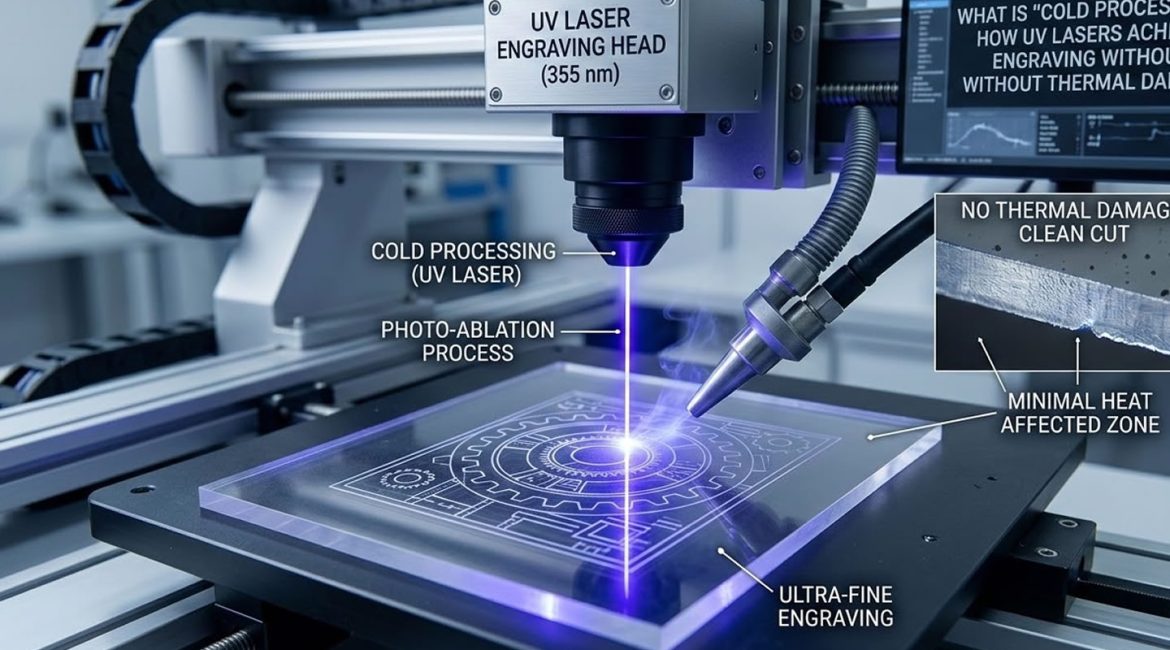
Traditional laser processing often imagines a high-energy “flamethrower.” This “flamethrower” melts or vaporizes materials through high temperatures. It cuts metal or wood. However, fine engraving on a fingernail-sized chip is challenging. Opening holes in paper-thin plastic film also presents difficulties. This “fire attack” causes material deformation, charring, or complete scrapping.
Therefore, the Ultraviolet laser (typically 355 nm wavelength) emerges. It offers a unique “cool” processing method. This advanced Ultraviolet laser becomes an ideal choice for precision manufacturing.
I. Core Mystery: Short Wavelength’s High-Energy Magic
To truly understand Ultraviolet laser operation, first grasp photon energy and wavelength. A fundamental physics formula states:
E = h·v = h·c/λ
Here, λ represents wavelength. This equation clearly shows: shorter wavelengths mean higher energy per single photon.
For instance, common infrared lasers (like fiber or CO2 lasers) have longer wavelengths. Their individual photon energy is lower. Consequently, they act more like “heat transporters” during processing. In contrast, the Ultraviolet laser’s wavelength is only 355 nm. Its individual photon energy is extremely high. This energy directly breaks chemical bonds within materials.
II. Mechanism Revolution: Photochemical Ablation, Not Thermal Melting
This marks the fundamental distinction between “cold processing” and “thermal processing”:
- Thermal Processing (Infrared/Green Laser): This method primarily relies on heat accumulation. Materials absorb many photons. Their temperature rises sharply. This continues until melting or vaporization occurs. Yet, this high-temperature action inevitably causes heat conduction. It affects the surrounding area. We call this the “heat-affected zone.”
- Cold Processing (Ultraviolet Laser): The Ultraviolet laser employs a unique “Photochemical Ablation” mechanism. Its high-energy photons are not simple heating tools. Instead, they function as extremely sharp “micro-scissors.” They directly and precisely cut the material’s molecular chains. This is a key capability of the Ultraviolet laser.
Vivid Analogy: Imagine thermal processing as melting a plastic rope with high heat. The cut end often shows sticky molten droplets and irregular edges. Conversely, cold processing, using an Ultraviolet laser, is like instantly cutting every fiber of the rope with countless miniature scissors. The cut is neat, dry. The surrounding area experiences almost no temperature increase.
III. Overcoming the “Heat Affected Zone (HAZ)” Challenge
In micro-precision processing, avoiding the “Heat Affected Zone” (HAZ) poses a major challenge. HAZ refers to the area around the laser irradiation point. Its material properties change due to heat conduction.
The Ultraviolet laser effectively avoids HAZ. Its energy almost entirely breaks molecular bonds directly. It does not convert into heat energy. This efficient energy utilization minimizes the HAZ produced by the Ultraviolet laser. It typically stays within micrometer levels.
This characteristic provides three significant advantages:
1.No Carbonization: Materials do not char or blacken from high temperatures like with traditional lasers.
2.No Deformation: Even extremely thin, sensitive materials (like films) do not curl, wrinkle, or deform from heat. This is a crucial benefit of Ultraviolet laser processing.
3.Extremely High Precision: It achieves ultra-fine processing and marking. This meets stringent micrometer-level precision requirements.
IV. UV Laser: High-End Manufacturing’s “Darling”
Indeed, thanks to its unique “cold processing” characteristics, the Ultraviolet laser dominates many fields. These fields demand high precision and material integrity. It becomes an indispensable tool for high-end manufacturing.
- Flexible Printed Circuit Board (FPC) Processing: The Ultraviolet laser performs high-precision cutting and drilling on soft circuit boards. These boards are densely packed with components. It avoids damaging surrounding structures.
- Wafer Processing: It precisely scribes and cuts extremely fragile semiconductor wafer materials. This ensures product performance. This application highlights the versatility of the Ultraviolet laser.
- Medical Device Manufacturing: It achieves non-contact, contamination-free, permanent precision marking. This happens on artificial stents or surgical instruments. These require strict biocompatibility and cleanliness.
- High-End Cosmetics/Pharmaceutical Packaging: The Ultraviolet laser creates exquisite and durable markings. This applies to white plastics or various special packaging materials. It enhances product grade and anti-counterfeiting capabilities.
Conclusion
In summary, the Ultraviolet laser is not physically “cold.” Instead, it cleverly bypasses the “heating” step of traditional lasers. It uses high-energy photons to directly break material molecular bonds. This achieves efficient, precise processing. It causes no thermal damage to the material. This “cool” processing method is a key technological support. It enables modern smart devices and precision components. They pursue thinness, high integration, and seamless design. The Ultraviolet laser truly revolutionizes manufacturing.