
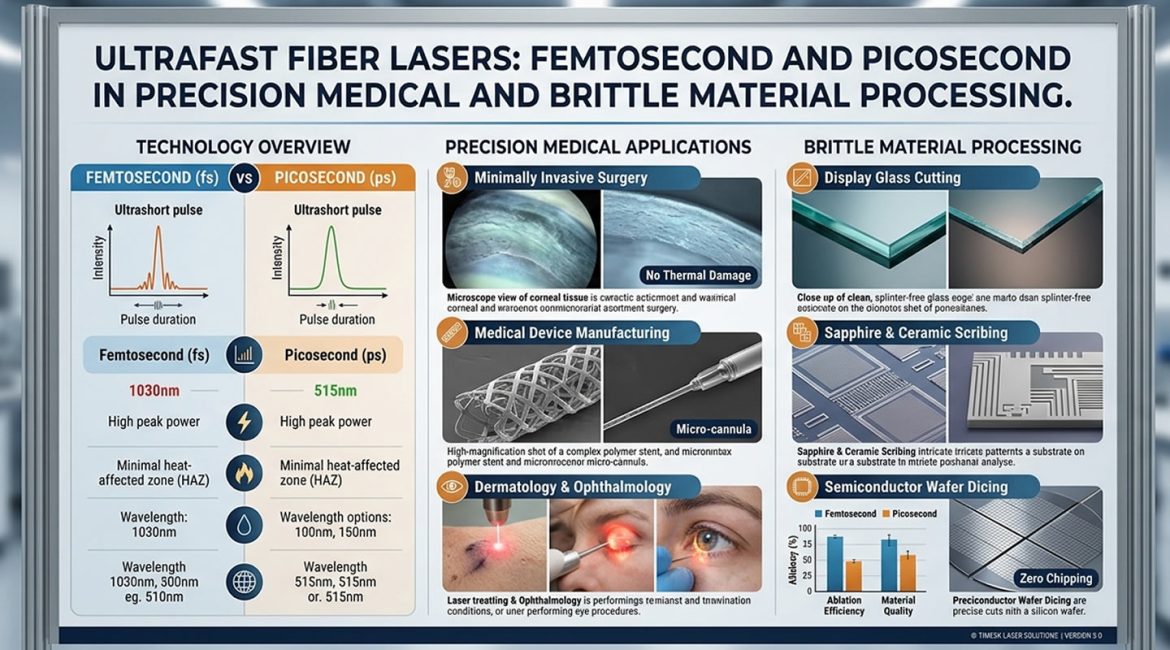
Traditional industrial lasers act like hot irons. They melt metal with high temperatures. In contrast, ultrafast lasers, particularly femtosecond and picosecond lasers, resemble invisible scalpels from the micro-world. These advanced tools do not rely on heat for success. Instead, they perform elegant micro-surgeries on material surfaces. They achieve this through extreme speed.
I. The Art of Time: What are Femtosecond and Picosecond?
In laser technology, “fast” is a relative concept. Continuous wave lasers provide sustained energy output. However, ultrafast lasers compress energy into extremely short pulses. These include both femtosecond and picosecond pulses.
- Picosecond (ps): This is 10⁻¹² seconds. Light travels about 0.3 millimeters in one picosecond. For perspective, light orbits Earth seven and a half times in one second.
- Femtosecond (fs): This is 10⁻¹⁵ seconds. It represents an even shorter timescale than picoseconds. One femtosecond compares to one second as one second compares to thirty-two million years. A femtosecond pulse is incredibly brief.
When laser pulses shorten to this extreme degree, their peak power becomes astonishing. Even with an average power of only a few watts, their instantaneous energy burst creates ultra-high electric field strengths. These strengths can break down any known material.
II. Core Mechanism: The Physical Miracle of “Cold Processing”
Why do we need such fast lasers? The answer lies in “heat conduction.”
During traditional processing, laser light illuminates a material. Heat then spreads through the material structure. This creates a heat-affected zone (HAZ). Consequently, melting, cracks, or discoloration often occur at the processing edges. This impacts product quality.
However, ultrafast laser pulses, especially femtosecond laser pulses, are extremely short. They are faster than the material’s internal heat conduction time (the phonon vibration period). Therefore, they achieve a unique “cold processing” effect.
1.Instantaneous Vaporization: Heat does not transfer to surrounding atoms. Instead, the target material instantly ionizes into plasma. It then sublimates directly from solid to gas. This avoids thermal damage.
2.Non-linear Absorption: Femtosecond lasers possess extremely high light intensity. This triggers “multi-photon absorption.” Thus, femtosecond lasers can precisely cut even glass, which is transparent to visible light. This avoids the thermal cracks typical of traditional lasers.
This mechanism bypasses melting. It directly vaporizes the material. We commonly call this “cold processing.”
III. Precision Medicine: The “Stabilizing Force” in Ophthalmic Surgery
Ultrafast laser applications in medicine are well-known. Most notably, femtosecond laser LASIK surgery (SMILE) stands out. This particular femtosecond application has revolutionized eye care.
- Non-destructive Penetration: The cornea is transparent. Therefore, femtosecond lasers can pass through the corneal surface like an illusion. They act only at a pre-set depth. This creates an extremely precise lenticule matrix.
- Extremely High Safety: No thermal damage occurs. Consequently, the corneal edge remains smooth after surgery. Healing is very fast. This micron-level precision allows surgeons to operate on the eye with “embroidery-like” delicacy.
This significantly enhances surgical safety and effectiveness.
Furthermore, ultrafast lasers show immense potential. They can replace traditional mechanical processing in cutting cardiovascular stents. They also aid in precise orthopedic trimming and other minimally invasive surgeries.
IV. The Nemesis of Brittle Materials: Semiconductors, Glass, and Ceramics
In industry, glass, ceramics, and silicon wafers are “brittle materials.” They are hard and fragile. Traditional tools or thermal lasers often cause chipping or micro-cracks. This makes processing extremely difficult.
- Semiconductor Wafer Dicing: Chips are becoming thinner and more integrated. Traditional saw dicing no longer meets requirements. Picosecond lasers achieve narrower cuts and almost zero chipping. This greatly increases wafer yield and product quality.
- Glass Drilling and Micromachining: For instance, femtosecond lasers enable precise cutting and micro-hole processing. They work on smartphone screen covers, camera lenses, and flexible folding screens. They do this without compromising material strength. This achieves extremely intricate structures.
- Ceramic Circuit Boards: Ultrafast lasers effectively solve precise trimming issues after ceramic substrate sintering. This ensures stable circuit performance at high frequencies. It meets the demands of high-end electronic products.
V. Future Outlook: From Lab to the Internet of Everything
Ultrafast fiber lasers, particularly femtosecond fiber lasers, combine the high stability of “fiber” with the precision of “ultrafast.” As technology matures, their size shrinks. Costs steadily decrease. Their application scope broadens day by day.
From semiconductor packaging and testing to micro-hole processing on aerospace blades, from precise bio-chips to future flexible electronics, ultrafast lasers are defining new manufacturing limits. It is more than just a beam of light. It is a precise tool. It directly replicates human imagination onto microscopic matter.
Expert Summary:
The value of ultrafast lasers lies not in “force,” but in “finesse.” If you seek zero heat affected zones, micron-level precision, and the conquest of extremely difficult-to-process materials, then femtosecond and picosecond lasers offer your ultimate solution.