
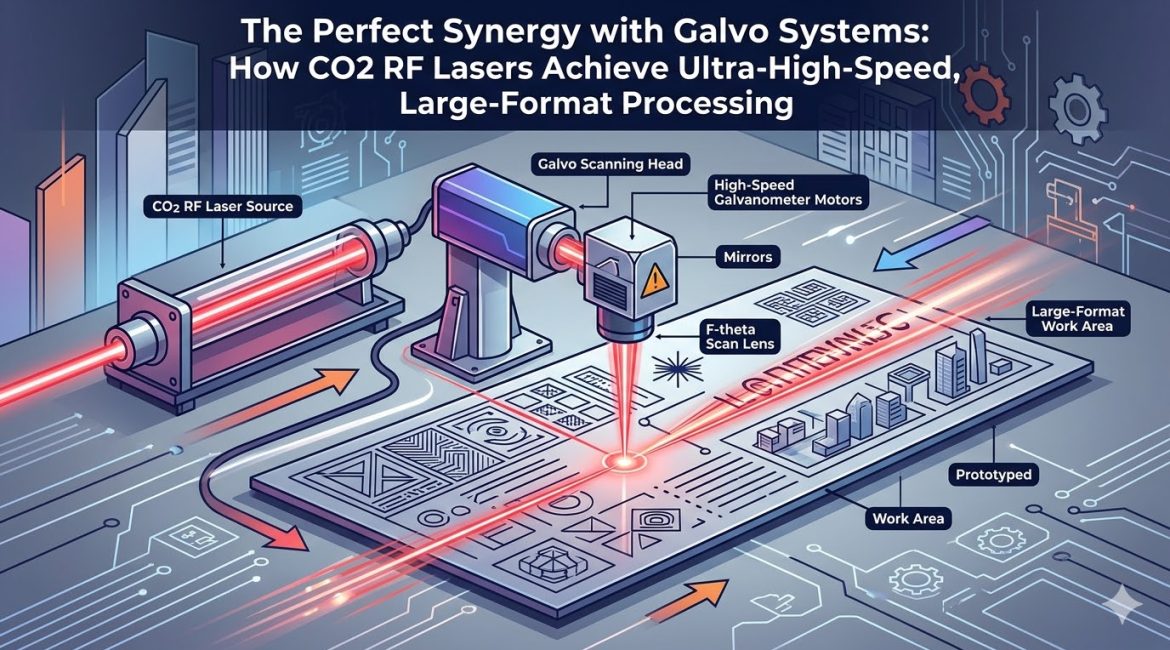
The Perfect Fusion: How CO2 RF Lasers Enable Ultra-High-Speed, Large-Format Processing with Galvo Systems
In laser processing, speed is paramount. Traditional gantry systems resemble old plotters. Motors move an entire crossbeam. These systems offer high precision and robust power. However, physical inertia severely limits their speed.
In contrast, galvo systems operate differently. They abandon heavy mechanical arms. Instead, they use two small, fingernail-sized mirrors. This lightweight design, combined with the unique electrical characteristics of CO2 RF lasers, truly unlocks high-speed processing capabilities.
I. CO2 RF Lasers: The “Nerve Reflex” Power Source
Why must galvo systems pair with CO2 RF lasers, not ordinary glass tube lasers? The core difference lies in their modulation response speed.
- Glass Tube Lasers: Their ignition and shutdown depend on gas ionization. Like old fluorescent lamps, a slight delay occurs. During high-frequency switching, they become sluggish. Consequently, they cannot match the galvo system’s high-speed rhythm.
- CO2 RF Lasers: Their operation mimics a high-speed radio switch. Specifically, CO2 RF lasers complete laser ON/OFF actions within microseconds or even nanoseconds. This means a CO2 RF laser responds instantly. It ensures continuous and precise processing. Galvo mirrors rapidly move to the next coordinate.
II. Galvo System: The Beam’s “High-Speed Navigator”
Galvo systems contain two perpendicular, small, high-speed motors. Each motor drives a high-reflectivity mirror.
- 2D Galvo: X and Y axis mirrors use tiny oscillating angles. This rapidly moves the laser beam across the processing plane. Mirrors are extremely light. Their rotational inertia is minimal. Thus, their scanning speed easily reaches meters or tens of meters per second.
- Control System’s “Brain”: A professional control card acts as the galvo system’s command center. It calculates and synchronizes laser pulses with mirror positions in real-time. If the laser responds slowly, processed lines will show breaks or trailing. The “zero-delay” characteristic of CO2 RF lasers ensures precision. Every laser spot lands accurately on its predetermined coordinate, even at tens of thousands of pulses per second.
III. F-Theta Lens: Breaking the “Spherical Focus” Spell
When the laser beam exits the oscillating galvo mirrors, its theoretical path is spherical. Direct projection onto a flat workpiece causes inconsistent focal lengths. This results in blurry or distorted patterns at the edges.
Therefore, the F-Theta field lens becomes crucial.
- Flat-Field Focusing: The field lens employs special optical design. It flattens the spherical focal plane onto a single plane.
- Linear Mapping: It ensures a linear relationship. Laser deflection angle and displacement on the processing plane are proportional. Consequently, spot size and energy density remain highly consistent. This applies whether the beam deflects to the center or the edge.
IV. From 2D to 3D: Conquering “Large-Format” Processing
Traditional 2D galvo systems face limitations. Their field lens aperture restricts processing area, typically to small sizes (e.g., 110×110 mm). Larger areas cause spot distortion. To address this, 3D dynamic focusing systems provide a solution.
1.Dynamic Z-axis: Engineers add a movable linear axis before the galvo. It houses a dynamic focusing lens.
2.Real-time Compensation: As the laser moves to the edge of a large processing area, the system automatically adjusts the dynamic focusing lens. This changes the beam’s convergence.
3.Cooperative Operation: High-speed pulses from CO2 RF lasers, real-time Z-axis focusing, and rapid XY galvo deflection work synergistically. This maintains micron-level focusing precision. It works even on areas of 600×600 mm or larger. Experts often term this technology “large-format dynamic focusing.”
V. Practical Advantages of “Instant Response”
Integrating CO2 RF lasers with galvo systems brings significant performance enhancements:
- Extremely High Throughput: For instance, a gantry machine might take one minute for a LOGO engraving task. A galvo system completes it in just 1-2 seconds.
- On-the-Fly Marking: The laser system synchronizes perfectly with conveyor belt speeds. It enables real-time coding on continuously moving products. Only the ultra-fast response of CO2 RF lasers can achieve this.
- Fine Grayscale Engraving: Precisely adjusting the pulse duty cycle of CO2 RF lasers allows rapid, fine grayscale variations in images. This is crucial for gift customization and high-end anti-counterfeiting applications.
Expert Summary
The CO2 RF laser acts as the system’s “heart.” The galvo system serves as its flexible “arms.” The field lens and control software function as the “eyes” and “brain.” Only when these core components, especially the responsive CO2 RF laser, collaborate in the sub-microsecond range can they truly achieve astonishing ultra-high-speed, high-precision laser processing capabilities.