
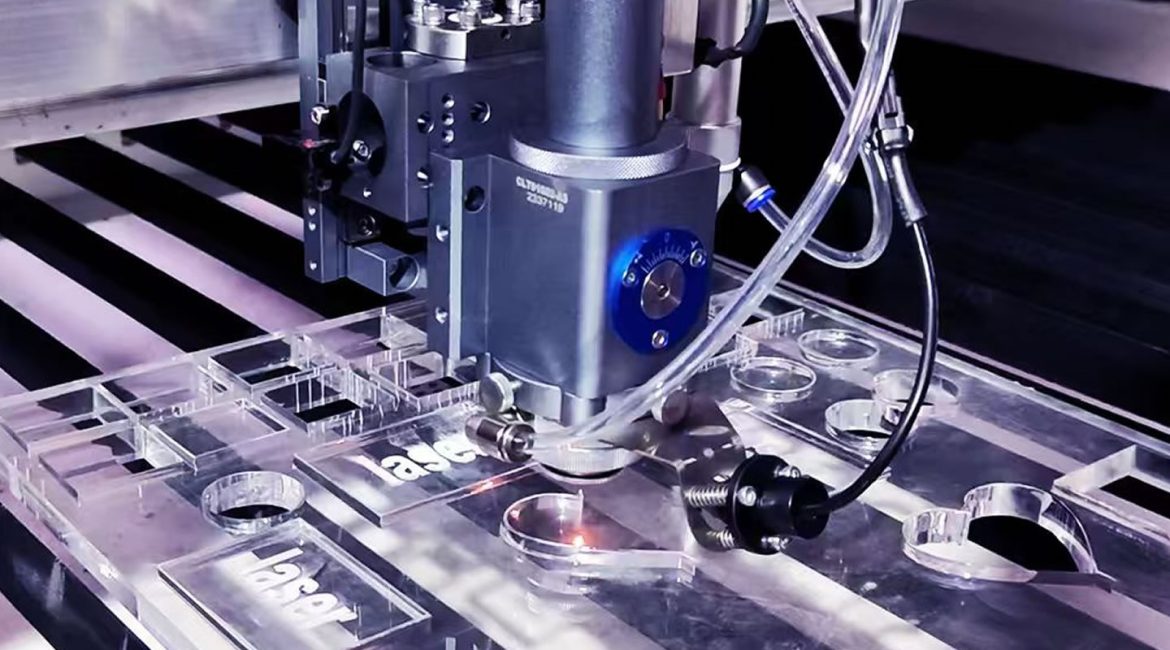
In the vast family of carbon dioxide (CO2) lasers, wavelengths are not uniform. We often categorize them as far-infrared lasers. However, at a microscopic level, subtle differences among 10.6 µm, 9.6 µm, and 9.3 µm wavelengths dictate their performance on various materials. One wavelength acts like a “surgical knife.” In contrast, another may resemble a “red-hot branding iron.” Understanding these distinctions is crucial for optimal processing.
I. Core Principle: Material’s “Fingerprint” and Absorption Rate
Why do we need different laser wavelengths? This involves a key physics concept: the “absorption spectrum.”
Each non-metallic material, for instance plastics, wood, or biological tissues, possesses a unique molecular vibration frequency. When a laser’s wavelength precisely matches a material’s absorption peak, the material rapidly absorbs photon energy. It then vaporizes directly, much like a sponge soaking up water. Conversely, if the wavelength match is poor, some energy reflects away. Other energy converts to heat, diffusing into surrounding areas. This often causes melting, charring, or deformation at the processing edge. Therefore, choosing the correct wavelength is paramount.
II. 10.6 µm: The Industrial “Workhorse”
This is the most standard and widely used CO2 laser wavelength. Indeed, it remains a cornerstone of industrial applications.
- It serves as the primary choice for most industrial processing tasks. Furthermore, its technology is the most mature. It also offers the most economic solution. Many industries rely on the 10.6 µm wavelength daily.
- Strengths: The 10.6 µm laser excels at processing wood, paper, leather, and most acrylics. These materials effectively absorb 10.6 µm light energy. Therefore, for general cutting and engraving, the 10.6 µm wavelength performs exceptionally well.
- Limitations: However, when processing high-performance plastics like PET or delicate electronic films, its absorption efficiency is relatively low compared to other wavelengths. This often creates a larger heat-affected zone (HAZ). Consequently, processing edges may appear less sharp when using 10.6 µm for these specific materials.
III. 9.3 µm: The “Precision Scalpel” for Microelectronics and Films
This wavelength has gained significant favor in advanced manufacturing. It is particularly prevalent in radio-frequency (RF) excited lasers.
- Ideal for PET Plastic: Polyethylene terephthalate (PET) finds widespread use in beverage bottles, display films, and various packaging. PET shows only moderate absorption at 10.6 µm. In stark contrast, it exhibits an extremely significant absorption peak at 9.3 µm. Using a 9.3 µm laser to cut PET produces clean, transparent edges. It eliminates the thick melted edges typically associated with conventional 10.6 µm lasers.
- A Tool for Glass Processing: Glass demonstrates higher absorption at the 9.3 µm wavelength. This allows for smaller crack formation during surface marking or micro-scribing. The resulting effects are consequently more delicate than those achieved with 10.6 µm.
- Specialized PCB Coverlay Processing: Flexible Printed Circuit Board (FPC) manufacturing often requires stripping polyimide (PI) coverlays. A 9.3 µm laser precisely removes this thin film. Importantly, it does not damage the underlying copper lines. This precision surpasses what 10.6 µm typically offers.
IV. 9.6 µm: The “Intermediate Force” in Electronics
The 9.6 µm wavelength falls strategically between 9.3 µm and 10.6 µm. Its distinct advantages primarily target specific polymer processing.
- Exclusive for Polyimide (Kapton/PI): Many electronic industry tapes and insulation materials are made of PI. The 9.6 µm wavelength aligns perfectly with the molecular bond vibration frequency of this material.
- Application Benefits: This wavelength delivers very high contrast and minimal thermal damage. Such characteristics are crucial for electronic component encapsulation removal and precise marking on plastic enclosures. Thus, it offers a specialized solution where neither 9.3 µm nor 10.6 µm provides the optimal balance.
Summary: How to Choose the Most Suitable Wavelength?
The principle for selecting a laser wavelength is very clear: base your decision on material characteristics and required processing precision.
- For Versatility and Economy: If your primary needs involve creating advertising letters, crafting artifacts, or cutting leather, the 10.6 µm laser is undoubtedly the most efficient and economical choice. Its broad applicability makes 10.6 µm a valuable asset.
- For High-End and Ultimate Results: However, if your products include precision plastic films (like PET/PI), flexible circuit boards (PCB/FPC) processing, or demand exceptionally high edge quality for transparent packaging, then a 9.3 µm RF laser will deliver significant performance enhancements. It offers superior results compared to 10.6 µm for these tasks.
- For Specific Polymers: Furthermore, for certain semiconductor encapsulation materials, the 9.6 µm laser offers an irreplaceable balance point. It often outperforms both 9.3 µm and 10.6 µm in these niche applications.
In the world of laser processing, no single wavelength suits all materials. Indeed, only by “tailoring the choice” and selecting the most compatible wavelength can the laser beam achieve its maximum power and deliver optimal processing results.