
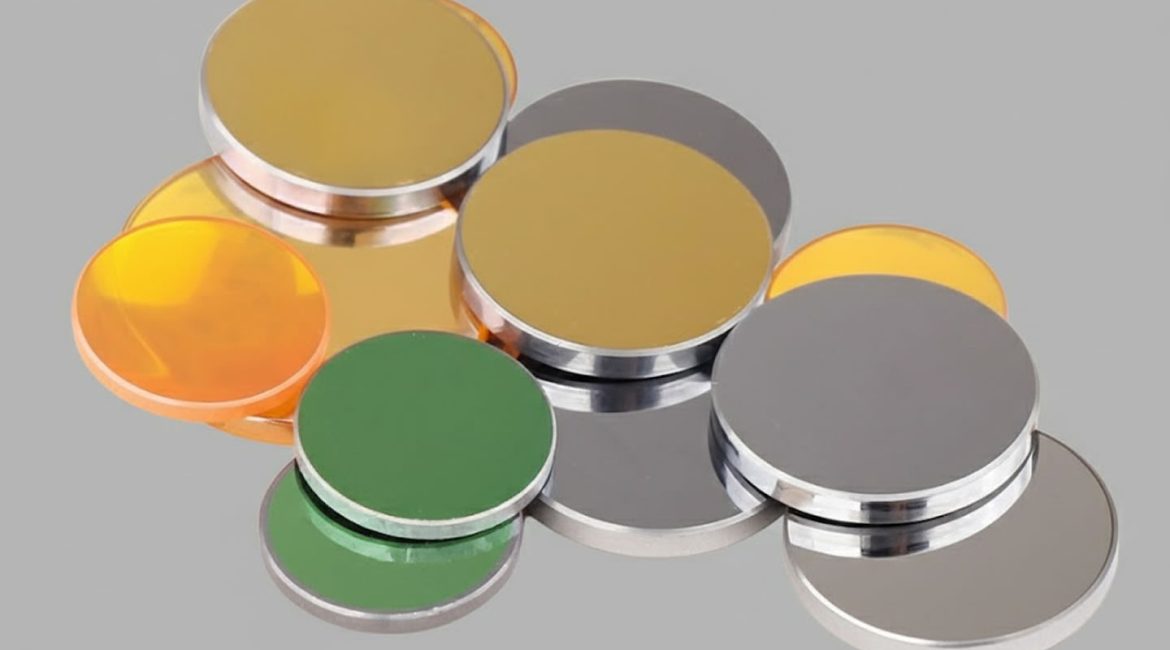
In laser processing, every beam turn causes minor energy loss. For high-power laser systems, this 1% or 2% loss is not just an efficiency issue. It converts into significant heat. This heat directly threatens optical path stability and equipment lifespan. To balance high reflectivity and effective heat dissipation, laser engineers developed two distinct contenders: molybdenum mirrors and coated silicon reflectors.
1.Molybdenum Mirrors: The Indestructible Workhorse
Molybdenum is a rare metal. It boasts a high melting point and high hardness. In laser applications, molybdenum mirrors often undergo direct grinding and polishing. They sometimes do not require additional coatings.
- Robust Durability: Molybdenum offers remarkable physical stability. It features a low expansion coefficient and extreme hardness. Thus, in dusty or harsh cutting environments, users can wipe molybdenum mirrors multiple times. This prevents scratches and significantly extends their service life.
- Superior Thermal Management: Molybdenum’s melting point reaches 2623°C. It withstands extremely high energy densities without failure. For ultra-high-power CO2 lasers, engineers often design molybdenum mirrors with internal cooling channels. The metal’s excellent thermal conductivity efficiently removes excess heat.
- Limitations: Molybdenum’s natural reflectivity is not the highest. It typically sits around 98%. This means it absorbs more laser energy. Without a robust cooling system, the mirror itself may slightly deform due to heat.
2.Silicon Mirrors (Si): The Ultimate Efficiency Master
Silicon mirrors use single-crystal silicon as their substrate. They usually feature gold, silver, or dielectric coatings on their surface. This makes the silicon reflector the most prevalent choice for medium to high-power laser applications today.
- Lightweight and Efficient: Silicon’s density is only about one-third that of molybdenum. In galvanometer scanning systems, which demand ultra-high response speeds, a lightweight silicon mirror allows motors to operate faster and more precisely. Furthermore, advanced vacuum coating technology easily pushes a silicon reflector’s reflectivity beyond 99.5%.
- The Power of High Reflectivity: Do not underestimate this seemingly small 1% difference. In a multi-kilowatt optical path, a 0.5% increase in reflectivity means the silicon mirror absorbs 50 fewer watts of heat. This significantly mitigates the thermal lensing effect. Consequently, it ensures optical path stability.
- Delicate and Vulnerable: A silicon reflector is relatively “delicate.” If dust contaminates the surface coating, or improper cleaning causes scratches, reflectivity drops rapidly. This concentrates energy on the damaged area. Ultimately, it can burn out the silicon reflector.
3.Application Strategies in High-Power Optical Paths
In CO2 laser (10.6µm wavelength) and fiber laser (1.06µm wavelength) applications, selection strategies for mirrors differ significantly.
- CO2 Laser Systems: CO2 lasers exhibit pronounced thermal effects on materials. Therefore, molybdenum mirrors typically serve as the “first line of defense.” Engineers place them near the laser output to absorb the initial, most intense energy impact. In contrast, silicon mirrors appear more frequently at the optical path’s end or inside the cutting head. Their high reflectivity ensures optimal final output power density and beam quality.
- High-Power Fiber Laser Systems: Fiber lasers primarily transmit through optical fibers. However, external optical paths—like welding heads or large-format cutting heads—still require reflective mirrors. Here, engineers commonly use silicon-based reflectors or fused silica mirrors with complex dielectric coatings. Fiber lasers have shorter wavelengths. This demands much stricter requirements for surface roughness and coating quality than CO2 lasers.
4.Thermal Management: The Key to Reflector Survival
Regardless of whether it is a molybdenum mirror or a silicon reflector, “thermal management” remains central. It determines the stable operation of high-power laser systems.
- Passive Cooling: Leveraging the high reflectivity of silicon mirrors inherently reduces laser energy absorption. This constitutes a crucial passive cooling method for silicon reflectors.
- Active Cooling: For multi-kilowatt laser processing, mirror mounts must integrate a circulating water cooling system. With molybdenum mirrors, cooling water can flow directly across the mirror’s back surface. The metal’s conductivity then removes heat. For silicon reflectors, heat typically dissipates through highly conductive metal mirror mounts.
- Combating Thermal Lensing Effect: Severe mirror heating causes its surface to bulge like a convex lens due to thermal expansion. This phenomenon is “thermal lensing effect.” It leads to laser focus drift. Consequently, materials previously cuttable suddenly become uncuttable, severely impacting processing quality. Choosing low-expansion single-crystal silicon or highly conductive molybdenum effectively suppresses this thermal expansion-induced geometric distortion. Thus, it ensures optical path stability.
Summary: How to Make Your Choice?
When selecting between molybdenum mirrors and silicon reflectors, weigh your actual application scenario and core requirements.
- Choose a Molybdenum Mirror if: Your work environment is harsh. Examples include stone engraving or dusty metal rough processing. Or, if you need a stable system. This system must withstand extreme impacts and not require frequent coating replacement.
- Choose a Silicon Reflector if: You seek ultimate processing precision. You need an extremely fine spot. Or, if you perform high-speed precision processing. Examples include mobile phone component cutting or electronic marking. High reflectivity and lightweight design are your primary demands.
In the world of lasers, mirrors do more than just change light direction. They also guard energy. The resilience of molybdenum and the agility of silicon form the robust foundation of modern high-power laser processing systems.