
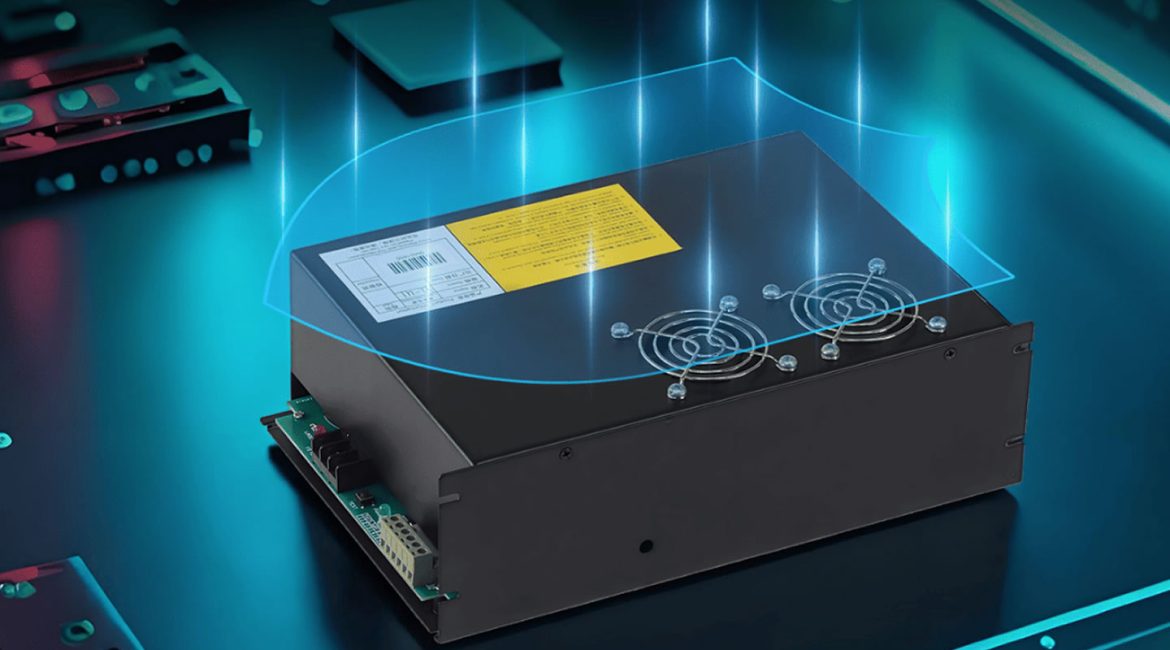
When users face issues like incomplete laser cutting or fuzzy engraving lines, their initial thought often is, “My laser tube is failing.” However, as an experienced expert, I find a significant portion of these problems actually originate from the laser power supply. Indeed, the quality of electrical energy output from the laser power supply directly dictates the gas discharge state inside the laser tube. Ultimately, this influences laser stability and overall performance.
I. Voltage and Current: The Dual Controls of Laser Energy
A laser power supply typically outputs two core parameters: drive voltage and operating current. Consider these as crucial valves controlling laser energy.
- Voltage: The ‘Thrust’ for Starting and Maintaining the Laser — For DC glass tube lasers, the laser power supply generates tens of thousands of volts. This high voltage breaks down the internal gas. It then ignites the gas to produce laser light, a process we call “striking.”
— Conversely, for RF metal tube lasers, the laser power supply provides stable low DC voltage (e.g., 30V or 48V). This powers its internal RF circuitry.
If the voltage is too low, the laser tube may not ignite properly. Consequently, the laser cannot output.
— Furthermore, excessive voltage accelerates electrode aging. It can even cause dielectric breakdown in the laser tube or internal electronic components of the laser power supply. This leads to damage. - Current: The ‘Gate’ for Energy Output
— The current magnitude directly determines the laser’s output power. Therefore, higher current means higher laser power.
— Crucially, a laser power supply must possess extremely high current control precision.
— If the current is unstable, even a 5% fluctuation becomes immediately apparent. During high-speed marking or precision cutting, this manifests as inconsistent line thickness. You might also see noticeable “ripples” on the cut surface. Such instability severely compromises processing quality.
II. Ripple: The ‘Invisible Killer’ of Laser Tube Lifespan
Voltage and current are observable “health indicators.” Ripple, however, represents the “invisible noise” or “interference” hidden within the laser power supply output. Ripple refers to small AC components superimposed on the DC output. Imagine it as tiny ripples on a calm lake surface.
- Causes Non-uniform Discharge: Excessive ripple from the laser power supply induces high-frequency oscillations in the laser tube’s gas discharge (plasma). While the laser beam appears stable macroscopically, its intensity actually flickers at a very high frequency microscopically. This unstable light intensity causes minute thermal cracks on the processed material surface. Ultimately, this affects product quality and aesthetics.
- Accelerates Gas Aging: These high-frequency fluctuations cause gas molecules inside the laser tube to collide irregularly and frequently. This generates additional, ineffective heat. For sealed laser tubes, this accelerates the failure of internal catalysts and gas decomposition. A laser tube designed for a five-year lifespan might show significant power degradation within two years. This happens when a low-quality laser power supply “torments” it over time, drastically reducing its operational life.
- Induces Electronic Component Fatigue: Particularly for radio frequency (RF) lasers, large ripple from the laser power supply severely interferes with the proper functioning of the RF matching circuit. This leads to energy return (i.e., increased reflected power). It can even burn out power transistors inside the laser power supply, causing equipment failure.
III. How to Conduct a ‘Professional Health Check’ for Your Laser Power Supply?
As an experienced operator or maintenance professional, we strongly recommend a quarterly system check for your laser power supply:
1.Static Voltage Test: In the device’s standby state (no laser emission), use a multimeter. Measure the laser power supply’s output voltage. Confirm its deviation remains within ±1% of the rated value.
2.Dynamic Current Monitoring: During full laser power output, carefully observe the current meter’s fluctuations. If the needle or digital display frequently wavers (and this wavering isn’t a regular variation modulated by the control system), it usually indicates a decline in the laser power supply’s constant current performance.
3.Ripple Observation: If conditions permit, use an oscilloscope. Measure the peak-to-peak ripple at the laser power supply output terminals. Typically, for high-quality RF laser power supplies, ripple should be controlled to below 1% of the output voltage. This ensures optimal performance.
4.Connector Temperature Check: Inspect the laser power supply output connector for signs of overheating or blackening. Poor contact leads to increased contact resistance. This is a significant cause of unstable current. Furthermore, it poses a fire hazard.
Expert Warning: Laser power supplies involve high voltage or high current operations. During the health check, always ensure the equipment is properly grounded. Only qualified personnel should perform these procedures. Under no circumstances should you touch exposed terminals while the power is on, as this risks electric shock!