
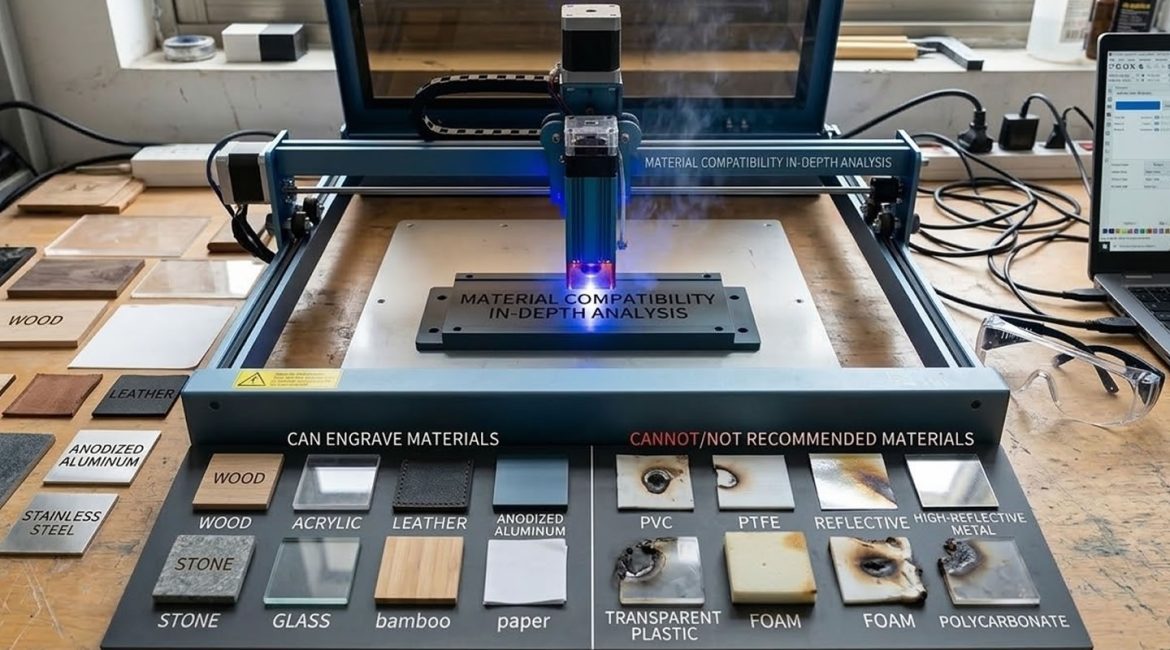
A blue light laser typically refers to a semiconductor laser. Its wavelength is approximately 450 nanometers. In the world of laser engraving, this blue light engraving machine acts like a “picky eater.” It shows strong enthusiasm for some materials. Conversely, it completely ignores others. This “enthusiasm” depends entirely on the material’s absorption rate of blue visible light.
I. Blue Light’s “Delicacies”: Areas of Expertise
For blue light engraving machines, dark-colored, organic materials are ideal partners. A 450nm wavelength falls within the visible light spectrum. Thus, darker colors absorb more energy. This leads to better processing results.
- Wood and Paper: This is the absolute domain for a blue light engraving machine. Wood fibers absorb blue light exceptionally well. Where the laser scans, the wood precisely carbonizes. This leaves deep caramel or black textures. Whether cutting basswood or photo-engraving wood, the results are outstanding.
- Dark Leather: Both genuine and artificial dark leather surfaces instantly lock in blue light energy. A blue light engraving machine easily achieves fine LOGO engraving or precise outline cutting. Furthermore, the cut edges often have a pleasing texture.
- Anodized Aluminum: This is a surprising application for a blue light engraving machine. While it cannot directly cut metal, it perfectly damages or alters the anodized layer. On black, blue, or red anodized aluminum, blue light engraves high-contrast white text and graphics. Its edge sharpness even surpasses some fiber lasers.
- Stainless Steel (with coating assistance): Modern high-power blue light engraving machines (20W and above) work with special sprays or ribbons. They can leave permanent black marks on stainless steel surfaces.
II. Blue Light’s “Invisible People”: Physical No-Go Zones
This section highlights common pitfalls for beginners. If a material physically “rejects” blue light, even doubling the power will not help.
- Transparent Acrylic: In the 450nm blue light’s view, transparent acrylic simply does not exist. It’s like air. The laser passes straight through. It might even burn the honeycomb panel underneath. Yet, it leaves no trace on the acrylic surface.
- Expert Tip: To process transparent acrylic, you need a CO₂ laser. This laser has a wavelength of 10.6 micrometers. This is because acrylic is opaque to infrared light.
- White or Light-colored Glass: Glass has very high transparency and reflectivity. When blue light shines on it, most light reflects or passes directly through. You can “force” engraving by painting the surface black. However, the results are often less effective than a frosted look. Moreover, glass is very prone to cracking due to uneven heating.
- White Plastic and White Fabric: White surfaces reflect all visible light. This includes blue light. You will find the laser merely “passes over” white materials. Even with increased power, you often get only a yellowish, melted edge. Clear engraving is impossible.
III. Blue Light Processing’s “Unwritten Rule”: Color Determines Success
The processing efficiency of a blue light engraving machine follows simple logic. Higher contrast between material color and the laser results in better absorption.
If you want deeper marks on light-colored wood, increasing power is one method. However, sometimes switching to a darker material works better. Alternatively, simply spraying the light-colored surface black can double the effectiveness.
- The Mystery of Absorption: Laser energy is efficiently absorbed. Then, it converts into heat. This happens when the laser’s wavelength “resonates” with the material’s molecular vibration frequency. Blue light is a short-wavelength visible light. It carries higher photon energy. Interestingly, even within visible light, materials absorb different colors with varying efficiency. For example, blue light’s absorption might be less ideal for certain orange or yellow materials. It performs better on dark green or dark blue ones.
IV. Purchase Advice: Have You Truly Made the Right Choice?
Before ordering a blue light engraving machine, consider your core needs:
1.If you are a personal DIY enthusiast: You primarily process wood, leather, and dark-coated metals. Then, a blue light engraving machine offers the best value for money. There is no better option.
2.If you need to process transparent artwork: Please opt for a CO₂ laser instead. A blue light engraving machine cannot meet this requirement.
3.If you want to create on light-colored objects: Consider preparing some water-soluble ribbons or black marking sprays. These can “force open” new possibilities for your blue light engraving machine. It can then process materials it normally cannot.
Conclusion
A blue light engraving machine is a delicate “artistic knife.” It performs almost perfectly on organic materials and dark coatings. Understanding its “optical dietary preferences” helps you avoid ineffective attempts in your creations. Ultimately, you can truly unleash the powerful potential of this blue light.