
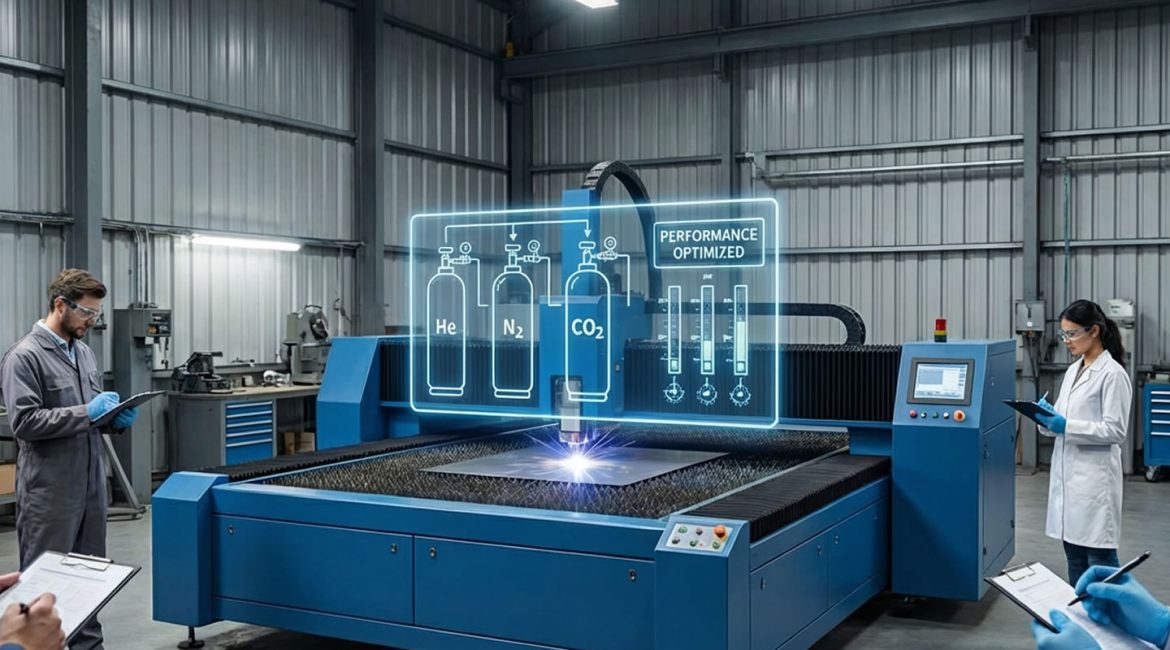
CO2 lasers do not use pure CO2 gas. Instead, they rely on a carefully formulated gas mixture. This blend primarily consists of helium (He), nitrogen (N2), and carbon dioxide (CO2). Sometimes, a small amount of xenon (Xe) is also included. This unique recipe is the result of years of research and practical optimization. Each gas plays an indispensable role, significantly impacting overall laser performance.
I. Physical Principles and Core Functions of Each Component Gas
To grasp the importance of this gas mixture, we must first understand each gas’s specific function.
1.CO2: The “Lasing” Protagonist
Carbon dioxide (CO2) is the core active medium for generating 10.6-micron laser light. Electrical energy excites CO2 molecules. They jump from a ground state to a higher energy state. Then, they release energy as photons, completing laser emission. The CO2 proportion in the mixture directly affects the maximum output laser power. Too little CO2 means insufficient lasing molecules, leading to low power. Conversely, too much CO2 accelerates molecule ‘bottlenecking’ in the upper energy levels. It also exacerbates gas decomposition, thus degrading laser performance.
2.N2: The “Energy Transfer” Helper
Nitrogen (N2) molecules serve as efficient energy transfer mediators during laser generation. High-energy electrons collide with N2 molecules. This readily excites N2 to a metastable state. This state is energetically similar to CO2’s upper laser level. These metastable N2 molecules have a long lifetime. Upon colliding with CO2 molecules, they efficiently and resonantly transfer energy. This helps CO2 rapidly accumulate excited particles, achieving population inversion and initiating laser action. This mechanism directly enhances laser performance by ensuring efficient energy pumping.
3.He: The “Cooling” and “Stabilizing” Guardian
Helium (He) is the most crucial auxiliary gas in CO2 lasers. It performs two vital roles.
- Efficient Heat Dissipation: Helium boasts exceptional thermal conductivity. It rapidly absorbs waste heat. This heat comes from CO2 molecules after photon emission and during the discharge process. Subsequently, He transfers this heat to the laser tube walls, ensuring swift cooling. Rapid heat removal is critical for high-power CO2 lasers (especially slab and axial-flow types) to maintain continuous and stable output, thus improving laser performance.
- Discharge Stabilization: Furthermore, helium stabilizes the discharge. It increases the electrical breakdown voltage of the gas mixture. This promotes a more uniform and stable gas discharge. Moreover, He helps CO2 molecules quickly relax to their ground state after photon emission. This clears the ‘bottleneck’ in the lower energy level (the ‘lower level bottleneck effect’). Ultimately, it sustains continuous laser output and optimizes laser performance.
4.Xe: The “Low-Pressure Ignition” Enhancer
Xenon (Xe) typically constitutes a very small proportion. Its primary function is to lower the gas mixture’s ionization voltage. This allows the laser tube to initiate discharge more easily at relatively lower voltages. Therefore, it optimizes ignition and contributes to overall laser performance stability.
II. Impact of Gas Ratios on Performance
The gas mixing ratio fundamentally determines discharge stability, heat diffusion efficiency, and laser conversion efficiency. Optimal ratios vary significantly for different CO2 laser types, such as sealed-off and axial-flow designs, directly impacting their laser performance.
1.Impact on Conversion Efficiency:
The N2 to CO2 ratio requires precise matching. This ensures N2 maximizes energy transfer to CO2. Too much N2 leads to inefficient energy transfer. Conversely, too little N2 results in insufficient CO2 excitation. Both scenarios reduce electro-optical conversion efficiency, thereby diminishing laser performance.
2.Impact on Heat Diffusion Efficiency:
Higher He proportions increase the gas mixture’s thermal conductivity. This accelerates heat removal from the discharge region. Consequently, the laser can withstand higher input power, boosting saturation power. Therefore, high-power lasers typically feature the highest He ratio, crucial for maintaining optimal laser performance.
3.Impact on Discharge Stability:
He and Xe ratios jointly influence discharge uniformity and stability. Improper proportions can cause uneven discharge and localized arcing. This not only damages electrodes and tube walls but also severely degrades laser beam quality, directly impacting laser performance.
III. Gas Changes in Sealed-Off Tubes Over Time
For sealed-off CO2 lasers (e.g., common glass tubes), the gas mixture ratio irreversibly changes over operating time. This is the primary reason for their power degradation and declining laser performance.
1.CO2 Decomposition:
Continuous bombardment by high-voltage discharge causes some CO2 molecules to decompose. They break down into carbon monoxide (CO) and oxygen (O2). This decomposition is the main driver of laser tube power reduction. The active lasing medium (CO2) diminishes, directly affecting laser performance.
2.Gas Adsorption and Leakage:
Some gases, especially helium, may permeate through the tube walls or get adsorbed by electrode materials. A reduction in He directly lowers heat dissipation efficiency. This causes internal tube temperatures to rise, further accelerating CO2 decomposition. This creates a vicious cycle, negatively impacting laser performance.
Therefore, precise gas formulation and cavity hermeticity are two core technical challenges in designing high-performance CO2 lasers. Only through meticulous control and continuous optimization of these components can we ensure lasers stably deliver powerful light energy over extended periods, thus maximizing laser performance.