
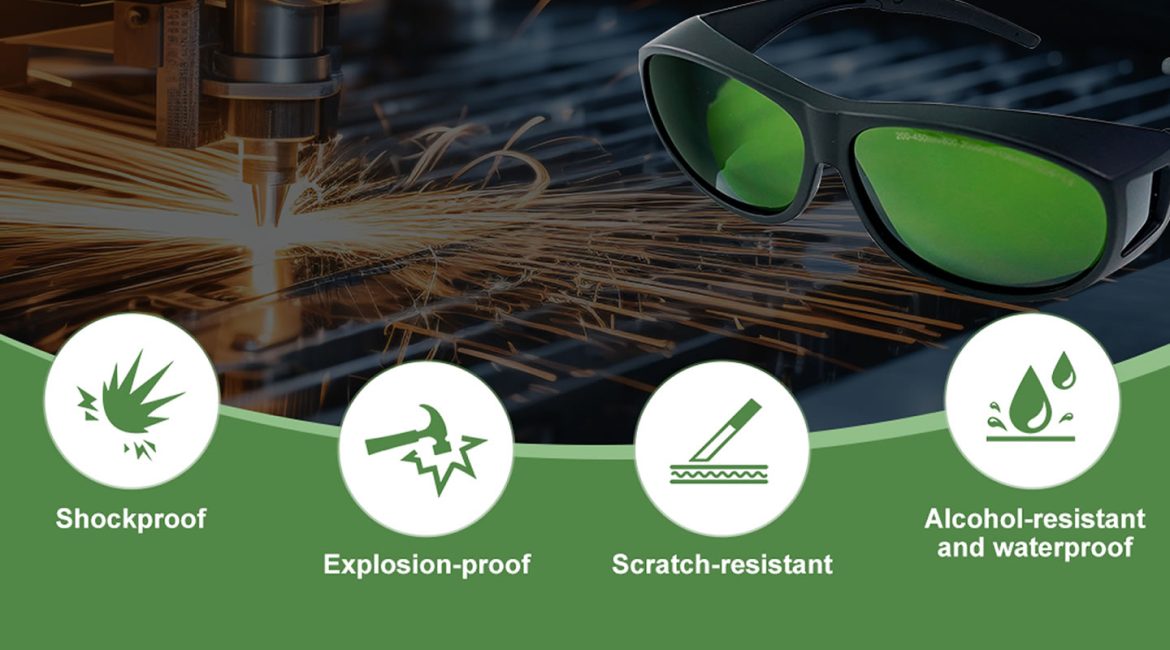
Lasers are powerful. They focus immense energy into a single point. If this energy accidentally hits your eyes, it can burn the retina in microseconds. This leads to permanent blindness. Therefore, laser protective goggles are crucial. They are not simple physical barriers. Instead, they use special absorbents or interference films. These form “precise filters” specifically for harmful lasers.
To choose the right laser protective goggles, you must understand three key lens indicators: protection wavelength, Optical Density (OD value), and Visible Light Transmission (VLT).
1.The Lock and Key Relationship: Protection Wavelength
Laser protective goggles are highly specific. Think of a lock and key. A pair of goggles blocking 10.6µm CO2 lasers might be useless against 450nm blue lasers. They would offer no protection.
- Selection Logic: First, identify your laser’s output wavelength. For example, fiber lasers typically operate around 1064nm. Blue semiconductor lasers are near 450nm. Quality goggles clearly state their protection range. For instance, “190-450nm & 800-1100nm” means they protect against both bands.
- Important Note: Never use laser protective goggles outside their stated wavelength range. This poses a high risk; they will not protect you.
2.The Thickness of Safety: Optical Density (OD Value)
Optical Density (OD value) quantifies the protection of laser protective goggles. It measures how much the lens attenuates laser energy. OD is a logarithmic concept. Higher values mean stronger protection:
- OD1: Allows 10% of laser energy through.
- OD2: Allows 1% of laser energy through.
- OD4: Allows 0.01% of laser energy through.
- OD6+: Means less than one-millionth of the energy penetrates the lens.
How do you choose the OD value? This depends on your laser power. Higher laser power typically requires a greater OD value. For industrial lasers above 5W, experts generally recommend OD6+ or higher. Imagine the OD value as a defensive wall. Stronger laser power means heavier “firepower.” Consequently, your wall needs to be thicker.
3.Visible Comfort: Visible Light Transmission (VLT)
Visible Light Transmission (VLT) is a crucial parameter. Many new users often overlook it. VLT shows the percentage of normal ambient light passing through the eyewear into your eyes, excluding laser light.
- Low VLT (e.g., below 20%): Your vision will be very dim. It’s like wearing heavy sunglasses indoors. This hinders your ability to see processing details. Furthermore, restricted vision can increase operational risks.
- High VLT (e.g., above 50%): Your vision will be clearer. Color rendition is better. This suits long working hours, reducing eye strain.
The challenge for laser protective goggles is twofold: they must block harmful laser wavelengths effectively. Yet, they must also allow useful visible light to pass through. High-performance lenses, often using multi-layer dielectric film structures, achieve high OD values. At the same time, they maintain good VLT.
4.Practical Purchase: A Three-Step Strategy
Follow this “three-step strategy” for ultimate assurance:
- Step One: Verify Wavelength. Match your laser’s output wavelength (e.g., 1064nm). Ensure the laser protective goggles’ stated protection range fully covers this value.
- Step Two: Assess Power and OD Value. Choose the appropriate OD value based on your laser’s power. For example, a multi-kilowatt fiber cutting machine generates significant scattered energy. Thus, OD7+ laser protective goggles are advisable. For low-power educational engravers, OD4+ usually provides sufficient safety.
- Step Three: Consider VLT and Comfort. If your workspace is dim, definitely choose laser protective goggles with higher VLT. This ensures clear vision. Additionally, consider wearing comfort. For instance, check if they fit over prescription glasses (OTG design). Also, evaluate frame material and weight.
Expert Summary:
Experts warn: Laser protective goggles are not “good enough” consumables. A subpar pair gives you a “false sense of security.” This is even more dangerous than wearing no protection at all. When you wear dark eyewear, your pupils naturally dilate as the environment darkens. If laser light then leaks through, the energy reaching your retina will multiply. This causes much more severe damage.
Remember this “password formula”:
Precise Protection Wavelength + Sufficient OD Value + High Clarity VLT = Your Eye Safety.