
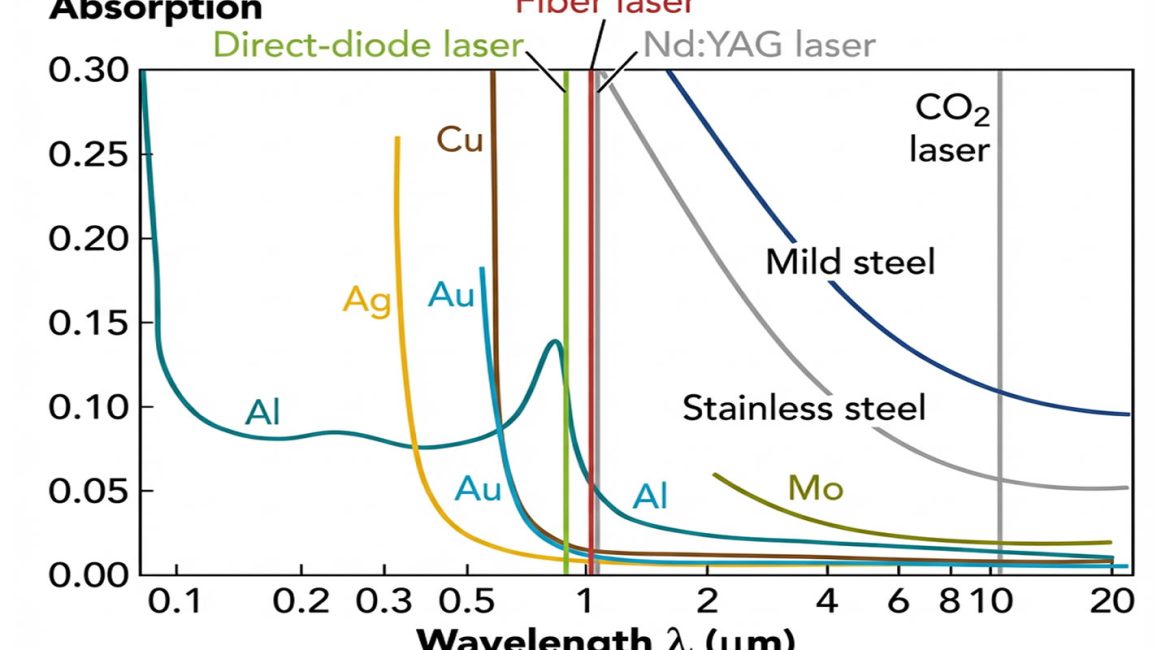
New users entering laser processing often ask: “Which laser is best?” However, in the laser world, no single “best” exists. Instead, the “most suitable” laser prevails. Currently, CO2 lasers, YAG lasers, and fiber lasers dominate the market. Each represents a distinct technological path. Understanding their wavelength characteristics, beam quality, and ownership costs for each, including CO2 laser systems, is your first step. This knowledge ensures informed decision-making.
1.Carbon Dioxide (CO2) Lasers: The Non-Metal Processing Expert
The CO2 laser stands as a long-established veteran in laser processing. Its wavelength typically measures around 10.6μm. This places it within the far-infrared spectrum.
- Applicable Materials: This specific wavelength efficiently absorbs into most non-metal materials. Therefore, if you primarily process wood, acrylic, leather, fabric, rubber, or plastics, a CO2 laser is your prime, often sole, economical choice. While a CO2 laser can cut metals, its efficiency falls significantly short of fiber lasers.
- Beam Quality and Maintenance: A CO2 laser generally offers good beam quality. This makes it ideal for large-area cutting and engraving. However, traditional CO2 laser systems, especially those with glass tubes, require high-voltage discharge. They also utilize complex reflective optical paths. Consequently, maintenance costs for a CO2 laser are higher. The equipment itself tends to be bulky.
- Energy Consumption: Its electro-optical conversion efficiency remains low, typically 5% to 10%. This means a CO2 laser consumes more electricity during operation. It also generates substantial waste heat. Therefore, it requires a large cooling system for dissipation.
2.YAG Lasers: Former Metal Processing Pioneer
A YAG laser is a solid-state laser. Its wavelength measures 1.064μm. Before fiber lasers became widespread, YAG lasers were primary tools. They dominated metal marking and welding applications.
- Applicable Materials: Metal materials readily absorb the YAG laser wavelength. Historically, it boasted extremely high peak power. This offered advantages when processing some highly reflective metals, such as aluminum and brass.
- Performance Bottlenecks: YAG lasers typically employ flashlamp pumping. This results in very short lamp life, often requiring replacement after only a few hundred hours. Furthermore, their beam divergence angle is large. This makes focusing into very fine spots challenging. Thus, it limits their use in precision machining.
- Energy Consumption and Maintenance: Among the three laser types, YAG lasers demand the most frequent maintenance. Users must regularly replace lamps. They also need frequent resonator cavity adjustments. Its electro-optical conversion efficiency is extremely low, usually only 1% to 3%. Consequently, YAG lasers consume significant energy. Fiber lasers have largely replaced YAG lasers in many general processing applications.
3.Fiber Lasers: The Modern Metal Processing Powerhouse
Fiber laser technology has emerged as a star over the last decade. Its wavelength, similar to YAG, is near 1.06μm. However, its method of laser generation and transmission represents a revolutionary change.
- Applicable Materials: Fiber lasers absolutely dominate metal processing. This includes stainless steel, carbon steel, copper, and aluminum. For instance, at the same power, a fiber laser cuts thin metals 2-3 times faster than a CO2 laser. However, note that it cannot process non-metal materials like wood or acrylic. These materials are nearly transparent to this specific laser wavelength.
- Beam Quality: The laser generates directly within the optical fiber. It then transmits through a flexible fiber. This eliminates the need for traditional reflective mirrors. Consequently, beam quality is excellent. It focuses into an extremely small spot. Energy density is exceptionally high. This makes it ideal for high-precision, fine processing tasks.
- Energy Consumption and Maintenance: This stands as the fiber laser’s greatest advantage. Its electro-optical conversion efficiency reaches 30% to 35%. This means it is highly energy-efficient, significantly reducing operating electricity costs. Furthermore, its all-solid-state structure ensures virtually maintenance-free operation. Its lifespan can extend for tens of thousands of hours. This drastically reduces downtime and maintenance expenses.
Selection Guide: Making Your Decision Quickly
If you remain undecided, consider following these simple decision steps:
Step 1: Identify Material Properties
- If your primary processing targets are non-metal materials, such as wood, plastics, fabric, or leather, choose a CO2 laser directly.
- If your processing targets are metal materials, proceed to the next step.
Step 2: Evaluate Production Needs and Operating Costs
- For industrial, high-volume production, prioritizing ultimate processing speed, lowest electricity bills, and virtually maintenance-free operation, select a fiber laser without hesitation. While initial equipment procurement costs might be slightly higher, its extremely low running costs (hourly electricity is a fraction of a CO2 laser) typically offset the difference within a year.
- If you perform highly specialized micro-processing, requiring extremely high single-pulse energy, or your budget is very limited for DIY projects with used equipment, a YAG laser might still have a place. However, for most new users, we do not recommend it as a primary choice.
Step 3: Consider Processing Environment and Integration Needs
- Fiber lasers transmit through optical fibers. Their compact structure makes them ideal for integration into robotic arms or automated production lines. This enables intelligent manufacturing.
- Conversely, traditional CO2 lasers, particularly tube-based designs, are more sensitive to environmental vibration. They also require greater optical path cleanliness. Thus, a CO2 laser needs a relatively stable working environment.
Expert Summary
In conclusion, fiber lasers are the undisputed champions for metal processing. The CO2 laser, for example, excels as the expert for non-metal applications. Meanwhile, YAG lasers are gradually fading from the mainstream market due to technological advancements.