
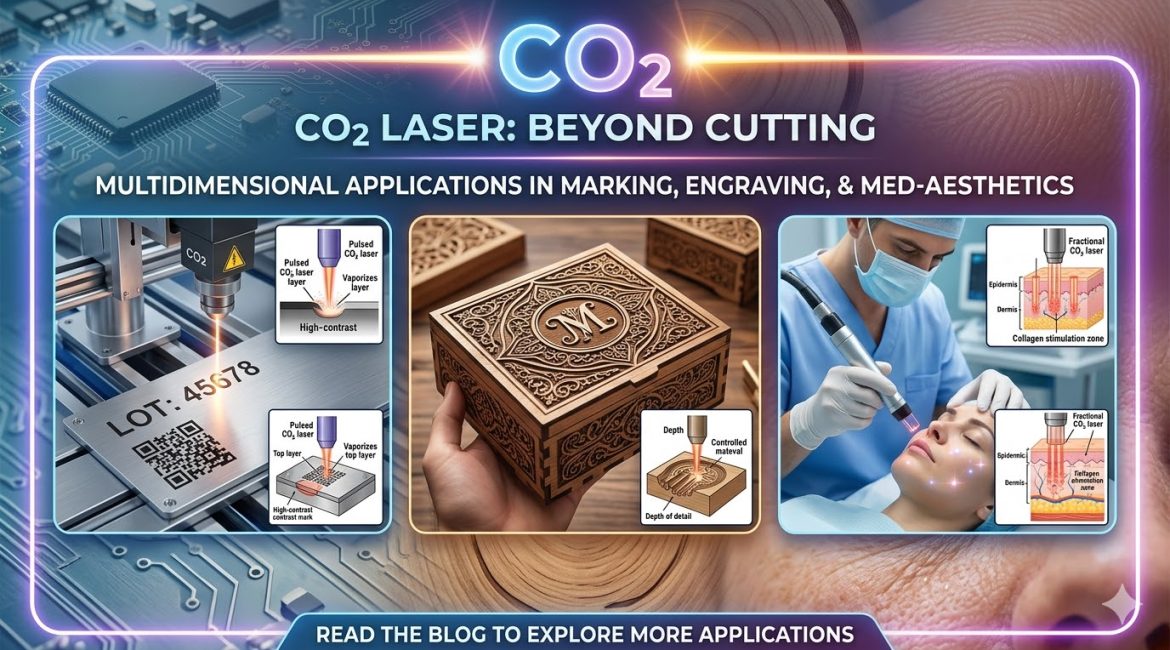
CO2 lasers offer applications far beyond cutting. With their unique wavelength and precise controllability, these CO2 lasers demonstrate exceptional multidimensional capabilities in various fields, including marking, engraving, and medical aesthetics.
I. The Art of Precision: Non-Metal Marking
Marking and cutting differ fundamentally in their “force of action.” Cutting aims to fully penetrate a material. In contrast, marking creates a lasting, clear impression on the material’s surface.
- Key Advantage: The 10.6-micron wavelength of CO2 lasers has a natural “affinity” for non-metal materials. Wood, leather, paper, and many plastics exhibit extremely high absorption rates for this specific wavelength. As the CO2 laser beam sweeps the material’s surface, it causes slight color changes or shallow gasification. Ultimately, this process forms clear, wear-resistant patterns.
- Special Requirements: Speed and contrast are crucial for successful marking. To prevent scorching surrounding areas, CO2 lasers need high-frequency pulse switching capabilities. This ensures rapid and precise surface treatment.
- Beam Quality Requirements: Marking demands extreme “fineness” and “precision.” Consequently, it requires a very high beam quality factor (M²), ideally approaching 1. Only with a sufficiently fine beam and uniform energy distribution (approaching a fundamental Gaussian mode) can engraved QR codes or logos have smooth, burr-free edges. Even at a rice-grain size, they remain clearly legible.
II. Power and Depth: Three-Dimensional Engraving
Deep engraving falls between marking and cutting. It goes beyond merely leaving surface marks. Instead, it precisely removes material layer by layer. This process creates a three-dimensional, embossed or debossed effect.
- Special Requirements: Stable power density is paramount. Deep engraving often removes significant amounts of material. If the CO2 laser power fluctuates, the engraved bottom will appear uneven, like a lunar surface. Such inconsistency greatly compromises the final outcome.
- Key Advantage: CO2 lasers precisely control pulse width and frequency. This allows them to accurately manage the material removal depth for each layer. This exact depth control plays an irreplaceable role in various applications. For example, these include intricate wood carvings, complex seal making, and even the “whiskering” aging process for designer jeans in the fashion industry.
- Beam Quality Requirements: Engraving demands that the laser beam maintains its shape stability within a specific depth range (focal depth). It must not significantly spread. Poor beam quality causes the spot size to rapidly enlarge as engraving depth increases. This blurs deep-seated details.
III. The Ultimate Gentleness: Medical Laser Aesthetics
This represents the most advanced and stringent application area for CO2 lasers. The “fractional laser” technology, commonly known for scar removal or wrinkle reduction, relies on a precisely controlled CO2 laser tube at its core. Crucially, extremely high stability and safety are paramount for medical applications. During skin treatments, the laser directly interacts with human tissue. Human tissue is rich in water, which exhibits an exceptionally high absorption rate for the 10.6-micron wavelength of CO2 lasers.
- Working Mechanism: Medical CO2 laser devices employ complex scanning systems. They precisely divide a single laser beam into hundreds or thousands of tiny “micro-columns.” These micro-columns create uniform micropores on the skin. This, in turn, stimulates the skin’s self-repair mechanisms, promoting collagen regeneration. Simultaneously, normal skin tissue between the micropores acts as a “bridge,” accelerating the overall healing process.
- Advantages: Compared to traditional surgery, fractional laser aesthetics cause less trauma, offer shorter recovery times, and provide lasting, significant results.
- Beam Quality Requirements: Medical aesthetics demand a near-textbook perfect TEM00 mode for beam quality. In aesthetic devices, spot consistency directly determines treatment uniformity. If the beam contains spurious modes, some treatment points might receive excessive energy, causing burns. Conversely, other points might receive insufficient energy, failing to achieve the desired effect. Therefore, medical-grade CO2 laser tubes have extremely strict requirements for beam roundness, uniformity, and stability.
IV. Summary: Choosing the Right CO2 Laser for Your Application
From the above discussion, we clearly see that different application scenarios demand distinctly different specifications for CO2 lasers. Let’s consider these points:
1.Heavy-Duty Processing: If your primary need involves large-scale, high-efficiency material removal or cutting, choosing a high-power CO2 laser is your top priority. In such cases, you can moderately relax beam quality requirements; raw power is the key.
2.Precision Gift Marking: For marking tasks requiring fine detail and fast response, an RF (Radio Frequency) excited CO2 laser tube is the ideal choice. It offers quick response, a delicate spot, and a low M² value. This makes it highly suitable for high-quality, fine processing.
3.Medical Aesthetics: For medical applications involving human skin, you must select a professional-grade CO2 laser. This laser must be specially calibrated, possess excellent beam quality, and offer extremely stable output. After all, in the medical field, safety always comes first.
Expert Insight: Balancing Power and Quality
Many buyers often focus solely on power when purchasing laser equipment. This is a common misconception. “Power dictates processing speed, but beam quality determines the final product’s excellence.” To illustrate this point, imagine trying to write tiny, intricate calligraphy with a thick marker. No matter how much force you apply, the result will be a blurry mess. Conversely, with a fine-tipped pen, even light pressure produces clear, elegant strokes. This precisely illustrates the core value and logic of beam quality in non-cutting CO2 laser applications.